The Hundred Guilder Print
Original title: The Hundred Guilder Print
kurzbeschreibung
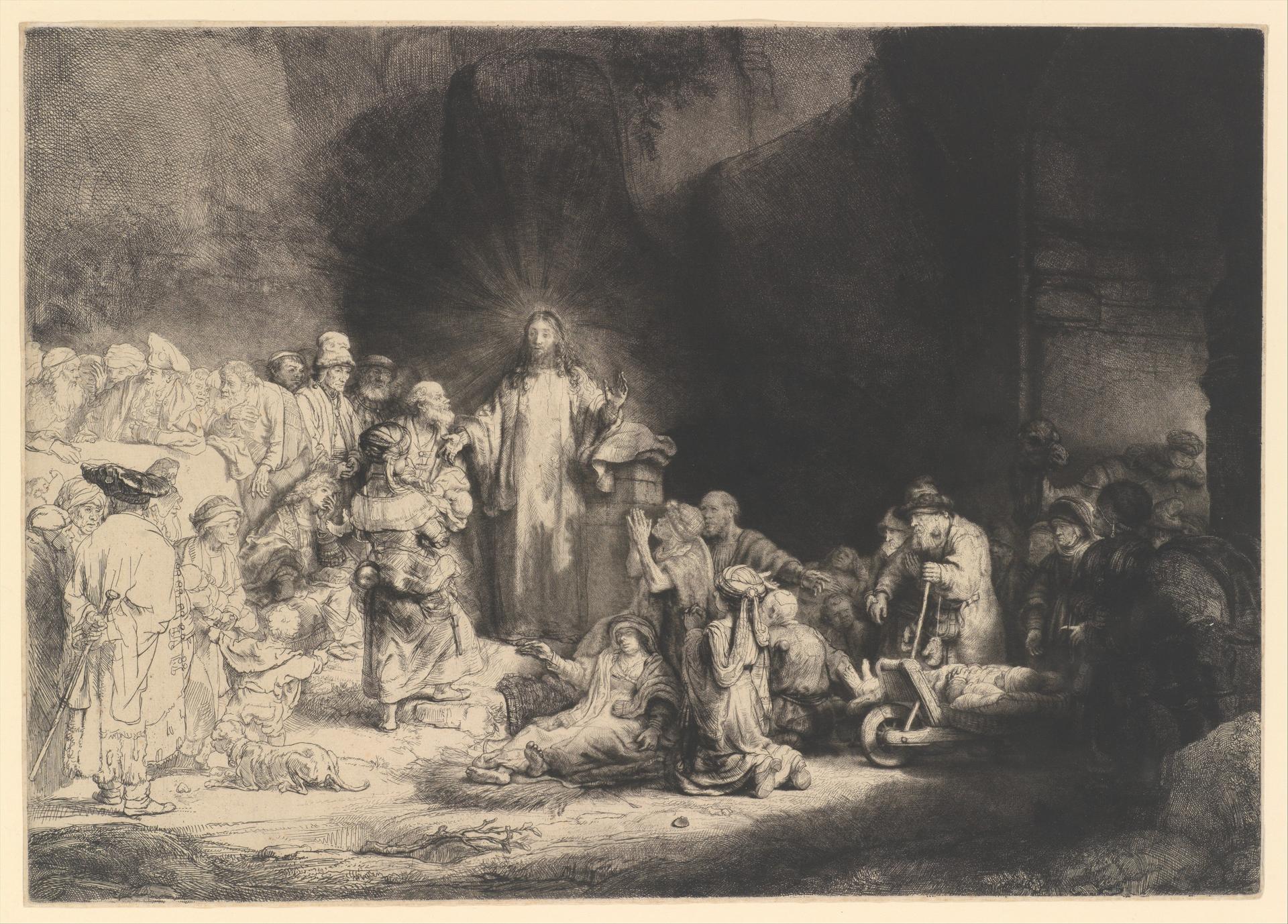
Rembrandt van Rijn made the Hundred Guilder Print in 1648 as an etching. It depicts a biblical event: Christ preaching to a gathered crowd and turning to the sick. The print is executed in etching, engraving, and drypoint, in the second of two states.
Description
A dark, cave-like space fills with people. At the center stands a figure in a long robe, arms raised, bathed in bright light. Around him the attendees are distributed, some upright, others kneeling or sunk to the ground, hands folded or in moved gestures. The layout runs symmetrically toward this central figure, where the brightness gathers and creates tension. Grays and blacks predominate, as is typical of etching; finely graded lines and hatching work out the bodies and the space in detail.
Context
This print belongs to Rembrandt's Amsterdam years around 1648, when he repeatedly turned to biblical subjects. The common name Hundred Guilder Print comes from a tradition that Rembrandt once received the high sum of one hundred guilders for a single impression of this etching. The work is often associated with the Gospel of Matthew (19:2), which tells of healings and the blessing of children.
Impact
The contrast between light and shadow exerts a strong pull, making the central figure stand out and giving the whole a spiritual quality. Because the many figures are so varied and worked out in detail, the viewer feels directly transported into the biblical event.
Technique
Etching, engraving, and drypoint interlock, with drypoint leaving fine, soft lines. The plate measures 28 x 39.3 cm. Graded etching times and reworking with the needle produce very precisely controlled shading.
AI-generated description text
Source: Metropolitan Museum of Art · Public Domain (CC0 1.0)