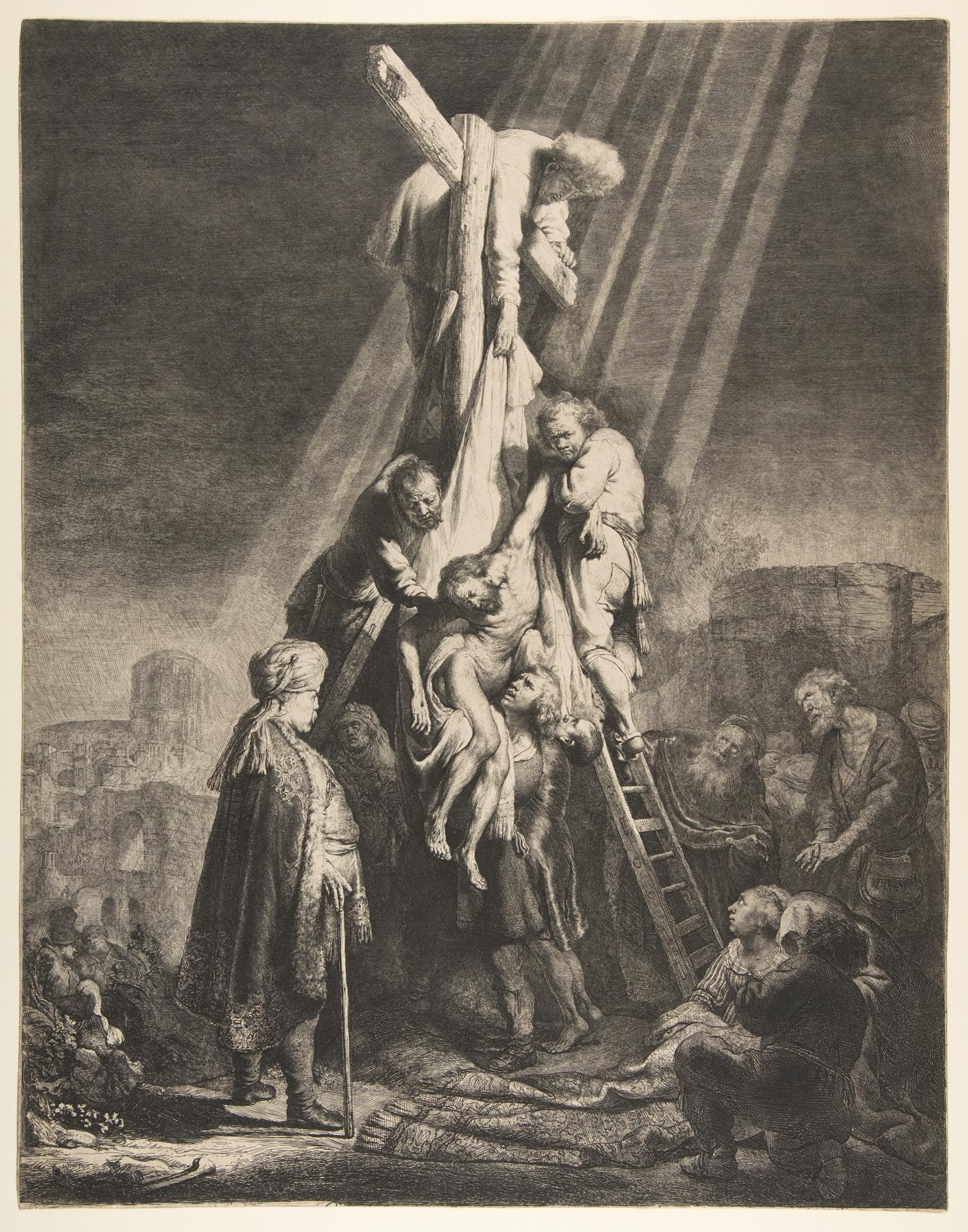
Descent from the Cross (1633)
Original title: Descent from the Cross
kurzbeschreibung
Rembrandt van Rijn created the etching 'Kreuzabnahme' (Descent from the Cross) in 1633, capturing the biblical moment when Christ's body is taken down from the cross. Executed as an etching with burin, the print measures 52.2 x 38.3 cm.
Description
Christ hangs at the center of the cross, surrounded by several figures who are lowering him. Some wear garments that suggest a bygone era. The arrangement feels restless: the figures move in different directions, heightening the tension of the moment. Light falls dramatically, and harsh contrasts and deep shadows underscore the tragedy of the event. The lines are sharp and detailed, as befits the Baroque style.
Context
The etching was made in 1633 during Rembrandt's early period in Leiden. It belongs to a series of Passion scenes he produced on commission from Stadtholder Frederik Hendrik of Orange. At the time, Rembrandt was strongly influenced by Italian art, especially Caravaggio, which is reflected in the dramatic lighting.
Impact
Dark contrasts and the agitated group of figures trigger a strong emotional response in the viewer. He feels immediately drawn into the dramatic event, which conveys both despair and hope. The precise linework encourages close looking and brings out the artist's virtuosity.
Technique
For this etching, the drawing was scratched into a wax layer on a copper plate and then etched. The additional use of the burin allowed precise, powerful lines. In this way Rembrandt could achieve fine gradations of light and shadow that are characteristic of his etchings.
AI-generated description text
Source: Metropolitan Museum of Art · Public Domain (CC0 1.0)