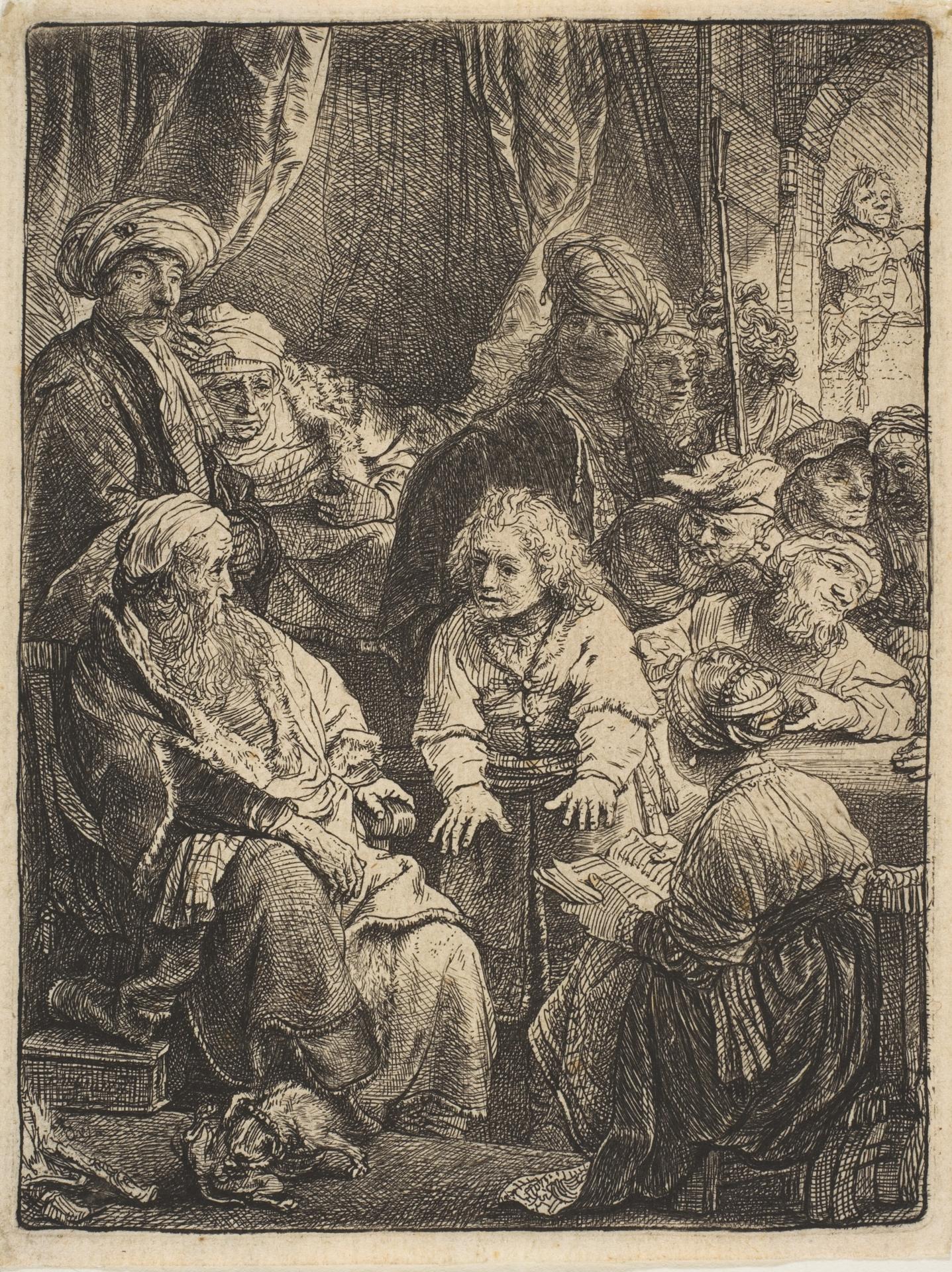
Joseph Telling His Dreams
Original title: Joseph Telling His Dreams
kurzbeschreibung
Unlike many other sheets in Rembrandt's Joseph cycle, this 1638 etching puts the act of storytelling itself at its heart: the young Joseph recounts his dreams before his father Jacob and his brothers. The tightly packed group of figures fills the space, and the third state of the plate shows that the work was taken further still.
Description
Heavy curtains form the dark backdrop of the room. A seated man turns toward the curly-haired boy, who stands before him in simple clothing; beside the boy a woman in traditional dress kneels, while other figures stay in the half-light. A dog lies on the ground before the seated man. Fine hatching and sharp contours build depth and model the light.
Context
The sheet was made in Amsterdam in 1638, when Rembrandt was turning more and more to biblical subjects. It belongs to a series of scenes from the story of Joseph made during the 1630s. The third state records reworking of the plate and thus the careful development of the print; Rembrandt regularly revised his etchings in several states in order to sharpen the effect of light.
Impact
The close staggering of the figures and the strong contrast of light and dark give the print an intimate, almost dramatic mood. The lighting guides the eye to the exchange between the boy and the seated man. Despite the small format the etching feels monumental and shows Rembrandt's feeling for gesture and structure.
Technique
An etching on paper made by the etching process; the plate measures 11.2 x 8.4 cm, the sheet 11.6 x 8.8 cm. The method allowed the fine lines and nuanced shading that are characteristic of Rembrandt's printed work. In the third state additional reworking comes through, giving further emphasis to light and shadow.
AI-generated description text
Source: Metropolitan Museum of Art · Public Domain (CC0 1.0)