The Death of the Virgin (1639, Met-Objekt 5158)
Original title: The Death of the Virgin
kurzbeschreibung
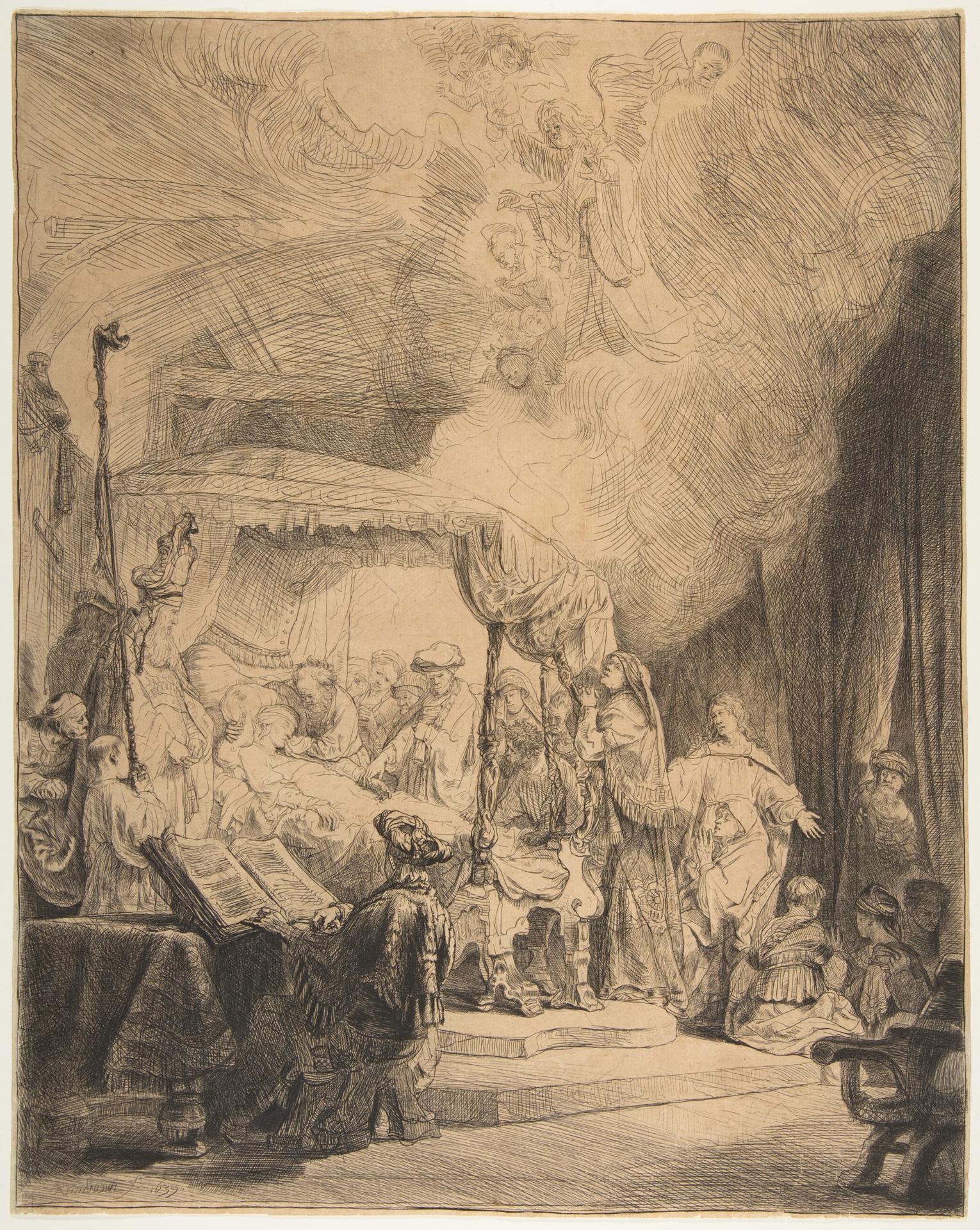
Mary, the mother of Jesus, lies dying. Rembrandt set down this scene in 1639 as an etching worked with drypoint. The sheet measures 41 x 31.4 cm and belongs among his religious prints. Mourners and angels surround the dying woman.
Description
Mary rests on a bed that anchors the middle of the image. Around her stand figures in historical dress, with cloaks and head coverings. Above her, angels hover in a restless, flowing formation, their garments seeming to tumble downward. Deeper in the hall-like space, further figures can be made out. Light falling from above picks out those present and the bed. The etching's greys and blacks are rich in contrast, the strokes detailed.
Context
In 1639 Rembrandt was working in Amsterdam and gave much of his attention to biblical subjects and printmaking. The death of Mary was a motif widespread in Catholic tradition, while Rembrandt worked in a Protestant setting. His account follows the iconography of Mary's transfiguration as it was customary in Catholic art. The sheet counts among his extensive printed oeuvre, which also drew notice internationally.
Impact
The handling of light and the dense row of figures give the scene something ceremonial and at the same time intimate. Fine needle strokes and deep shadows create atmospheric depth that draws the eye into the event. What lingers is a calm, almost meditative impression that stresses Mary's passing over.
Technique
For this sheet Rembrandt combined etching with drypoint to gain fine lines and soft transitions. The method let him produce graded greys by biting the plate and by working it directly. Etching and drypoint together give the details precision and texture.
AI-generated description text
Source: Metropolitan Museum of Art · Public Domain (CC0 1.0)