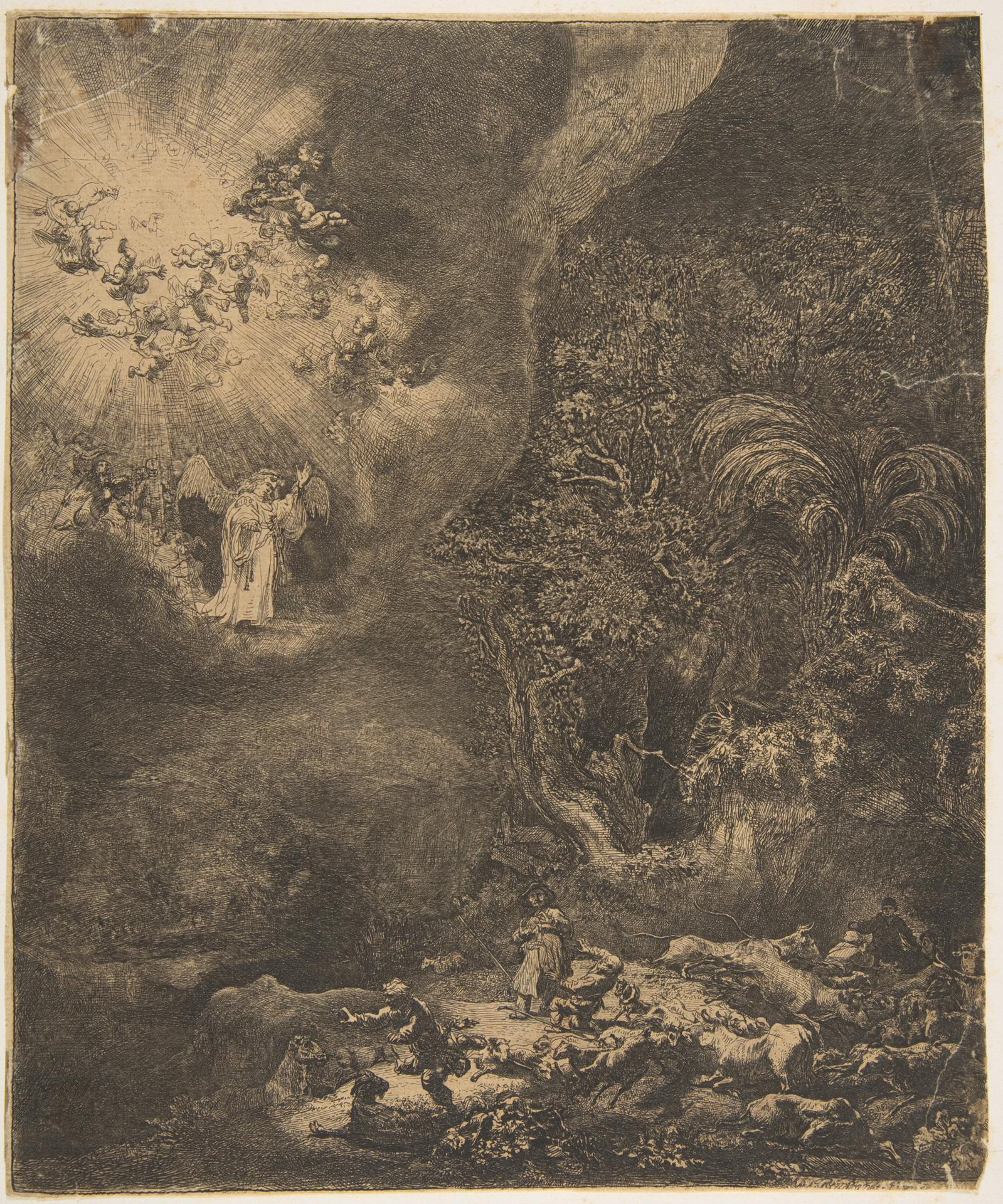
The Angel Appearing to the Shepherds (1634, Met-Objekt 5157)
Original title: The Angel Appearing to the Shepherds
kurzbeschreibung
Rembrandt van Rijn turned the biblical annunciation to the shepherds into an etching with drypoint in 1634, pulled here in the third of three states. The sheet measures 36.2 x 28.9 cm, the plate 26.1 x 22 cm. Its subject is the nighttime message of the angels to the shepherds in the fields.
Description
Above the hilly landscape a bright expanse of sky opens up, where several angels hover and send shafts of light downward. Below, shepherds stand and kneel among their sheep; some are in motion, others hold still. The arrangement feels irregular: angels and shepherds cluster toward the middle, while the animals lie along the lower edge. Nearly everything stays in dark gray tones, out of which the annunciation emerges.
Context
The etching was made in Leiden in 1634, during a period when Rembrandt often turned to biblical subjects. Its source is the Gospel of Luke (Luke 2:8–14), the announcement of Jesus's birth to the shepherds. It belongs to seventeenth-century Dutch printmaking, known for technical refinement and dense storytelling.
Impact
The sharp contrast between deep shadows and bright passages creates a tense yet intimate mood that lets the divine message stand out. Hatching and deliberate lighting draw the eye toward the heavenly apparition and give the image religious depth.
Technique
Etching and drypoint, printed in the third of three states, produce the finest lines and dense hatching from which the dark tonal values and lighting effects emerge. Drypoint lends the strokes their characteristic softness and depth, most clearly in the shadowed areas.
AI-generated description text
Source: Metropolitan Museum of Art · Public Domain (CC0 1.0)