Thomas Haaringh (Old Haaringh)
Original title: Thomas Haaringh (Old Haaringh)
kurzbeschreibung
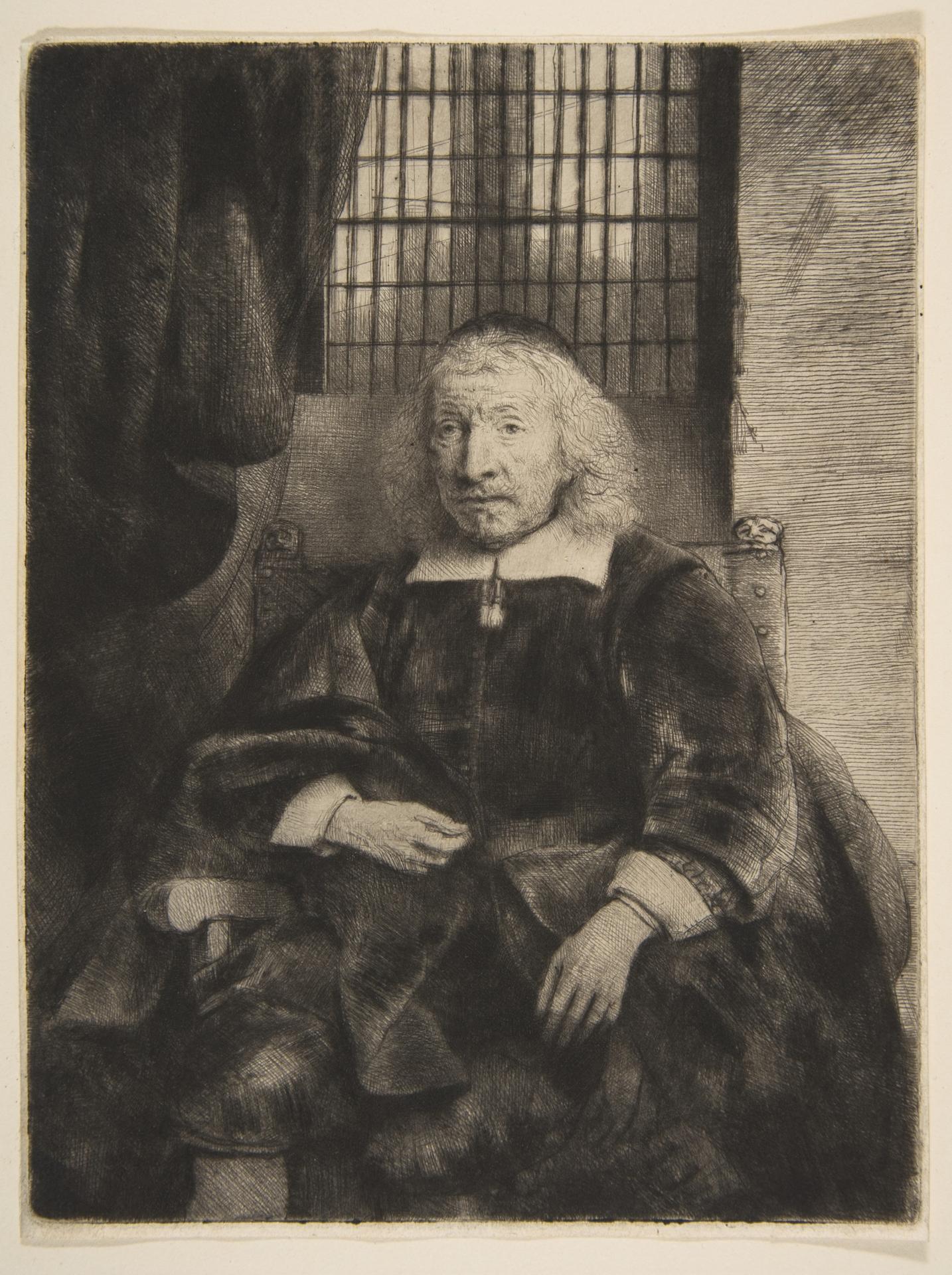
Thomas Haaringh, known as "Old Haaringh," sits facing the viewer with his hands folded in his lap, a barred window behind him. Rembrandt made this bust-length portrait around 1655 as a drypoint with burin; this impression is the third of three states.
Description
A dark gown with a light collar and a chain fastened to a neck ring frames the hands resting quietly in the lap. The man looks straight out at the viewer. Behind him a leaded window opens, partly covered by a curtain, and at the right the edge of a wooden piece of furniture is cropped by the plate. Light from the side picks out the face and the folds of cloth with precision. Fine lines and hatching govern the whole sheet.
Context
The sitter, Thomas Haaringh, was a Dutch bailiff and art collector whom Rembrandt portrayed more than once. During this period the artist devoted himself intensively to printmaking and commanded the drypoint technique with great skill. The third state adds burin work that strengthens the sense of depth. The portrait belongs to a series of etchings Rembrandt made of people in his circle.
Impact
The direct gaze and the calm seated pose give the view a concentrated, dignified presence. Side light lends the face sculptural weight, heightened further by the fine drypoint lines. The result is an intimate, almost monumental portrait on a small scale.
Technique
Drypoint with additional burin work, carried out in the third state of the plate. In printing, the drypoint leaves its characteristic velvety line edge, which produces soft transitions here. The burin served to deepen darker passages and increase the contrasts.
AI-generated description text
Source: Metropolitan Museum of Art · Public Domain (CC0 1.0)