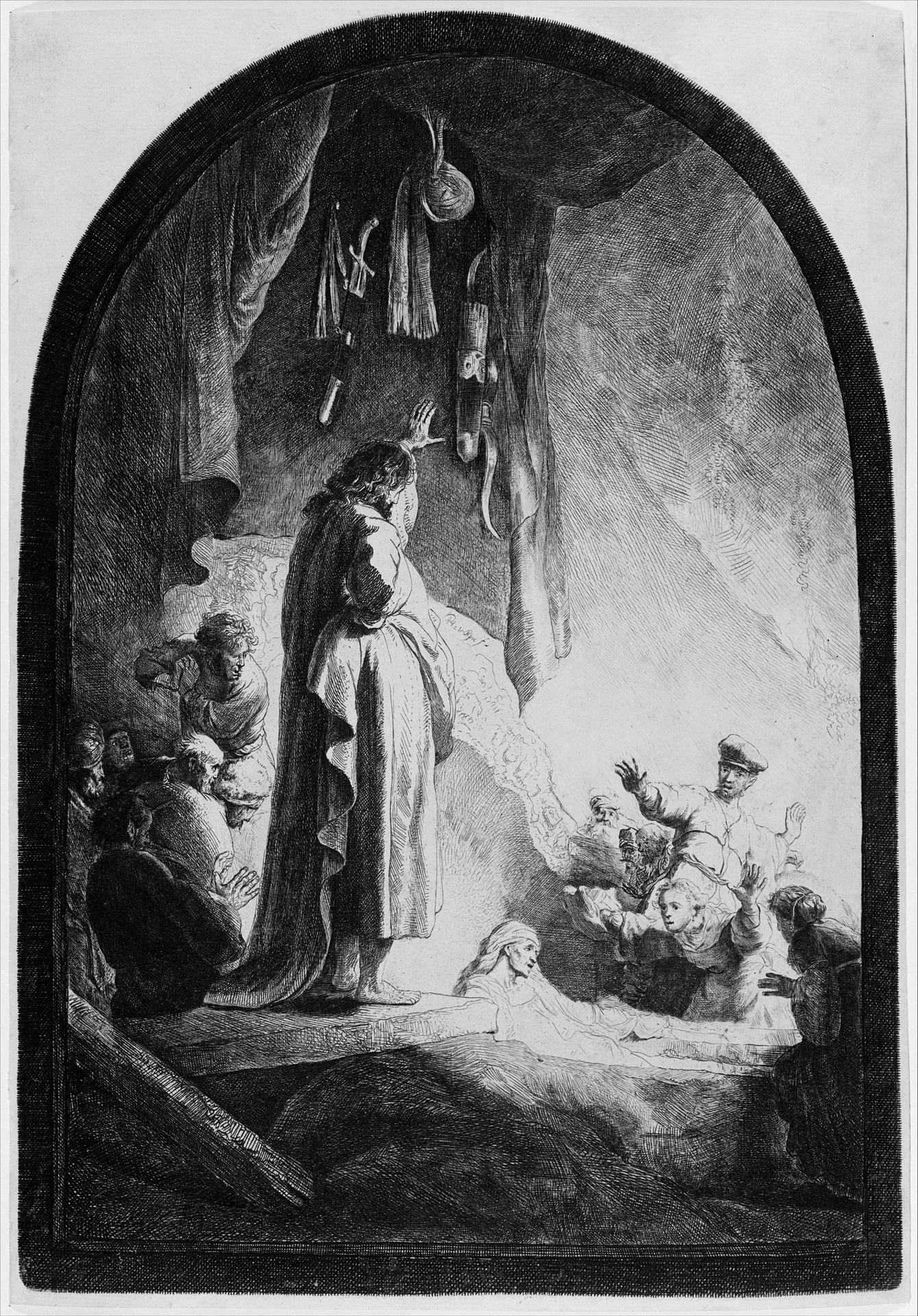
The Raising of Lazarus: The Larger Plate (ca. 1632, Met-Objekt 5151)
Original title: The Raising of Lazarus: The Larger Plate
kurzbeschreibung
Unlike many related depictions of Lazarus from the same period, Rembrandt's etching The Raising of Lazarus: The Larger Plate casts the miracle itself in a peculiar half-light. Made around 1632, the print combines etching and engraving and is now held by the Metropolitan Museum of Art.
Description
Jesus Christ stands at the center, hands raised, touching Lazarus, who lies on a table. Around him people crowd in with very different reactions: postures of prayer, terror, astonishment. Hints of a grave or a chapel can be made out behind them. The layout is symmetrically focused on Christ. Subdued light creates a dramatic, mysterious mood.
Context
The print comes from Rembrandt's early Leiden years, before he moved to Amsterdam in 1631/32. Its date is around 1632; it belongs to a series of biblical scenes from the 1630s. Nine states of the plate are known, and this impression represents the seventh. The source is the Gospel of John (John 11:1–44).
Impact
The dramatic lighting and the nuanced rendering of the figures heighten the emotional tension of the subject. Monochrome tones and fine shading give the sheet a solemn yet intimate atmosphere. The arrangement draws the eye directly to the central miracle and to the reactions of those standing by.
Technique
Etching and additional engraving allow for fine linework and rich tonal values. With the etching technique Rembrandt achieved soft transitions and deep shadows; the engraving serves precise details. The paper size with rectangular edges is 37.2 × 25.8 cm, the plate measures 36.8 × 25.5 cm.
AI-generated description text
Source: Metropolitan Museum of Art · Public Domain (CC0 1.0)