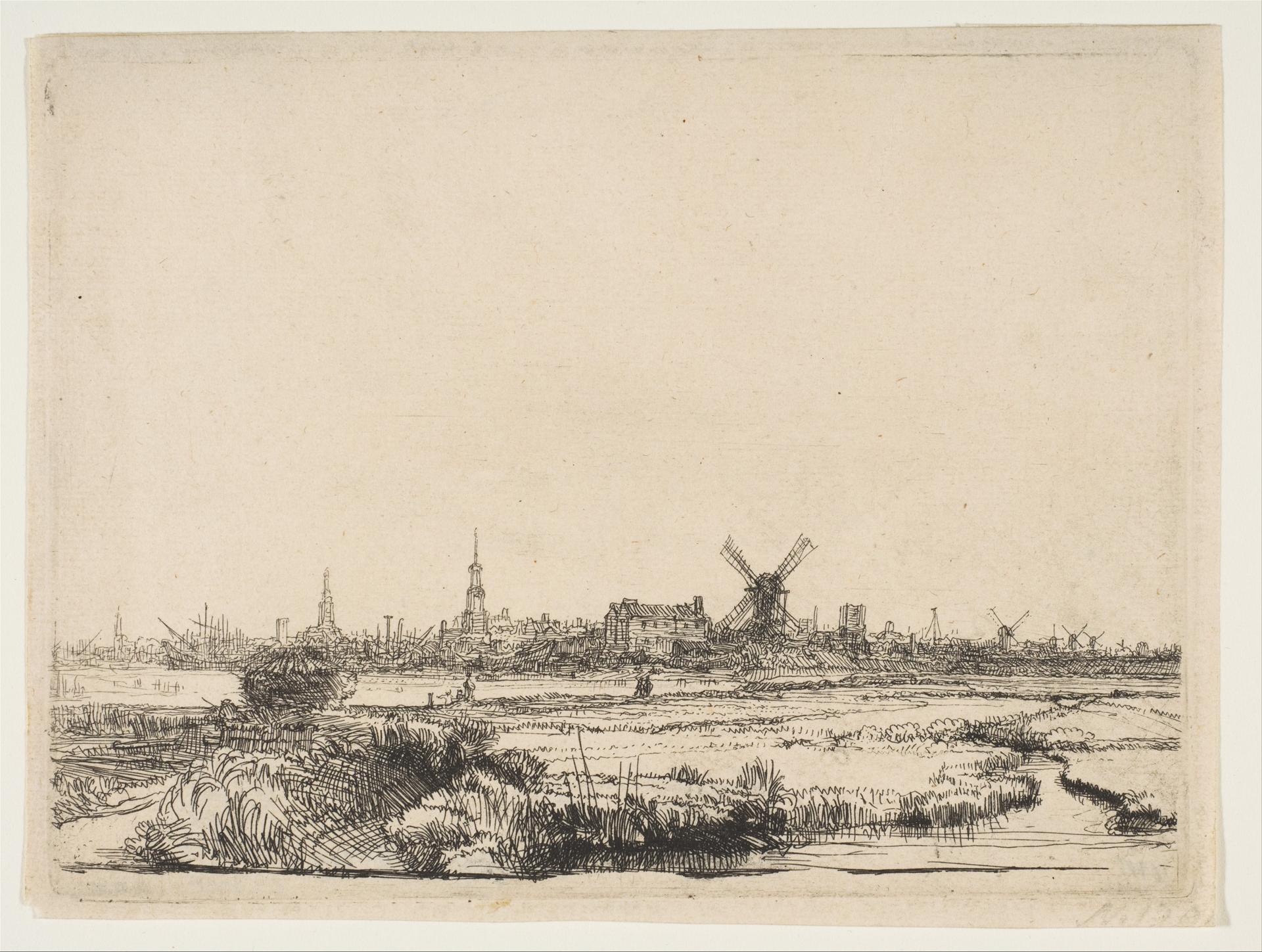
View of Amsterdam from the Northwest
Original title: View of Amsterdam from the Northwest
kurzbeschreibung
Around 1640, Rembrandt van Rijn etched 'View of Amsterdam from the Northwest,' an expansive cityscape seen from an elevated vantage point. From the foreground fields, the view stretches to the silhouette of Amsterdam with its churches and windmills. The print is executed as an etching on paper.
Description
The layout runs horizontally, with the horizon line near the middle. Fields and bushes fill the foreground and lead the eye toward the city center. A prominent church tower rises above the skyline, while several windmills appear on the right. Monochrome and evenly lit, the image relies on realistic, detailed linework: buildings and landscape features are carefully recorded.
Context
The etching dates from around 1640, when Amsterdam was enjoying economic and cultural prosperity. It likely grew out of sketches Rembrandt made on a trip to the city's surroundings. Topographical views of this kind were sought after in the seventeenth-century Dutch art market, reflecting civic pride.
Impact
The print feels calm and objective, thanks to the even distribution of light and clear lines. Windmills and the church tower stand out, giving the view an unmistakable silhouette characteristic of the Dutch landscape.
Technique
The drawing was incised into a copper plate and bitten with acid—an etching process. This produces precise contours and shading typical of Rembrandt's prints. The plate measures 11.2 x 15.2 cm, the sheet 12 x 15.8 cm.
AI-generated description text
Source: Metropolitan Museum of Art · Public Domain (CC0 1.0)