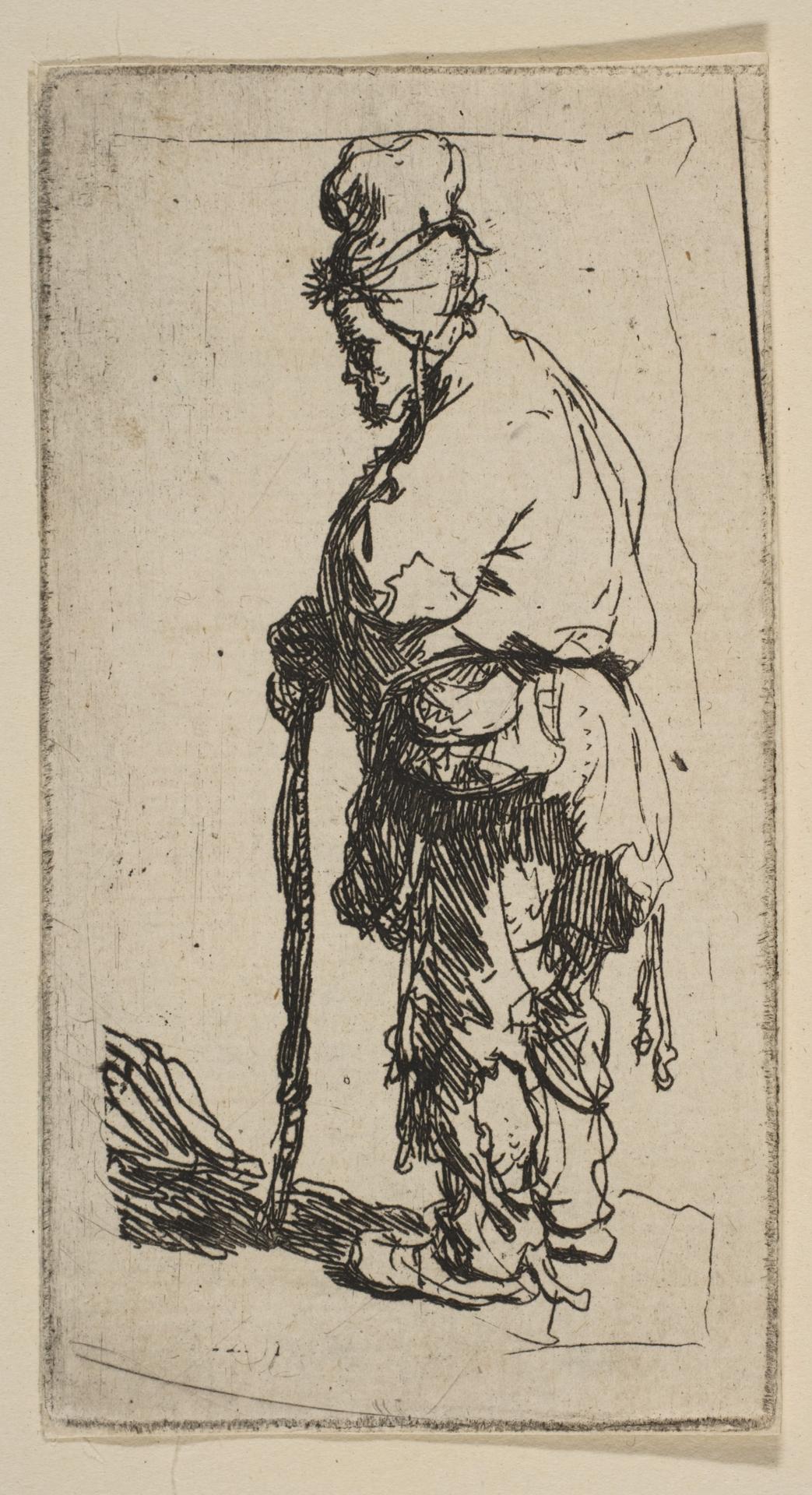
Beggar Leaning on a Stick, Facing Left
Original title: Beggar Leaning on a Stick, Facing Left
kurzbeschreibung
Rembrandt van Rijn made this etching around 1630, during a period when he frequently turned to beggars and social outsiders. It shows a beggar leaning on a long stick and looking to the left. The rendering stays plain and closely observed from life.
Description
Seen from behind, the beggar stands and turns his head to the left. A hood covers his head, his body is wrapped in a loose, disordered jacket, and his trousers look careless too; his hair falls long and unkempt. The thin, long stick he leans on touches the ground. Only a few details of the face are worked out, though a beard can be made out. The layout remains spare and entirely confined to the figure, while light and dark create a subdued mood.
Context
The print dates from Rembrandt's early Leiden years, when he studied beggars and marginal figures in depth. Such motifs were fairly popular in seventeenth-century Dutch art and often served as exercises in capturing posture and expression. Around 1630 Rembrandt produced a series of beggar depictions, and this work belongs to that group.
Impact
Despite the economy of means, the beggar is compelling and keeps a quiet dignity. The restrained linework and carefully graded light produce an intimate, reflective atmosphere that draws the viewer's eye to the figure and pulls them into his world.
Technique
For this print, the drawing was incised into a copper plate and then etched with acid to create an etching. This allows delicate and varied lines that in the print form a dense mesh of strokes. The paper is trimmed to the plate edge, which further emphasizes the image's structure.
AI-generated description text
Source: Metropolitan Museum of Art · Public Domain (CC0 1.0)