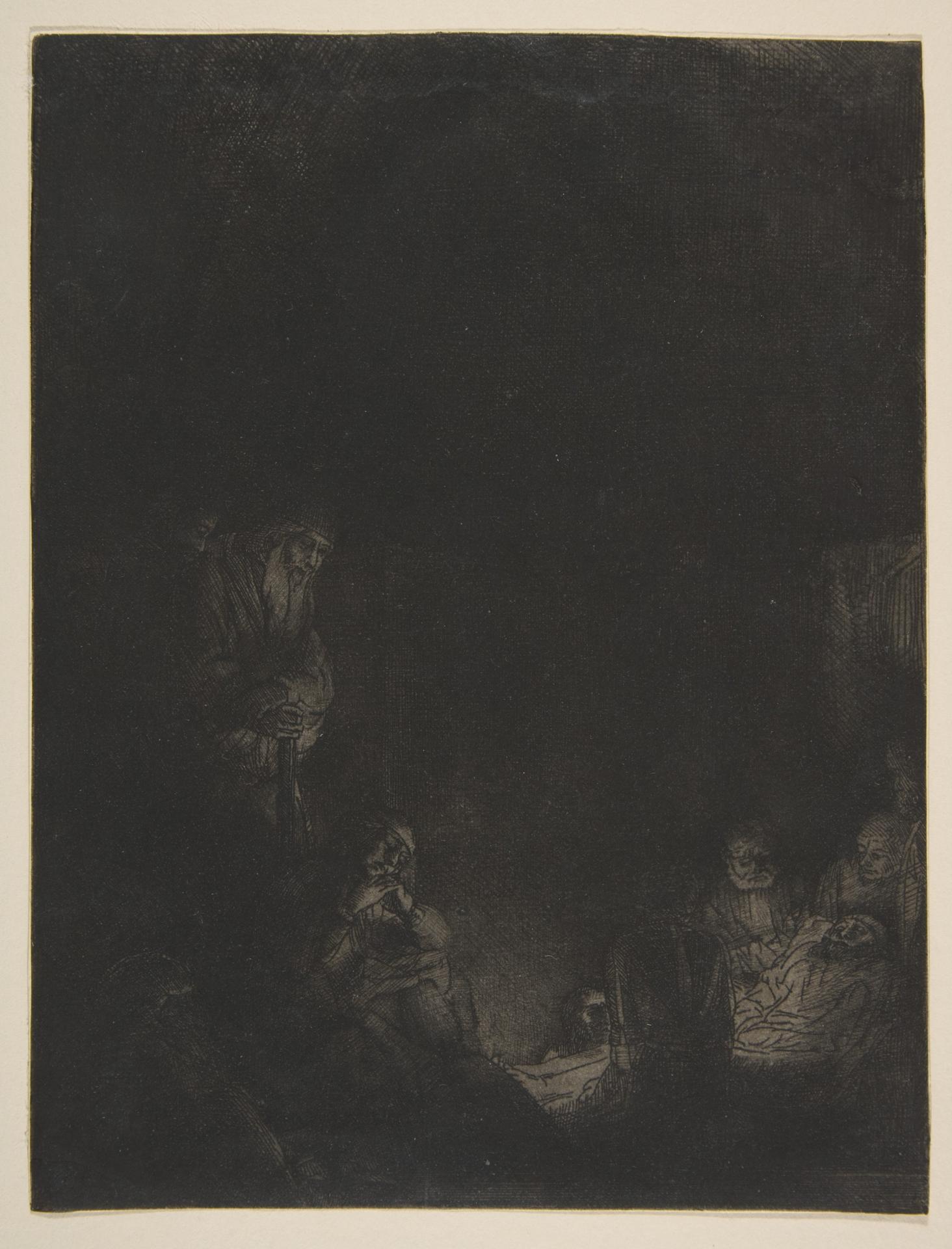
The Entombment (ca. 1654, Met-Objekt 5146)
Original title: The Entombment
kurzbeschreibung
Rembrandt van Rijn’s etching The Entombment, made around 1654, presents Christ’s burial as a crowded, shadowy event. The print combines etching, drypoint, and engraving and is the second of four states.
Description
In the foreground, several figures are gathered, among them a seated mourner and a standing figure that suggests a priest. Behind them, another body lies on a bier, understood as Christ. The layout avoids symmetry; shifted poses and gestures carry the tension of the moment. Tones from gray to black predominate, giving the whole a somber air. Fine lines and hatching run across the surface.
Context
The sheet belongs to Rembrandt’s later Amsterdam years, when biblical subjects were a focus of his work. It is part of a series of Passion scenes made in the 1650s. Through printmaking, his religious motifs could circulate widely. The source is the biblical account of the burial after the crucifixion.
Impact
First to strike the viewer is the muted, dark tone, which together with the agitated figures creates a palpable gravity. The eye is drawn from the graphic details to the main figures, reinforcing the devotional mood.
Technique
Etching, drypoint, and engraving are combined here, yielding a wide range of line weights and spatial depth. Drypoint leaves its characteristic soft edges and gives the impression a painterly quality. At 21 by 16 centimeters, the paper format remains small, which enhances the intimate effect of the subject.
AI-generated description text
Source: Metropolitan Museum of Art · Public Domain (CC0 1.0)