Two Dancers in a Rehearsal Room
Original title: Two Dancers in a Rehearsal Room
kurzbeschreibung
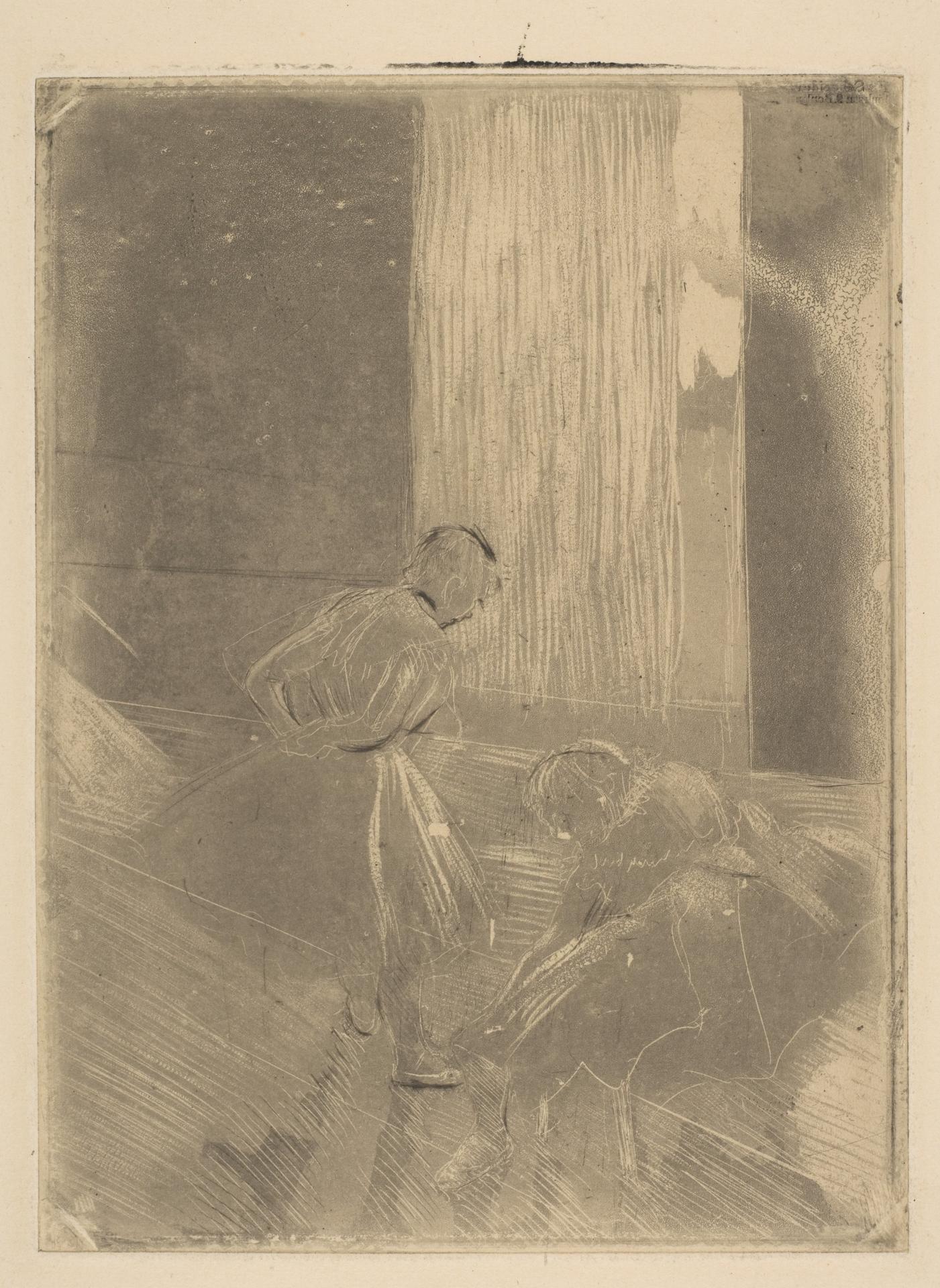
Edgar Degas's etching "Two Dancers in the Rehearsal Room" from 1877–78 presents two ballet dancers in a practice space. The subject draws on the ballet milieu that the artist returned to again and again.
Description
The arrangement feels asymmetrical: on the left, one dancer stands upright and looks to the left, while on the right a second kneels and leans forward, likely adjusting her shoes. Both wear traditional ballet attire, with folds and shadows clearly worked out. A large curtain in the background partially frames the figures. Diffused light from the front emphasizes the fabric folds and body poses.
Context
This print emerged during a phase of intense engagement with ballet, which Degas had been regularly observing in rehearsals and performances since the 1870s. It is an aquatint and drypoint etching, a technique the artist used at the time for his graphic experiments. Showing dancers in unposed, everyday poses aligns with his interest in snapshots of modern life.
Impact
The monochrome gray palette and delicate linework create a calm, intimate atmosphere. The relaxed posture of the figures conveys the impression of an observed moment, without staging. The layout directs the eye to the body poses and the materiality of the clothing.
Technique
The sheet is a single-state proof of an aquatint etching, combined with drypoint and scraping on laid paper. Aquatint produces fine gray tones, while drypoint contributes soft, velvety lines. Scraping was used to bring out bright areas specifically, modeling light effects.
AI-generated description text
Source: Metropolitan Museum of Art · Public Domain (CC0 1.0)