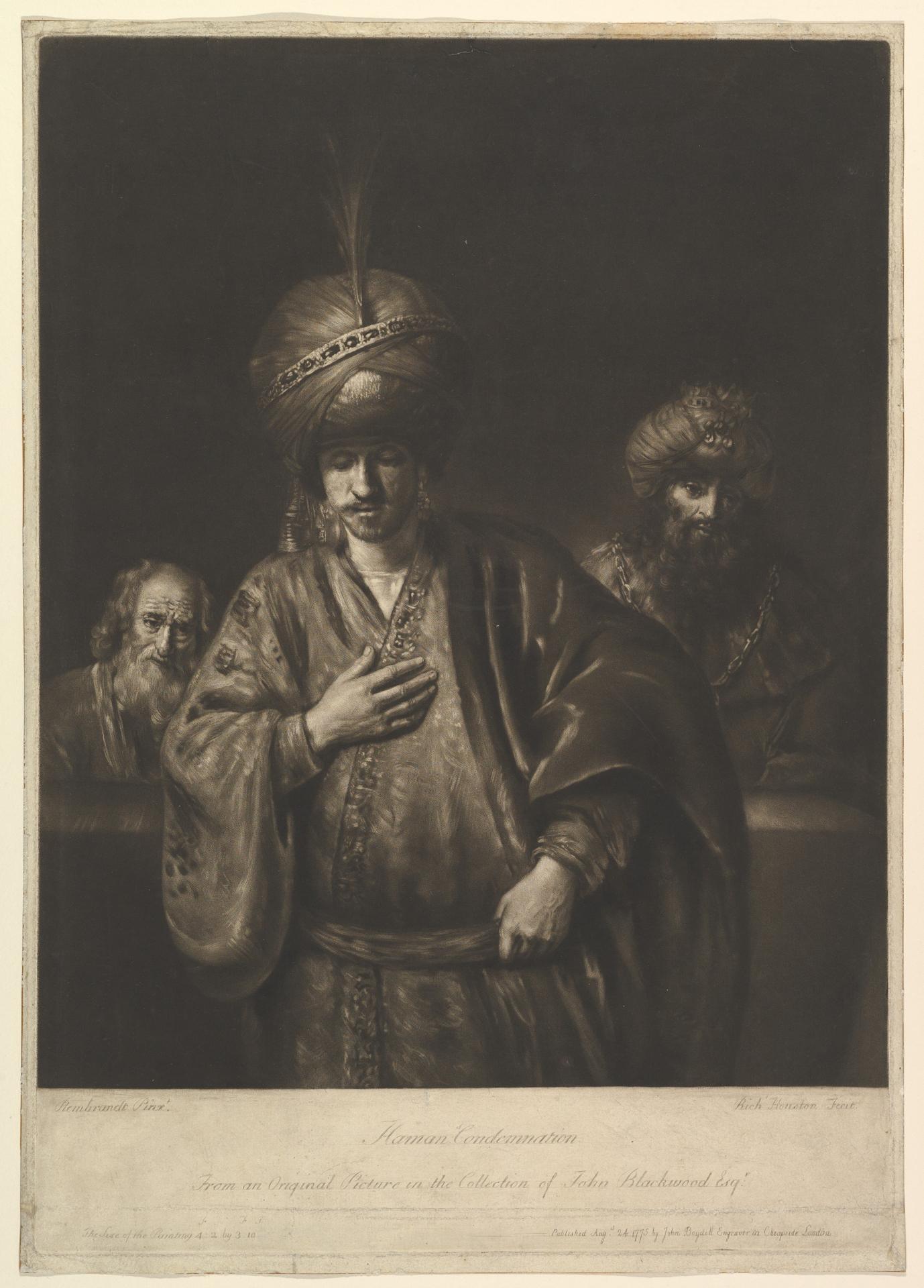
Haman's Condemnation
Original title: Haman's Condemnation
kurzbeschreibung
Richard Houston's mezzotint Haman's Condemnation, dated 24 August 1775, captures the moment when Haman, an adversary of the Jews, receives his sentence. The print measures 52.4 by 36.8 cm and carries the biblical narrative into the medium of printmaking.
Description
Haman stands at the front, his sumptuous robe and feather-trimmed turban cap clearly worked out; one hand rests on his heart, a gesture betraying grief or shame. To his left is an old, long-bearded man with an anxious gaze, likely Mordecai. On the right, another bearded figure wears a turban. The dark ground makes the figures stand out, while light falling from above accents the texture of the garments.
Context
Made in England in 1775, the sheet belongs to a period when religious and historical subjects were in demand in printmaking. The Irishman Richard Houston worked as an engraver in London. The source is the Book of Esther, in which Haman is condemned for his intrigues against the Jews. Mezzotint was a common means of reproducing paintings in the eighteenth century.
Impact
Light and shadow create a mood that is dramatic yet intimate. The precise rendering of fabrics and expressions heightens the emotional force of the moment. In its monochrome range of greys, the scene feels grave and solemn.
Technique
Mezzotint is an intaglio process: the plate is roughened and then selectively smoothed to gain tonal gradations, producing soft transitions and great closeness of detail. The sheet was printed in the scratched letter state, which points to an early printing phase.
AI-generated description text
Source: Metropolitan Museum of Art · Public Domain (CC0 1.0)