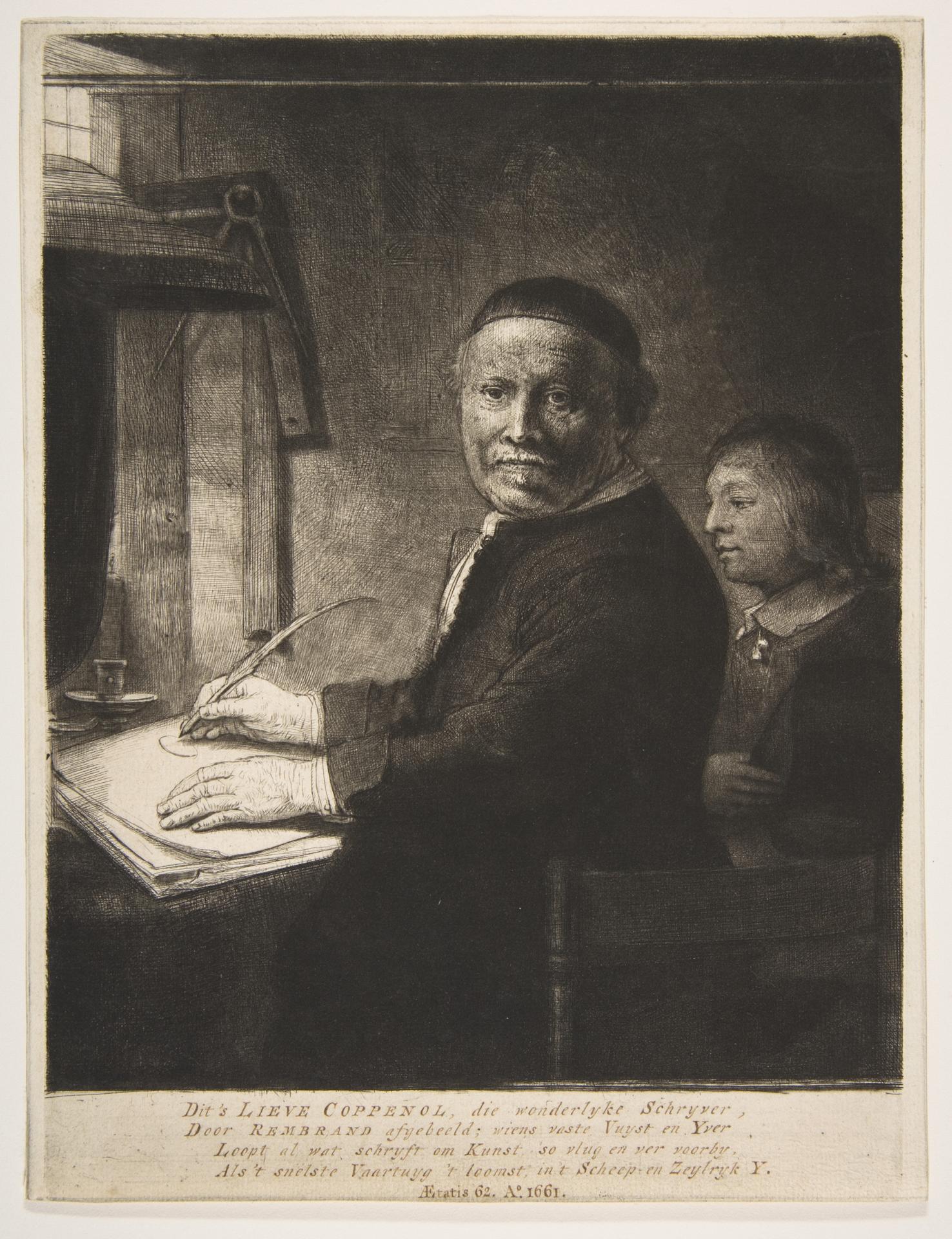
Lieven Willemsz van Coppenol with his Grandson
Original title: Lieven Willemsz van Coppenol with his Grandson
kurzbeschreibung
Around 1658 Rembrandt van Rijn portrayed the calligrapher Lieven Willemsz van Coppenol together with his grandson. The work is an etching with drypoint, the plate darkened with a mezzotint rocker, in the sixth of seven states. It captures a quiet moment of writing.
Description
Light enters from the left edge and draws the eye first to the faces and hands of the two figures. The grandfather sits at a table, writing in a book, while the boy stands beside him and watches. Behind them the ground remains dark; a tool or instrument resembling a pair of compasses can be made out there. Black and white dominate the sheet, bringing out the effect of etching and mezzotint. In its precision of detail and realism, the arrangement follows seventeenth-century Dutch art.
Context
In Amsterdam Lieven Willemsz van Coppenol was known as a distinguished calligrapher whose elaborate script was widely admired. Rembrandt portrayed him several times; this sheet dates from around 1658, when the artist was deeply engaged with printmaking. The inclusion of the grandson foregrounds the sitter's personal ties and domestic setting.
Impact
A calm, collected mood emanates from the print, reinforced by the light falling from the side. The careful execution and familiar scene draw the viewer close, as if attending the writing and the exchange between grandfather and grandson.
Technique
The artist worked in etching and drypoint; he also treated the plate with a mezzotint rocker to achieve deeper tones. This allowed fine transitions between light and dark, characteristic of Rembrandt's printed work. In the sixth state, reworkings are already present that give the black greater depth.
AI-generated description text
Source: Metropolitan Museum of Art · Public Domain (CC0 1.0)