Democritus and Heraclitus
Original title: Democritus and Heraclitus
kurzbeschreibung
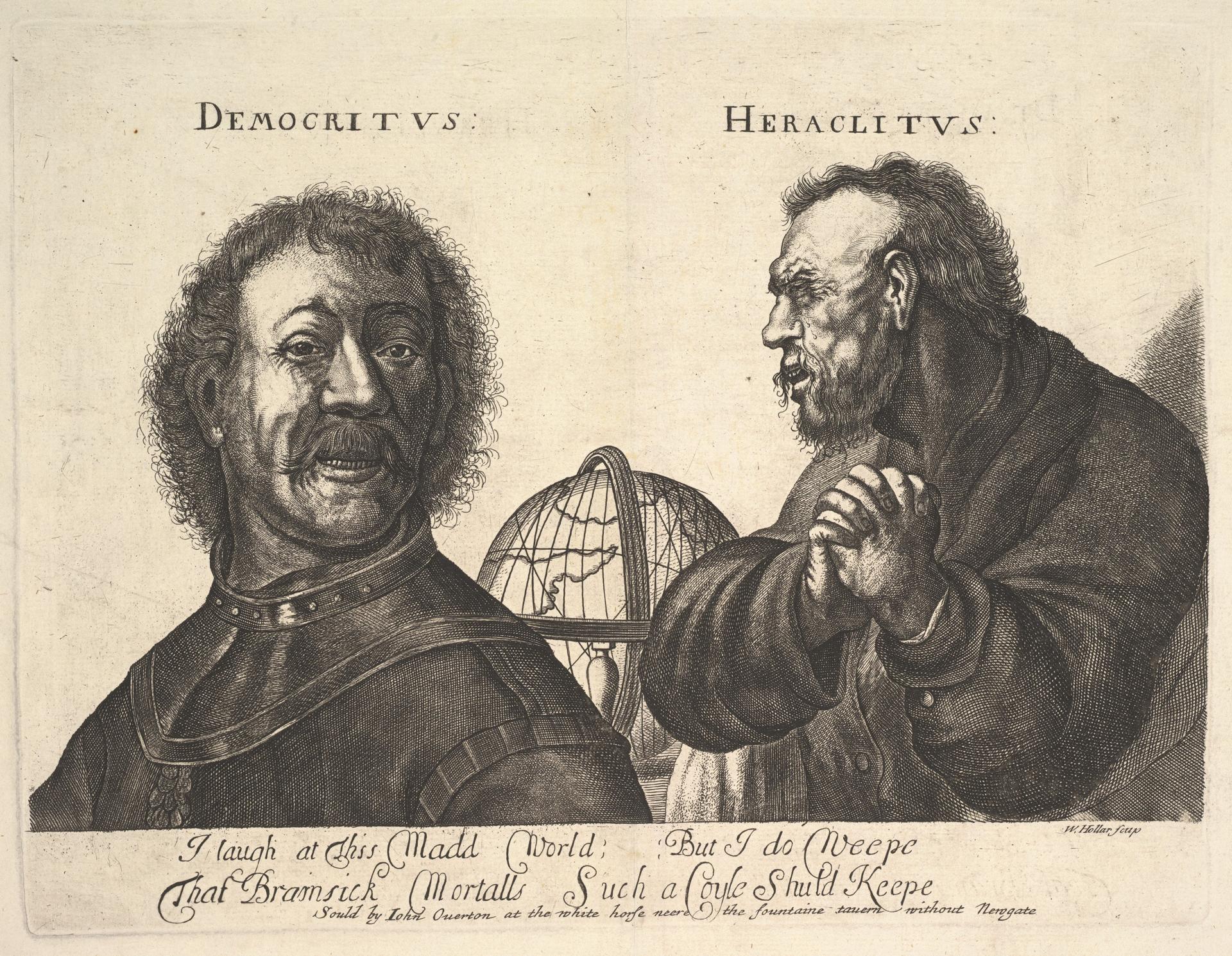
In this etching from around 1650–60, the ancient philosophers Democritus and Heraclitus face each other in a symmetrical arrangement. The print is attributed to Wenceslaus Hollar, though the execution is not his.
Description
On the left stands Democritus with long curly hair and armor-like clothing; his face wears a thoughtful, laughing expression. To the right is Heraclitus with short, curly hair and a beard, looking serious, his hands folded in front of his body. A globe between the figures in the rear refers to their interest in nature and the cosmos. The layout is symmetrical, the sheet in black and white, the light evenly distributed, with baroque details in faces and garments.
Context
Created between 1650 and 1660, the etching is attributed to Wenceslaus Hollar, a Bohemian printmaker known for his detailed prints. The motif of the two philosophers—Democritus as the laughing thinker, Heraclitus as the weeping one—was very popular in the Baroque era and played on their opposing attitudes to the world. The attribution to Hollar is uncertain because the technique is not his; it may be a copy or a work from his circle.
Impact
The contrasting physiognomies of the two philosophers create a calm, reflective mood. The globe in the rear gives the sheet a cosmic dimension and underscores the philosophical depth of the motif. The symmetrical arrangement and fine shading lend the view a balanced, classical feel.
Technique
In this etching, the drawing is scratched into an acid-resistant layer on a copper plate and then etched. This allows fine lines and shading, visible in the rendering of hair, beards, and clothing details. The printing plate measures 24.3 × 32 cm; printed in black on paper.
AI-generated description text
Source: Metropolitan Museum of Art · Public Domain (CC0 1.0)