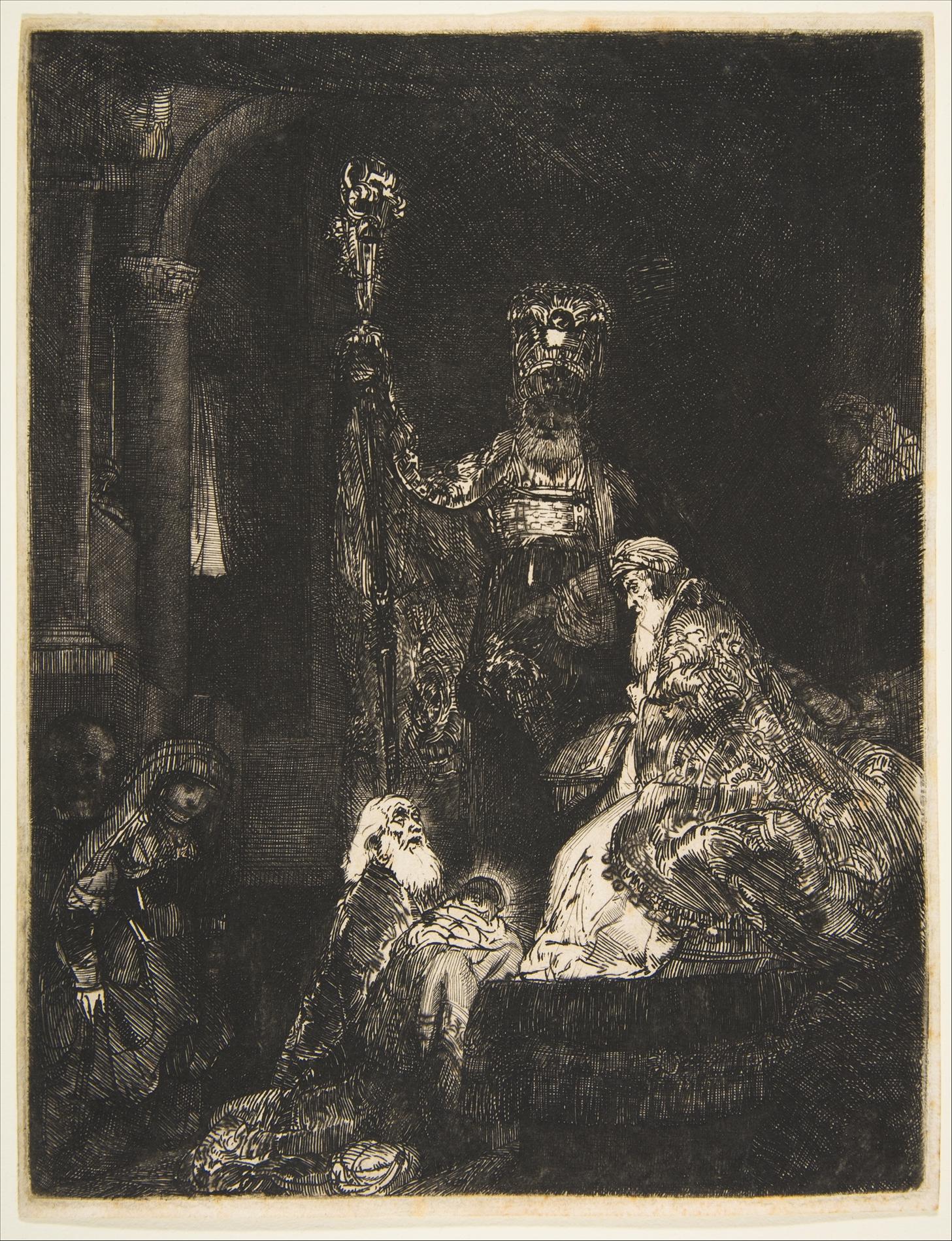
The Presentation in the Temple in the Dark Manner
Original title: The Presentation in the Temple in the Dark Manner
kurzbeschreibung
When Jesus is presented in the temple, Rembrandt captures this moment in an etching from about 1654, known by the title "The Presentation in the Temple, in the Dark Manner." The sheet is executed in etching and drypoint, and the plate measures 21 x 16.2 cm.
Description
A figure wearing a head covering and a flowing cloak carries a child on their arms and also holds a vessel reminiscent of a chalice. Beside this figure, an old bearded man sinks down in deep bows, and on the right a richly dressed woman kneels, her gaze fixed on the child. Behind them, other people are suggested, along with columns and arches. Light falls from above onto faces and hands, while the surrounding space remains largely in darkness.
Context
Around 1654 Rembrandt worked increasingly on biblical motifs with pronounced chiaroscuro effects. The addition "dark manner" names precisely these strong contrasts, which arise from the interplay of etching and drypoint. The sheet takes its place in a series of scenes from the life of Christ and reveals how much the artist was interested in devotion and divine light, especially in the ordinary.
Impact
The symmetrical layout with the central figure gives the sheet a calm, solemn quality. The dark areas create a concentrated, almost devotional mood that deliberately directs the viewer's gaze to the bright spots.
Technique
The motif is worked in drypoint and etching on the copper plate; the needle leaves fine, burred lines that allow soft transitions. The overall dark effect results from densely set hatching and an almost complete absence of light areas, giving the print a special graphic depth.
AI-generated description text
Source: Metropolitan Museum of Art · Public Domain (CC0 1.0)