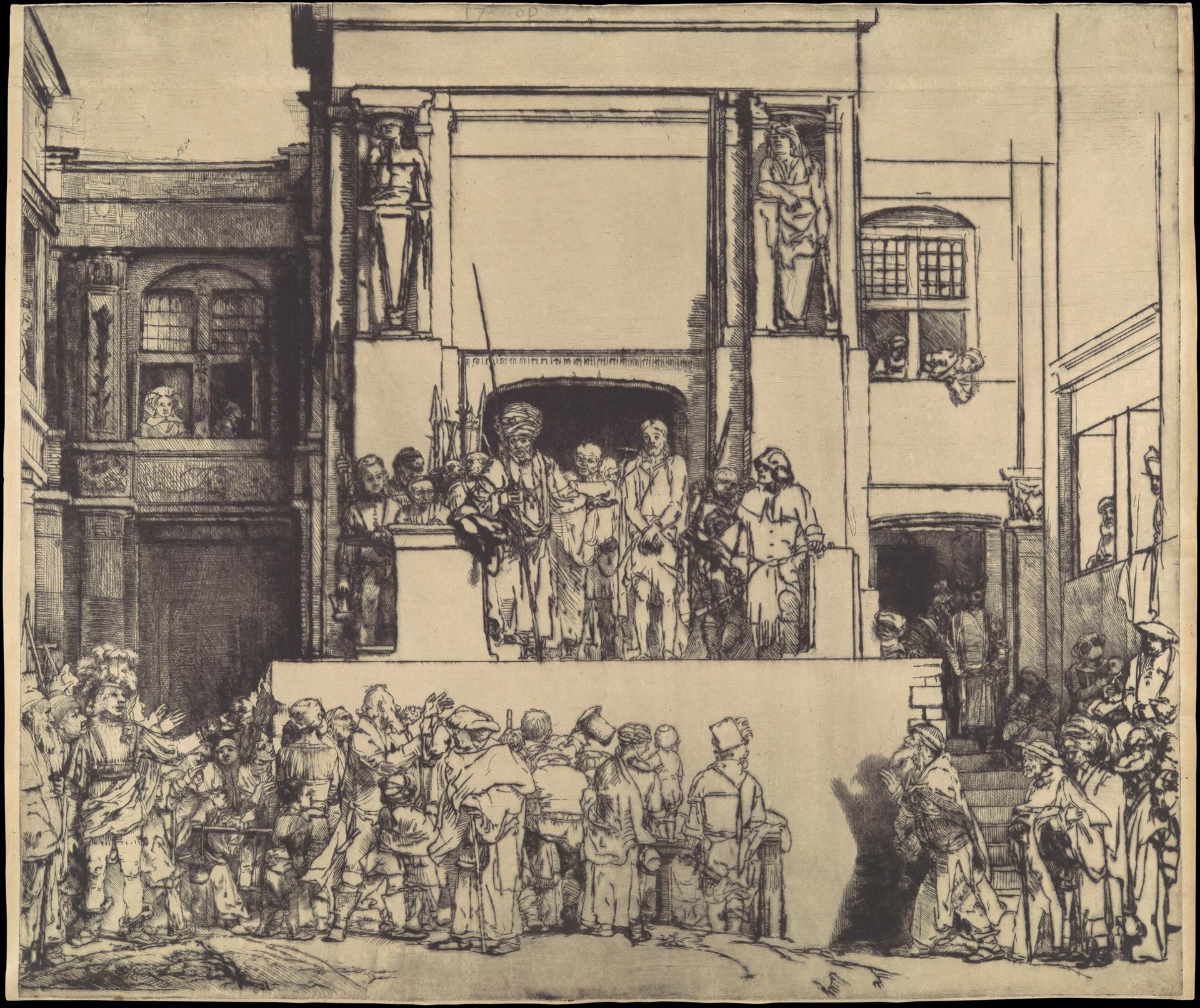
Christ Presented to the People (1655, Met-Objekt 5133)
Original title: Christ Presented to the People
kurzbeschreibung
Rembrandt van Rijn made this print in 1655, showing Christ presented to the people. It is a drypoint on Japanese paper, fourth state of eight. The subject is a dense crowd in a palace courtyard, framed by architecture.
Description
A courtyard sets the stage. In the foreground stands a group of figures in historical dress, some holding staffs or weapons. Behind them rises a building with columns and statues, while more figures appear on balconies and at the entrance. Light areas and deep shadows emphasize spatial depth and bring the central figure of Christ forward. The layout is clearly structured, the figures carefully arranged, creating a calm but dense atmosphere.
Context
This sheet arose during a period when Rembrandt was deeply engaged with biblical subjects and the depiction of crowds. It belongs to his Amsterdam years, when he worked as an established artist but also faced financial difficulties. The etching is part of a series of Passion scenes from the 1650s. The fourth state shows clear revisions, evidence of Rembrandt's experimental working method.
Impact
Fine lines and nuanced hatching create a lively surface that draws the eye into close looking. The interplay of light and shadow gives the scene a dramatic, almost theatrical effect that heightens the tension of the moment. The crowd seems both restless and static, stressing the ambiguity of the situation.
Technique
The lines are scratched directly into the copper plate, producing soft, velvety strokes. Printing on Japanese paper enhances the depth of the blacks and the fineness of detail. The fourth of eight states shows later revisions that refine the layout and intensify the lighting.
AI-generated description text
Source: Metropolitan Museum of Art · Public Domain (CC0 1.0)