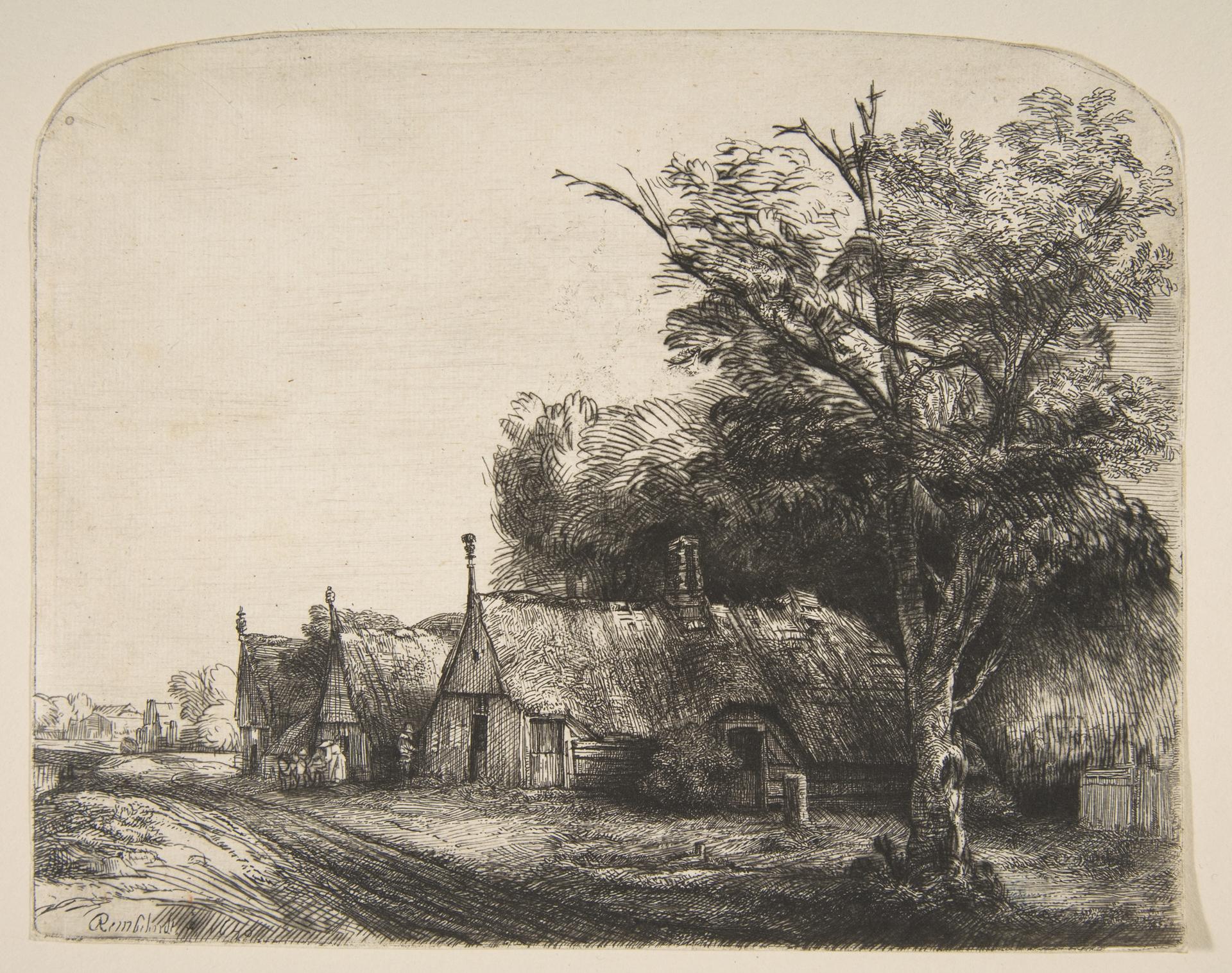
Landscape with Three Gabled Cottages Beside a Road (1650, Met-Objekt 5132)
Original title: Landscape with Three Gabled Cottages Beside a Road
kurzbeschreibung
Rembrandt made this etching in 1650, capturing a rural view with three gabled houses along a path. The print, executed in etching and drypoint, is the third of three states.
Description
Three houses with gables, thatched roofs, and simple doors and windows shape the layout. A smaller, isolated building with a pointed roof sits on the left, while on the right a large tree with spreading branches dominates the sheet. A path runs through the scene from left to right; beyond it, more trees and a small structure come into view. The natural-looking light emphasizes the textures of the houses and the tree.
Context
The etching dates from 1650, a time when Rembrandt was deeply engaged with landscape motifs. Based in Amsterdam since the 1630s, he produced several landscapes in the 1640s and 1650s. Thatched houses were a common subject in seventeenth-century Dutch art.
Impact
A quiet, rural mood emanates from the print, carried by the natural lighting and the precise rendering of the architecture. The monochrome approach draws attention to the graphic structures and the delicate lines of the etching.
Technique
Rembrandt combined etching and drypoint; the sheet is the third of three states. This technique allows for fine lines and soft transitions that capture the texture of roofs and foliage. The drypoint leaves its characteristic slightly blurred edges.
AI-generated description text
Source: Metropolitan Museum of Art · Public Domain (CC0 1.0)