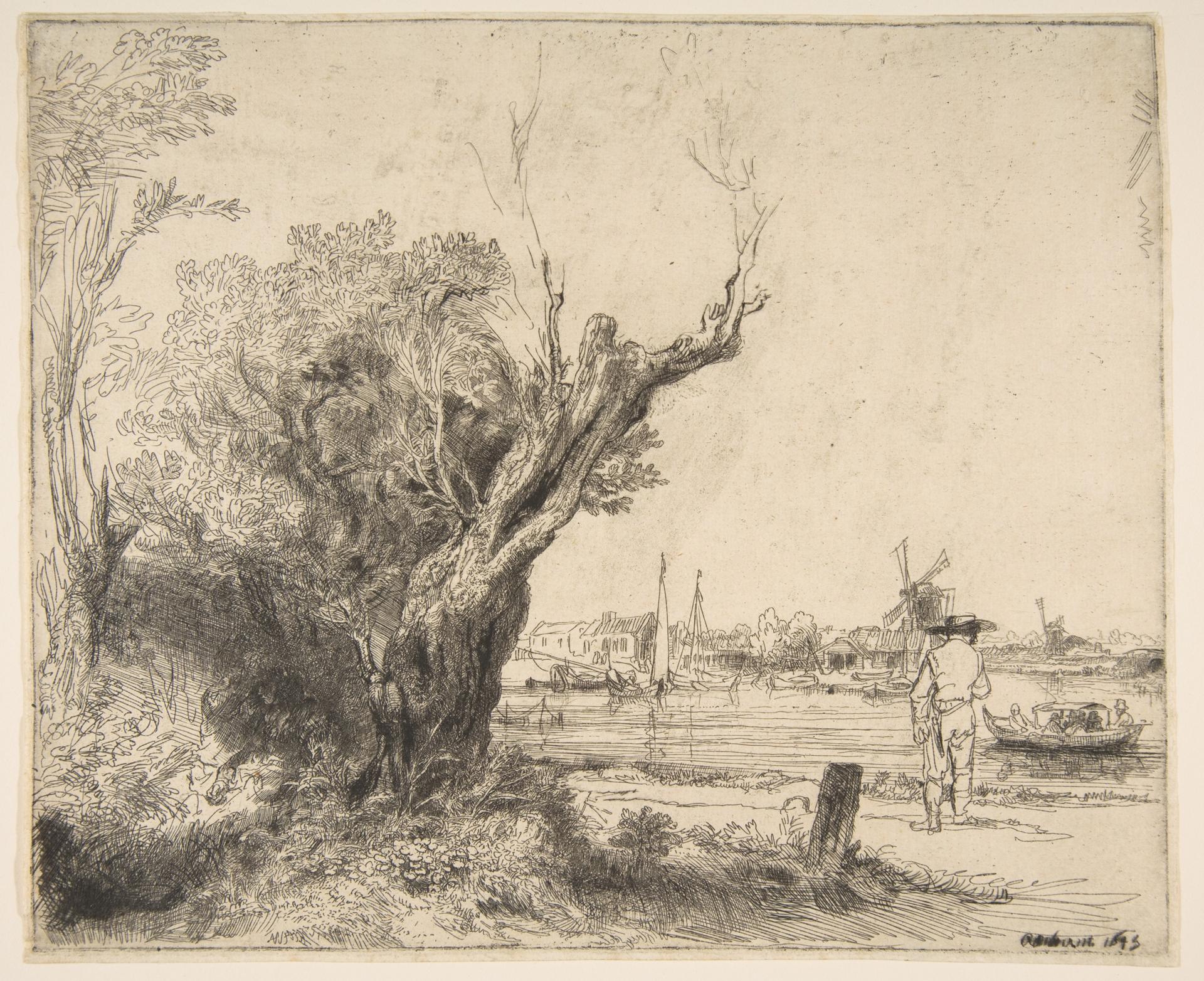
The Omval
Original title: The Omval
kurzbeschreibung
Rembrandt van Rijn made the etching Der Omval in 1645. A striking tree fills the foreground, a lone figure stands on the bank, and a village with sailing ships lies beyond. Etching and drypoint are combined here, and the impression is the second state of two.
Description
A large trunk, worked out down to the smallest detail with branches and leaves, dominates the left side and reaches across to the right. On the bank at right a man in traditional dress stands looking off to the right. Several buildings suggesting a village rise in the distance, along with sailing ships on calm water that mirrors its surroundings. Trees and shrubs fill out the landscape. The black-and-white strokes shift in strength, bringing out the textures of tree and ground.
Context
The print dates from 1645, a time when Rembrandt was devoting close attention to landscape. The Omval, an area near Amsterdam, was a popular spot for outings in those years. This work belongs to a group of landscape etchings Rembrandt produced during the 1640s. The view records a real place, but one idealized and enriched with genre elements.
Impact
A quiet, idyllic mood comes across, reinforced by the reflective water and the finely worked details. The contrast between the commanding tree in front and the delicate landscape behind guides the eye and creates a sense of depth.
Technique
In this etching with drypoint, lines are also scratched directly into the etched plate with a needle. The drypoint gives a soft, velvety effect that shows most clearly in the shadowed areas. The handling of line is precise and varied in strength, so that the texture of bark, leaves and ground comes alive.
AI-generated description text
Source: Metropolitan Museum of Art · Public Domain (CC0 1.0)