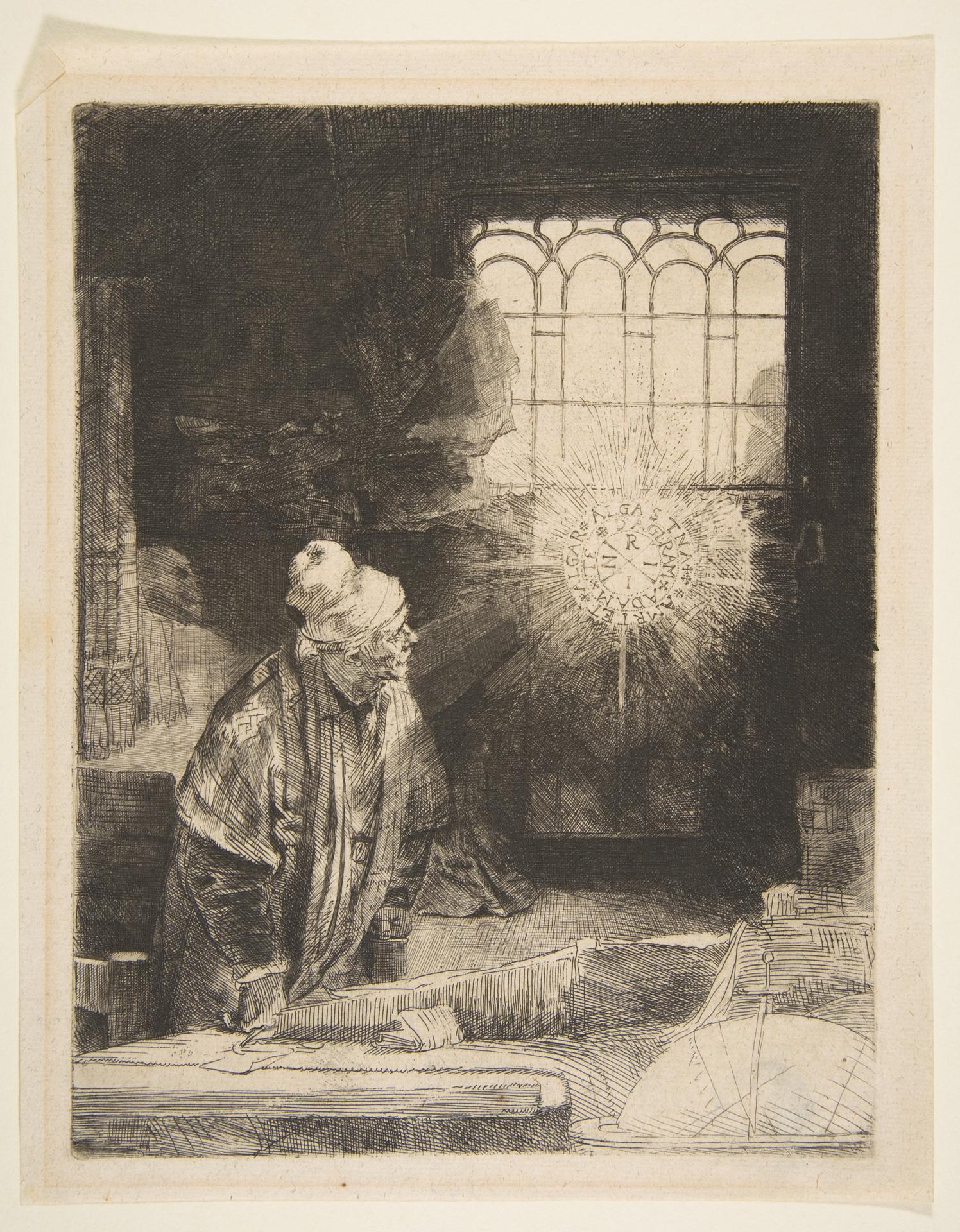
Faust (ca. 1652, Met-Objekt 5128)
Original title: Faust
kurzbeschreibung
Rembrandt's etching Faust, made around 1652, shows a pensive man in a gloomy room looking toward a brightly lit window. The print combines etching, drypoint, and engraving and is the first of seven states.
Description
A seated figure wearing a cap and jacket looks toward a window in a thoughtful pose. The window has a pattern and gives off bright light that gathers into a beam in the middle. The light emanates from a sign or text on the window, though this area remains only partly legible. The room feels bare; a table and some objects on the floor can be made out. The layout is asymmetrical and monochrome, with visible traces of etching and drypoint.
Context
Rembrandt was working in Amsterdam around 1652, in a phase of intense experimentation with printmaking techniques. The story of Faust, the learned magician, was widespread in the seventeenth century, but Rembrandt's interpretation differs from conventional images. The linking of light and writing may allude to alchemical or kabbalistic ideas discussed in scholarly circles of the time. The sheet belongs to a series of etchings that testify to Rembrandt's interest in mystical and philosophical themes.
Impact
A calm, contemplative mood arises from the interplay of darkness and bright light. The figure's thoughtful pose invites the viewer to reflect on knowledge and enlightenment. Delicate lines and shading give the print depth and an intimate aura.
Technique
Rembrandt combined etching, drypoint, and engraving to achieve fine transitions of light and shadow. Drypoint creates soft, velvety lines, while etching allows clear contours. The sheet was trimmed to 21.7 × 16.7 cm and shows the first of seven print states.
AI-generated description text
Source: Metropolitan Museum of Art · Public Domain (CC0 1.0)