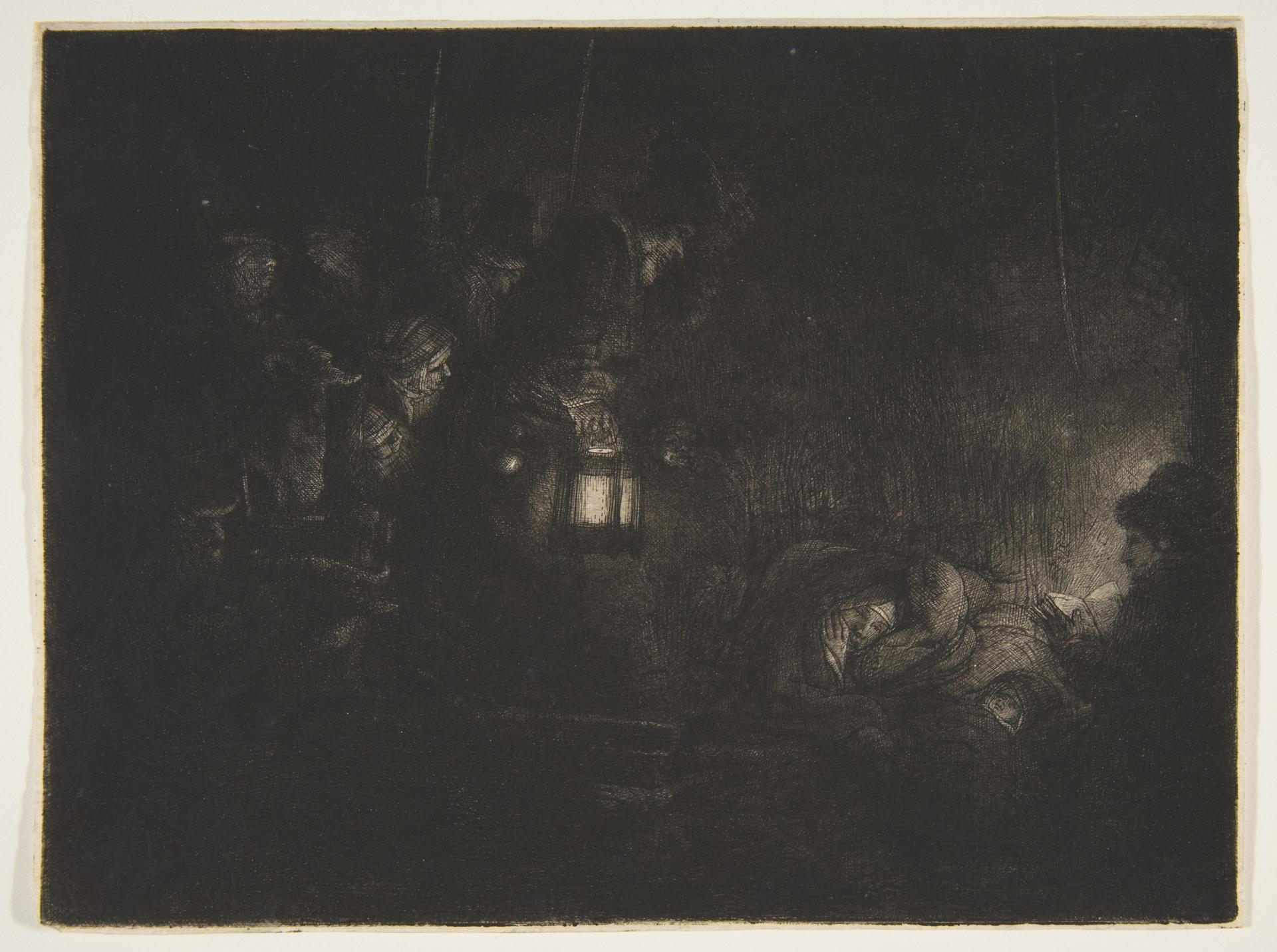
Adoration of the Shepherds: A Night Piece
Original title: Adoration of the Shepherds: A Night Piece
kurzbeschreibung
Unlike most contemporary depictions of the Adoration of the Shepherds, Rembrandt's etching of about 1657 relies not on radiant divine light but on a single lantern as the only source of illumination. This fifth-state print measures 14.6 x 19.5 cm (plate) and presents the biblical scene as a pronounced nocturne.
Description
A lantern forms the bright core of the layout, its faint glow sliding over the contours of figures and objects. In traditional garments, the shepherds recline in various poses around this light, some near the foreground, others deeper in the space. Muted, mostly dark tones dominate the sheet and carry the nocturnal mood. Where the lantern strikes, hard contrasts make bodies and objects stand out in relief; delicate strokes and hatching preserve the details of the figures and their outlines.
Context
The print was made during Rembrandt's late Amsterdam years, when biblical subjects were a focus of his work. It belongs to a series of night pieces the artist created in the 1650s. That he treats the Adoration as a study in artificial lighting reveals his enduring interest in the interplay of light and shadow, to which etching was particularly suited.
Impact
The strong contrast of light and dark creates a quiet, collected mood and draws the eye into the night scene. Because the light is so sparingly placed, attention turns almost automatically to the figures; the print feels calm and inclined to linger.
Technique
The motif is executed as an etching in the fifth state, worked with thin lines and graduated hatching. This method allows precise control of light and shadow: dense layers of strokes create the dark areas, while blank paper provides the lights.
AI-generated description text
Source: Metropolitan Museum of Art · Public Domain (CC0 1.0)