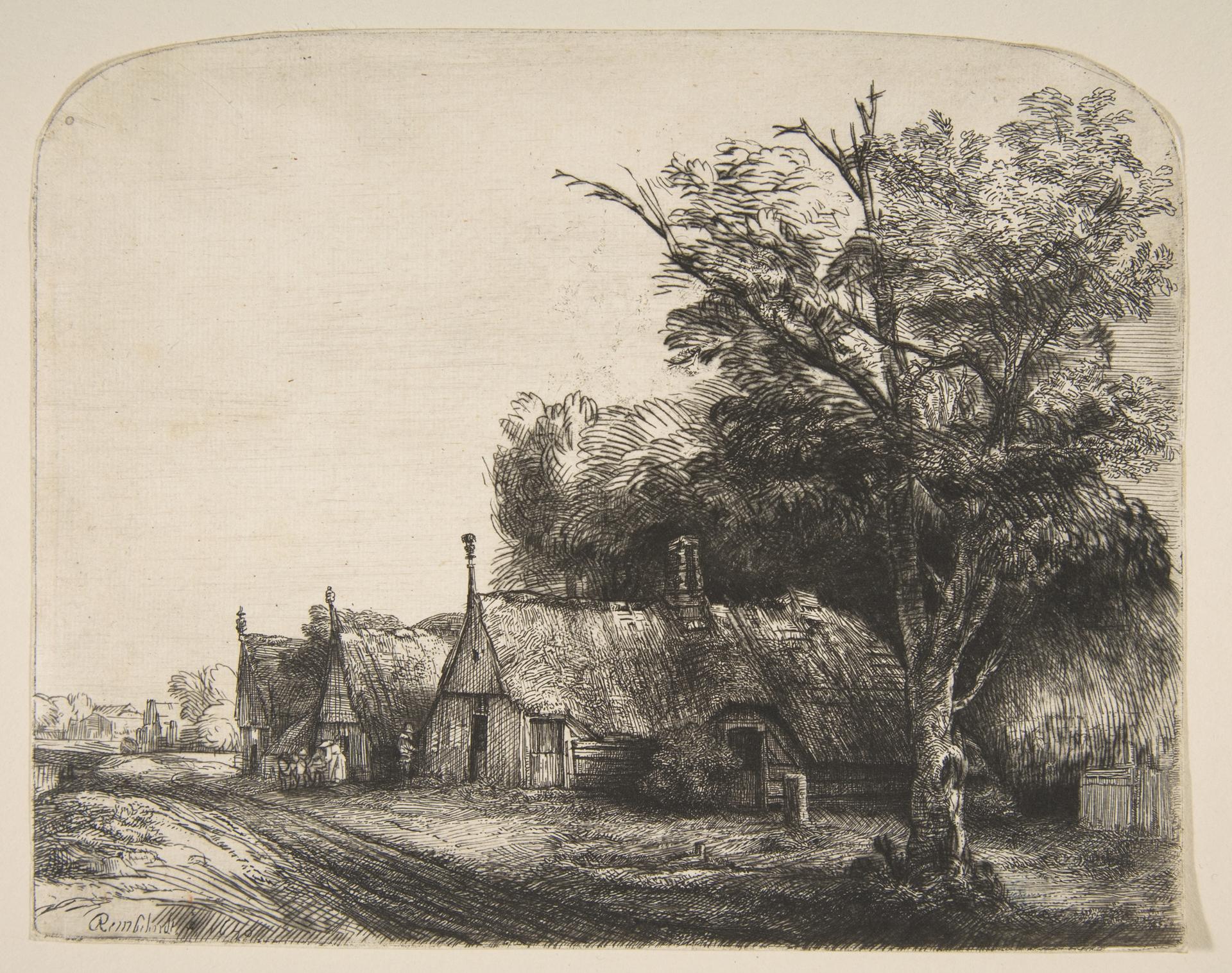
Landscape with Three Gabled Cottages Beside a Road (1650, Met-Objekt 5126)
Original title: Landscape with Three Gabled Cottages Beside a Road
kurzbeschreibung
In 1650 Rembrandt van Rijn etched a rural view in which three gabled houses stand in a row along a road. The print is an etching with drypoint and survives here in the third of three states. Its arrangement brings out the quiet, idyllic mood of the Dutch countryside.
Description
On the left sits a smaller house with a steep, reed-covered roof; to the right stand two larger buildings joined by a partition wall. A large, densely leafy tree rises in front of the houses and leans slightly to the left. The road runs parallel to the buildings and leads through the picture, with further trees and one more house visible beyond. Fine lines and hatching carry this black-and-white view, capturing structures and shadows with precision.
Context
The etching dates from around 1650, a period when Rembrandt was exploring landscape subjects in depth. Plain farmhouses with thatched roofs were a common theme in seventeenth-century Dutch art and spoke of an interest in rural surroundings. Rembrandt often combined etching and drypoint to achieve fine detail and soft transitions.
Impact
The sheet radiates a calm, contemplative mood and carries the viewer into the rural idyll of the seventeenth century. Finely graded lines and subtle shading give the view a lively texture that makes the scene almost tangible. The clear layout and detailed execution attest to Rembrandt's skill in printmaking.
Technique
For this sheet Rembrandt combined etching with drypoint, which allowed fine and precise linework. The third of three states shows the fully worked plate. The technique permits both strong contours and delicate hatching, decisive for the sculptural effect of trees and buildings.
AI-generated description text
Source: Metropolitan Museum of Art · Public Domain (CC0 1.0)