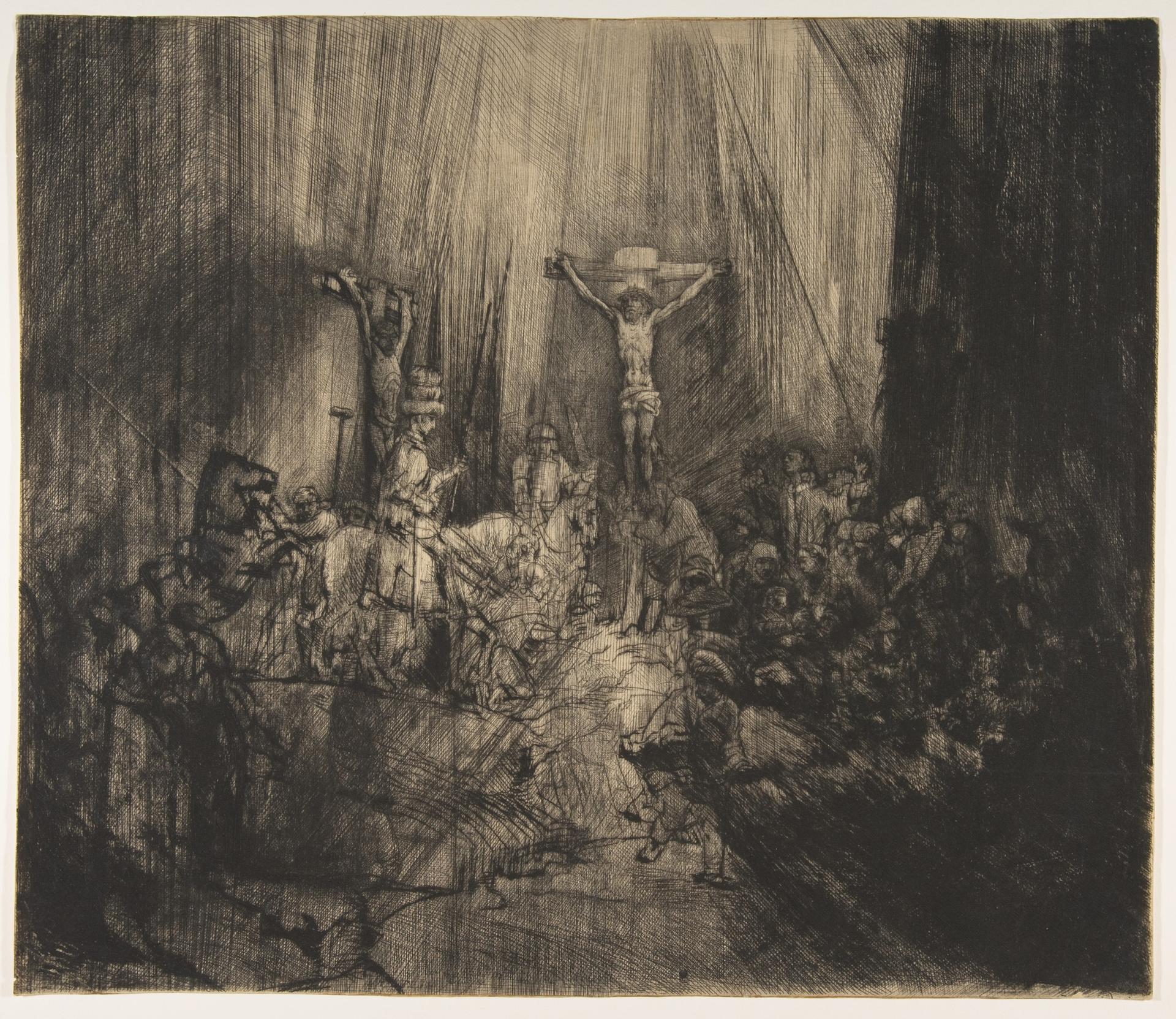
Christ Crucified between the Two Thieves: The Three Crosses (ca. 1660)
Original title: Christ Crucified between the Two Thieves: The Three Crosses
kurzbeschreibung
Rembrandt van Rijn made this drypoint, The Three Crosses, around 1660, placing Christ between two criminals on their crosses. The upright plate measures 38.2 by 44.4 cm and studies, with unusual force, how light and shadow meet across a narrow range of greys.
Description
Christ's cross holds the middle of the image, flanked by those of the two thieves. A tightly packed crowd stands around the event: figures pray, others cry out, others weep. Their clothing carries historical touches that point back to biblical times. Diffuse light falls from above and gives the scene a dramatic, almost otherworldly mood. Vigorous, at times expressive strokes sharpen its emotional charge.
Context
The etching dates from about 1660, a period when Rembrandt was devoting himself more and more to experiments in printmaking. It ranks among his best-known drypoints and demonstrates his knack for drawing painterly effects out of the technique. Crucifixion subjects were widespread in seventeenth-century Dutch art, yet Rembrandt's version pushes human tragedy and suffering further forward than many works by his contemporaries.
Impact
Steep perspective and a bright centre pull the viewer straight into the action. Precise observation of detail and dramatic heightening combine into a lasting emotional effect. Because the sheet stays within greys, line and lighting take over the attention and lend it an intensity that has not faded.
Technique
In drypoint the lines are scratched directly into the copper plate, raising a soft, velvety burr. That burr catches the printing ink and produces the characteristic dark, vibrating lines. Rembrandt used the method to reach fine gradations of light and shade that recall a washed drawing.
AI-generated description text
Source: Metropolitan Museum of Art · Public Domain (CC0 1.0)