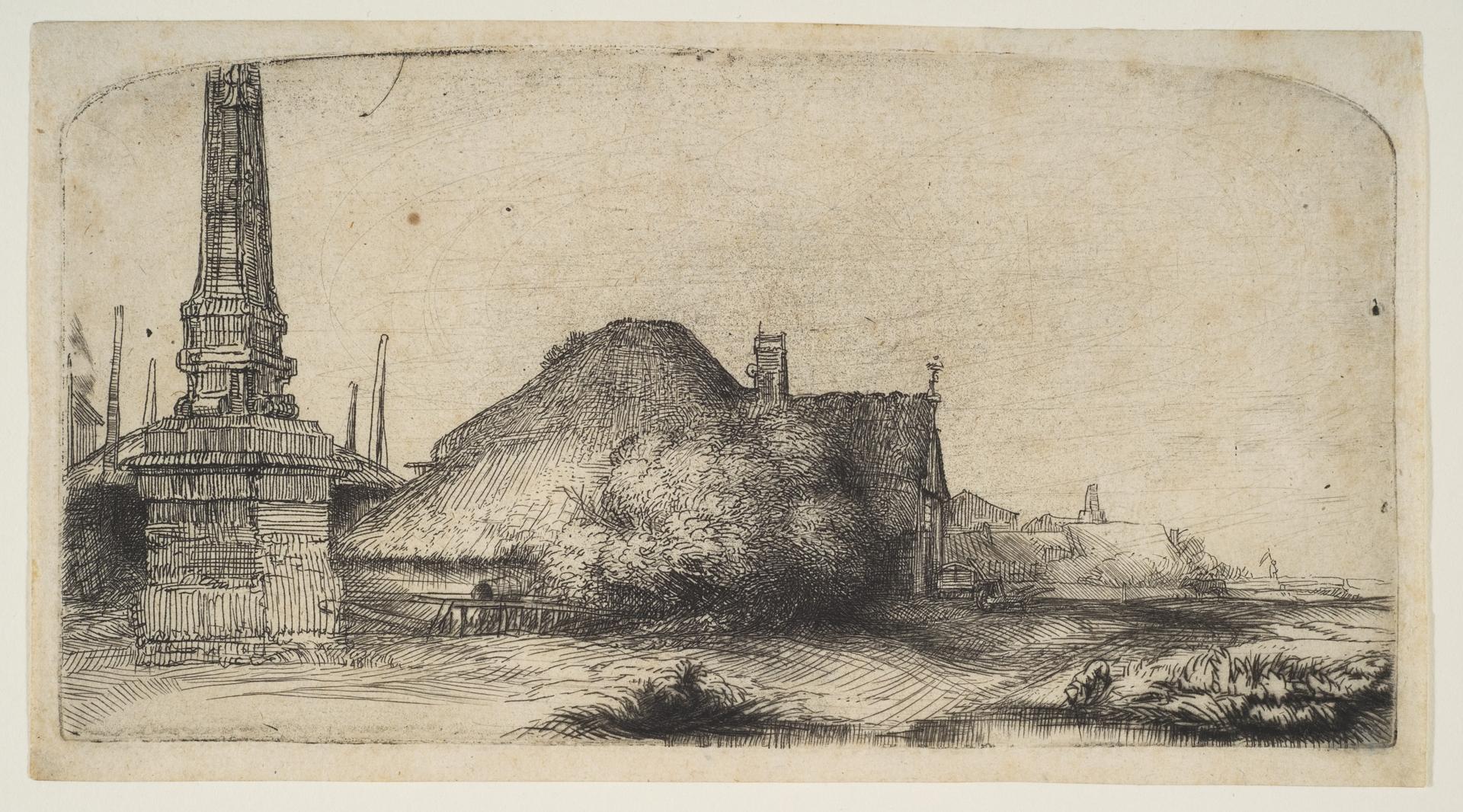
Cottage and Boundary Post on the Spaarndammerdijk ('L'Obelisque')
Original title: Cottage and Boundary Post on the Spaarndammerdijk ('L'Obelisque')
kurzbeschreibung
A tall obelisk stands within a low wall in Rembrandt's rural etching Häuschen und Grenzpfosten am Spaarndammerdijk, made around 1650. The print was worked in etching and drypoint and measures 8.4 by 16.1 cm.
Description
The obelisk rises in the foreground, held by a wall, and a thatched-roof building stands close beside it. Further buildings and a smaller obelisk can be made out in the distance, while scattered bushes and grass cover the open field. Calm, even light runs through the whole view, and the black-and-white of fine linear drawing brings out the structure of the buildings.
Context
Around 1650 Rembrandt turned intensively to landscape and produced many etchings of rural subjects. The Spaarndammerdijk, a dike near Amsterdam, points to a real and local setting. The obelisk may refer to an actual boundary marker or monument in the landscape of the time.
Impact
Even light and the open breadth of the field give the image a quiet, idyllic mood. Precise linework draws the eye to the architectural details, and the scene carries an almost documentary clarity.
Technique
Rembrandt executed the plate in etching and drypoint; it survives in the second of two states. Extremely fine lines and the capacity for soft tonal passages mark his printmaking of this period.
AI-generated description text
Source: Metropolitan Museum of Art · Public Domain (CC0 1.0)