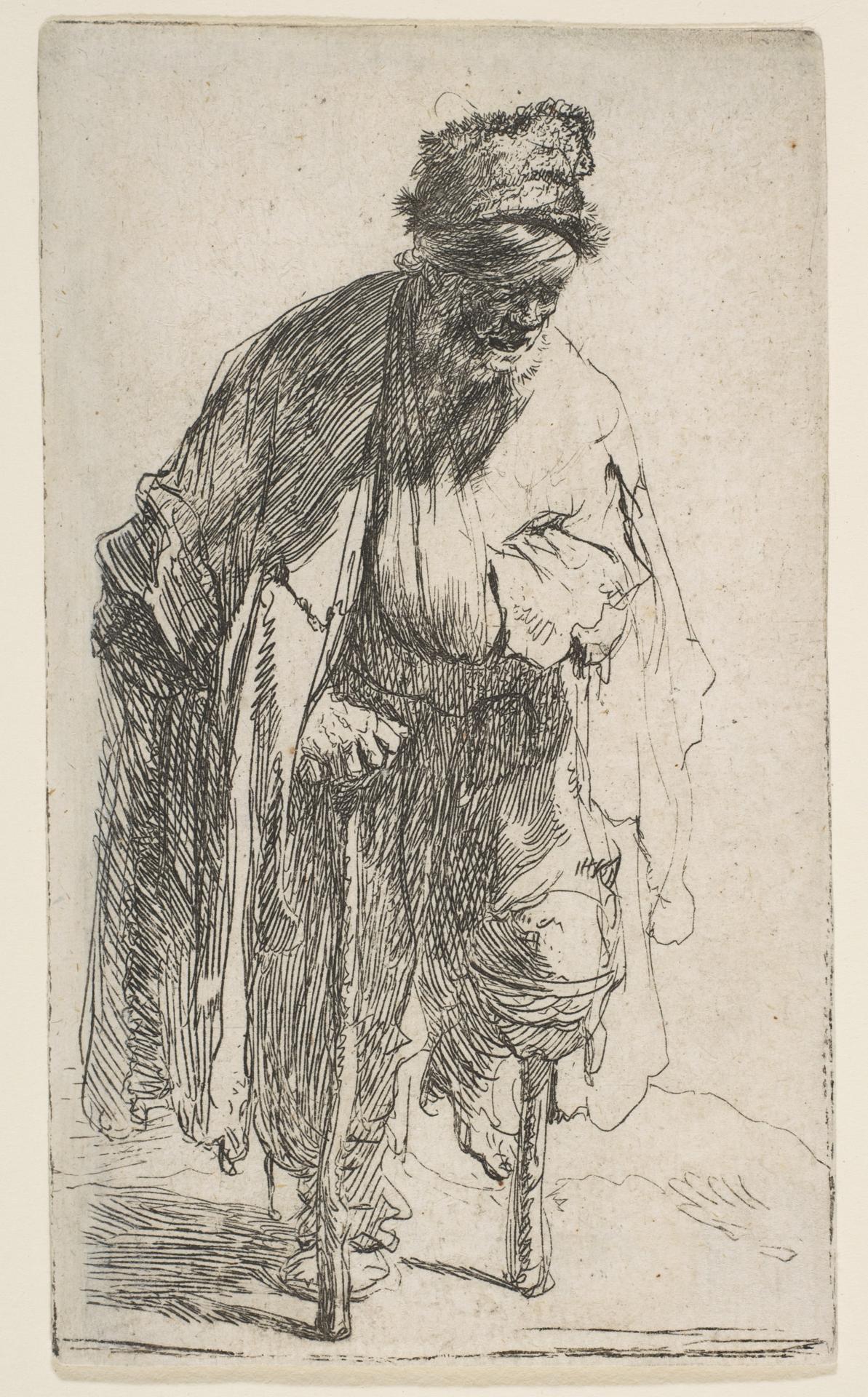
Beggar with a Wooden Leg (ca. 1630, Met-Objekt 5122)
Original title: Beggar with a Wooden Leg
kurzbeschreibung
Around 1630, Rembrandt van Rijn etched a lone beggar in worn, tattered clothing whose right leg has been replaced by a wooden prosthesis. The sheet belongs to a series of beggar figures and reveals, early on, the artist's interest in people living at the margins of society.
Description
A single figure in a cap, torn jacket and trousers commands attention at once, standing dead center. The wooden leg is sharply outlined; the body leans on a stick that rests on the ground. Everything around the man stays blank, so the eye has nowhere to wander but back to him. Line weight shifts from passage to passage, now thickening over the fabric of the clothes, now tightening along the edge of the prosthesis. Greys dominate, and the light falls evenly, avoiding hard shadows.
Context
In the years around 1630 Rembrandt turned more and more to beggars and other social outsiders. Subjects of this kind were common in seventeenth-century Dutch art and dealt with social reality as much as with moral questions. This particular sheet is an etching and survives in the first of four known states.
Impact
The beggar meets the viewer directly, close and precisely observed. Because the figure stands isolated, with so little space around him, the gaze concentrates on him alone, and the mood settles into something quiet and thoughtful.
Technique
For this etching the lines were incised into an etched plate and then printed on paper. Varying the thickness of the strokes produces gradations of grey and gives the image a sense of sculptural depth. The sheet measures 11.4 × 6.7 cm and represents the first of four states.
AI-generated description text
Source: Metropolitan Museum of Art · Public Domain (CC0 1.0)