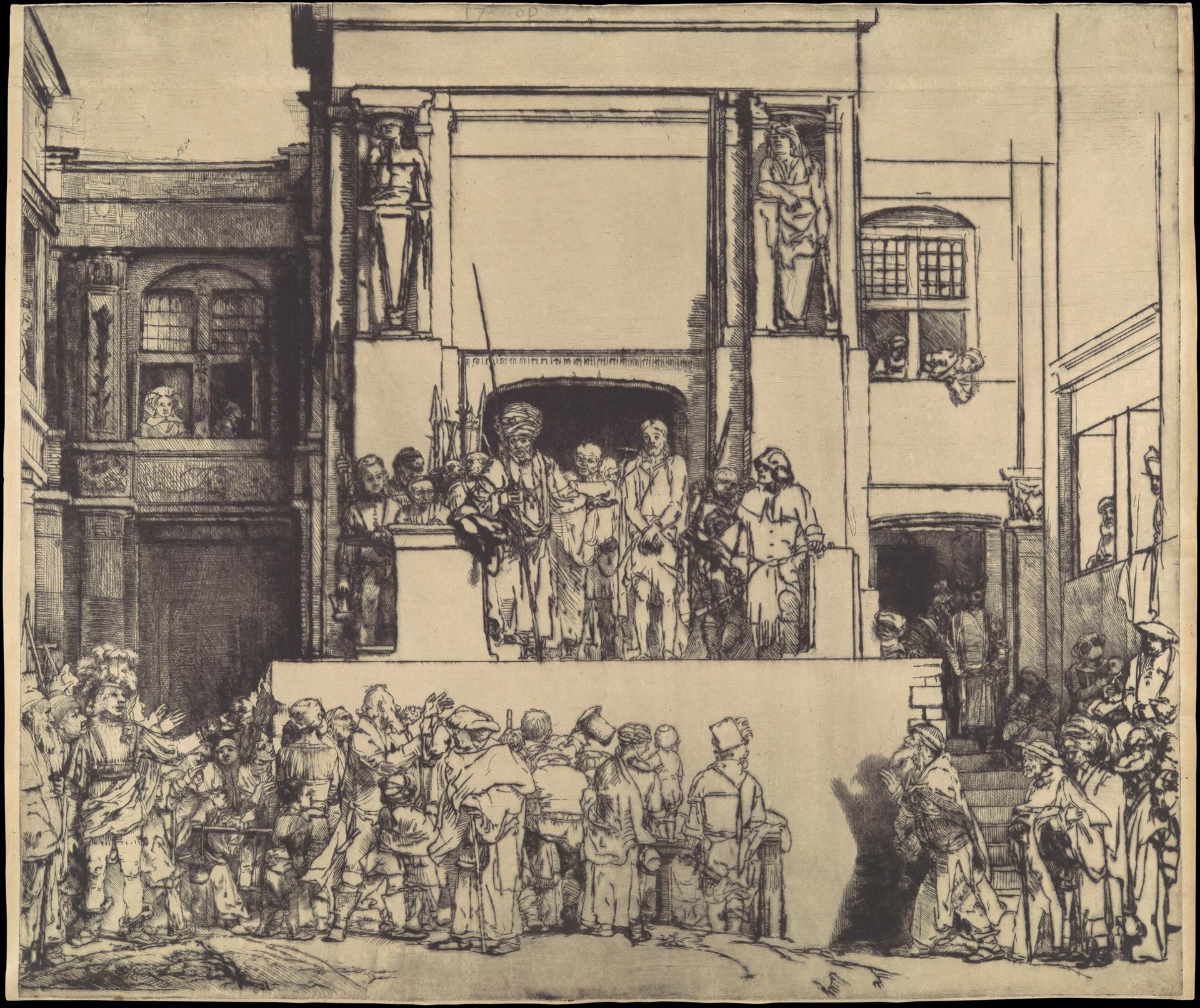
Christ Presented to the People (1655, Met-Objekt 5119)
Original title: Christ Presented to the People
kurzbeschreibung
Unlike many Passion depictions that isolate the moment of condemnation, Rembrandt's 1655 drypoint embeds the presentation of Christ before Pilate in a dense crowd. The artist takes up a motif from the Passion story and translates it into his own printmaking, setting the scene amid a press of people rather than against a blank backdrop.
Description
A crowd throngs a public square; behind it rises a building with columns and statues. A figure on a platform—likely Christ—steps forward while those around him partly watch, partly react. Figures and architecture are closely observed and rendered in gray tones. Light falls evenly, with no harsh shadows, so contours stand out.
Context
The sheet belongs to Rembrandt's late period, when he engaged deeply with printmaking techniques. It is the eighth and final state of the etching, suggesting prolonged work on the plate. The artist was known for biblical scenes; often he brought human emotions and social tensions into focus. Drypoint allowed him fine lines and a soft tone, which he employs here.
Impact
A dense, almost theatrical mood draws the viewer into the biblical event. The even lighting and delicate lines create a calm yet tense atmosphere that emphasizes the tragedy of the moment.
Technique
In drypoint, a needle scratches directly into the copper plate, leaving soft, velvety lines. This is the eighth of eight states, meaning Rembrandt reworked the plate multiple times. The sheet measures 35.6 x 45.5 cm and is printed on paper.
AI-generated description text
Source: Metropolitan Museum of Art · Public Domain (CC0 1.0)