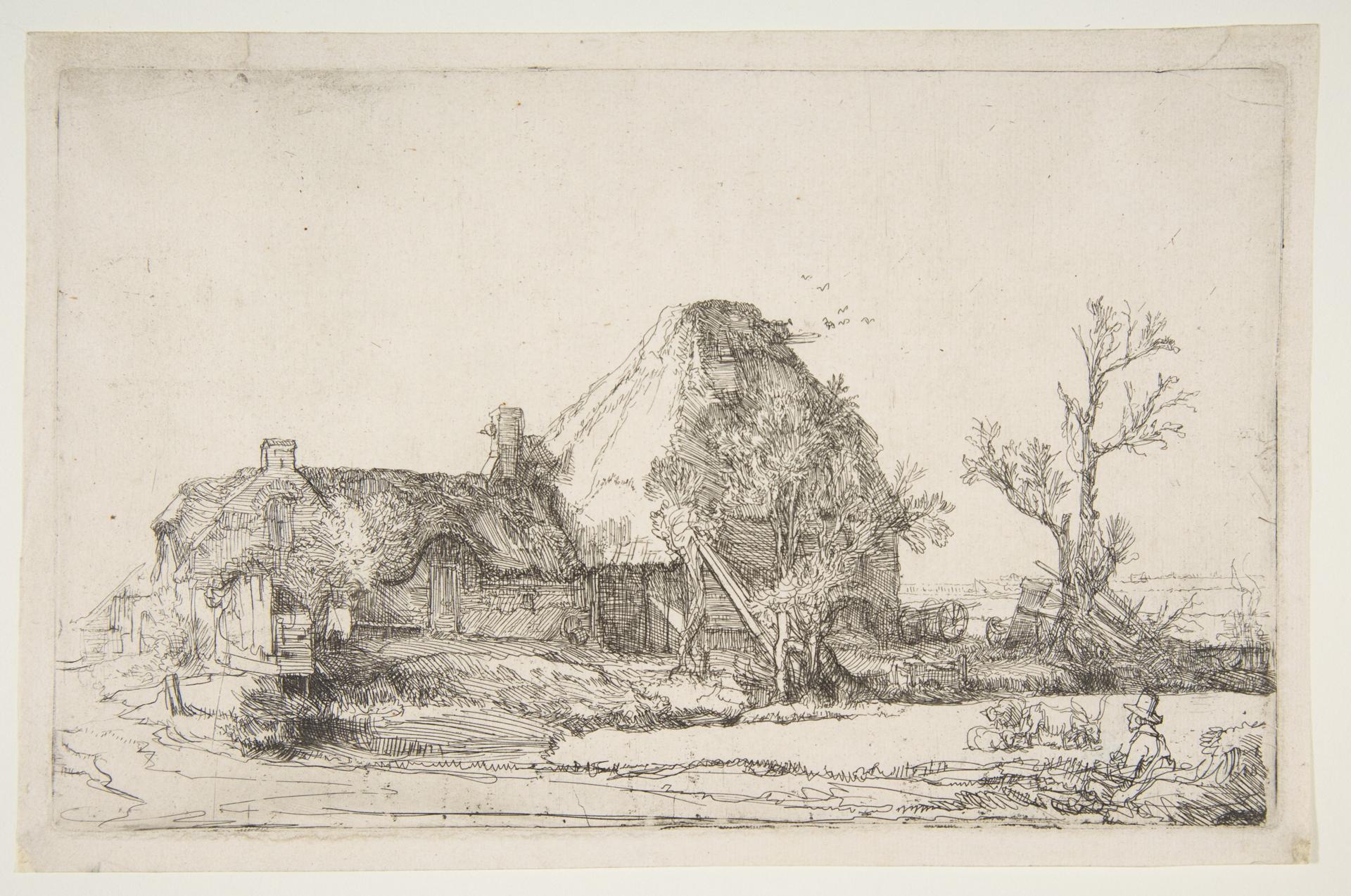
Cottages and Farm Buildings with a Man Sketching
Original title: Cottages and Farm Buildings with a Man Sketching
kurzbeschreibung
Rembrandt made this etching around 1645: a rural view with a thatched farmhouse, outbuildings, and a man seated on the ground in the foreground, drawing. It is an etching on paper, measuring 13 x 21 cm.
Description
A large thatched farmhouse dominates the near ground, with a smaller structure beside it, likely a stable or barn. To the right stands a single tree with sparse foliage, while further back more buildings and a second tree come into view. In the lower left a man crouches, apparently drawing or sketching. Grass and shrubs cover the ground, and the light falls evenly, without harsh shadows. The etching needle has teased out structures and details in thin lines.
Context
This etching belongs to the years around 1645, when Rembrandt turned increasingly to landscape. Modest farmhouses were a popular subject in seventeenth-century Dutch art and spoke of an interest in country life. The print was made in Amsterdam, where Rembrandt had a printing press at his disposal and could circulate his graphic work in larger numbers. It takes its place in a series of landscape etchings that demonstrate his skill in the technique.
Impact
A calm, idyllic mood settles over the sheet, helped by the even light and the careful rendering of the rural buildings. The drawing man in front lets the viewer share in the act of sketching, as though belonging to the scene. Thin lines and the precise description of straw and wood give things an almost tangible surface and bring closeness to nature to the fore.
Technique
For the etching, a copper plate was bitten with acid, inked, and printed on paper. The lines of varying thinness attest to Rembrandt's sure handling of needle and acid, translating straw, foliage, and masonry into different textures. This sheet is a state impression and shows the depth and richness of detail typical of Rembrandt's etchings.
AI-generated description text
Source: Metropolitan Museum of Art · Public Domain (CC0 1.0)