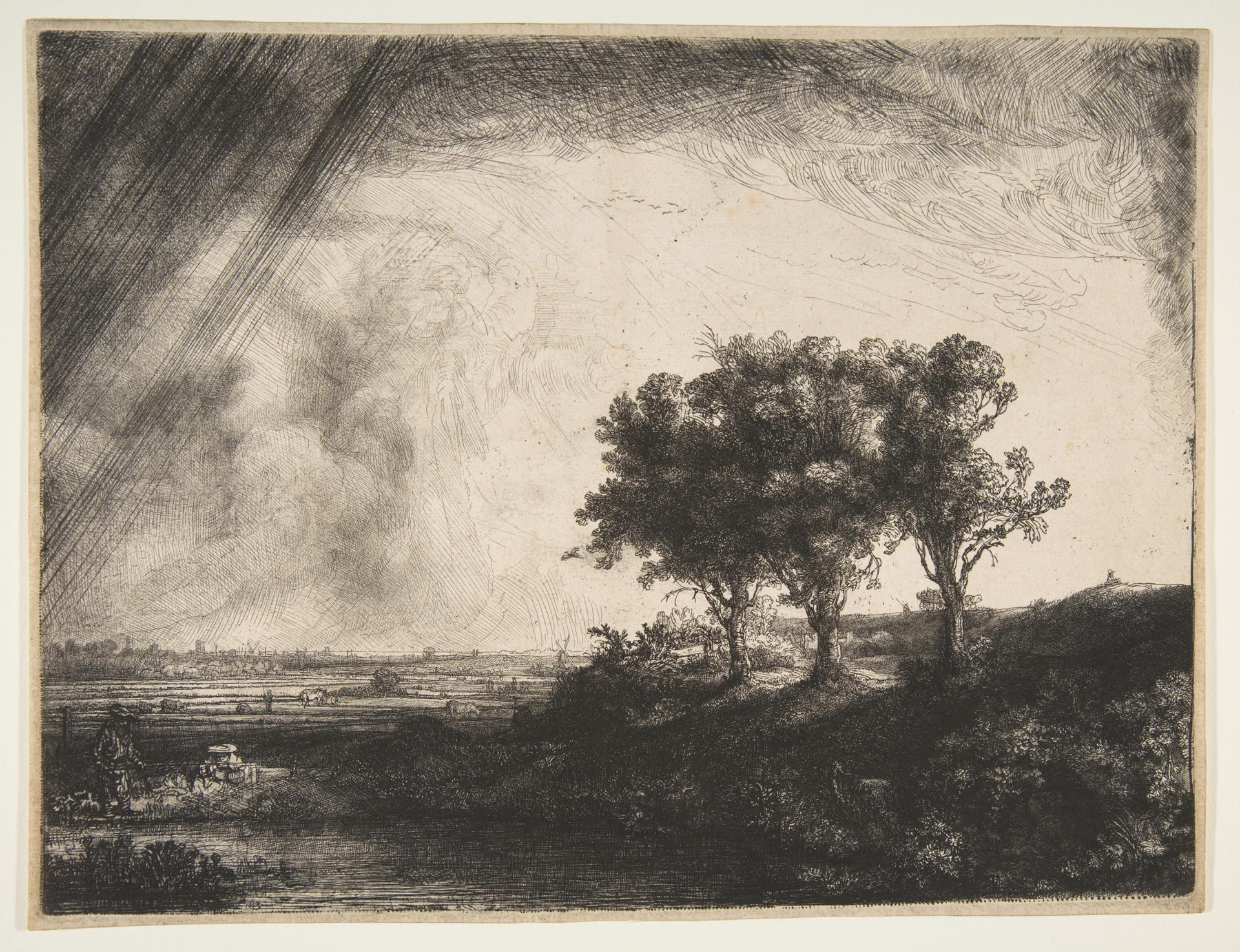
The Three Trees
Original title: The Three Trees
kurzbeschreibung
Rembrandt made this etching, Die drei Bäume, in 1643, combining etching, engraving and drypoint on one plate. An open stretch of country fills the view, and three striking trees rise from the foreground. Among his landscape prints, this sheet is one of the best known.
Description
Three trees with dense foliage stand on a low rise in the foreground. Beyond them the eye travels across fields and a windmill toward the distance. Heavy, rain-laden clouds dominate the sky, though isolated shafts of light break through. The arrangement runs horizontally, the trees holding the middle while the horizon sits far back. Lighting feels somber and atmospheric; the trees' shadows and the dark clouds deepen that impression.
Context
Around 1643 Rembrandt turned to landscape with particular intensity. The print was made in Amsterdam, where he had lived and worked since 1631. Echoes of seventeenth-century Dutch landscape painting are visible, a tradition that often recorded real terrain around Amsterdam. Few of his landscape etchings capture so dramatic a mood of weather.
Impact
A gloomy yet magnetic atmosphere comes off the sheet and draws the viewer into the landscape. Dark clouds and piercing rays of light build a dramatic tension. The wealth of detail invites lingering and shows Rembrandt's skill at rendering mood.
Technique
Rembrandt combined etching, engraving and drypoint to obtain fine lines and hatching. With the drypoint he achieved soft, velvety effects that appear above all in the clouds and shadows. The work was made on a copper plate and printed in several states; this impression is notable for its especially rich tonality.
AI-generated description text
Source: Metropolitan Museum of Art · Public Domain (CC0 1.0)