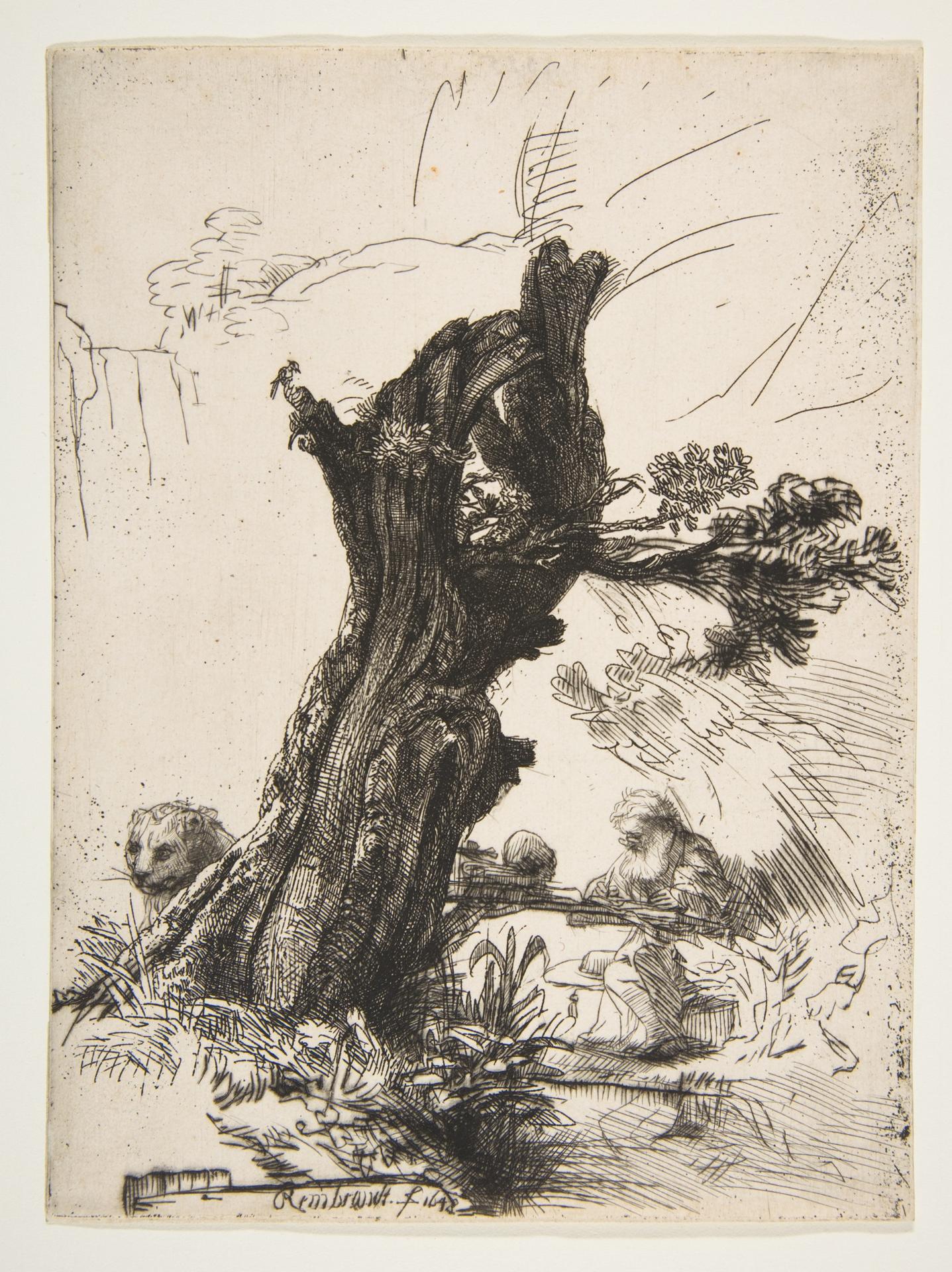
St. Jerome beside a Pollard Willow
Original title: St. Jerome beside a Pollard Willow
kurzbeschreibung
Hieronymus, wholly absorbed in a book, sits in a landscape — that is what the 1648 print presents. Rembrandt executed it as an etching with drypoint, in the fourth of four states.
Description
Out in the open, the saint reads. Beside him rises a massive, irregularly grown pollard willow. A lion lies on the ground close to the tree, and on the trunk another animal head can be made out, possibly a wolf. Behind, a landscape with mountains and clouds opens up, drawn with movement and a touch of disorder. The layout is asymmetrical, with the tree holding the center of the image.
Context
The print was made in 1648, a time when Rembrandt was working intensively in printmaking after completing the 'Hundred Guilder Print'. Seventeenth-century artists often took up Jerome because he unites scholarship and penance. In the fourth state, reworkings in drypoint were added that strengthen the lighting. A saint in the open air matched the era's taste for landscape devotional images.
Impact
A finely balanced relationship holds between the quiet reading scene and the large landscape. The vigorous lines of the willow and the soft shading produce a calm, reflective mood. Light draws the eye to the book and to the saint's face, bringing out the contemplative quality.
Technique
Etching and drypoint are combined here, with drypoint in the later states providing deeper blacks and gentler transitions. Varied, fine lines and hatching shape the bodies and create a dense texture. At 17.7 x 13.1 cm, the print remains a small, intimate format.
AI-generated description text
Source: Metropolitan Museum of Art · Public Domain (CC0 1.0)