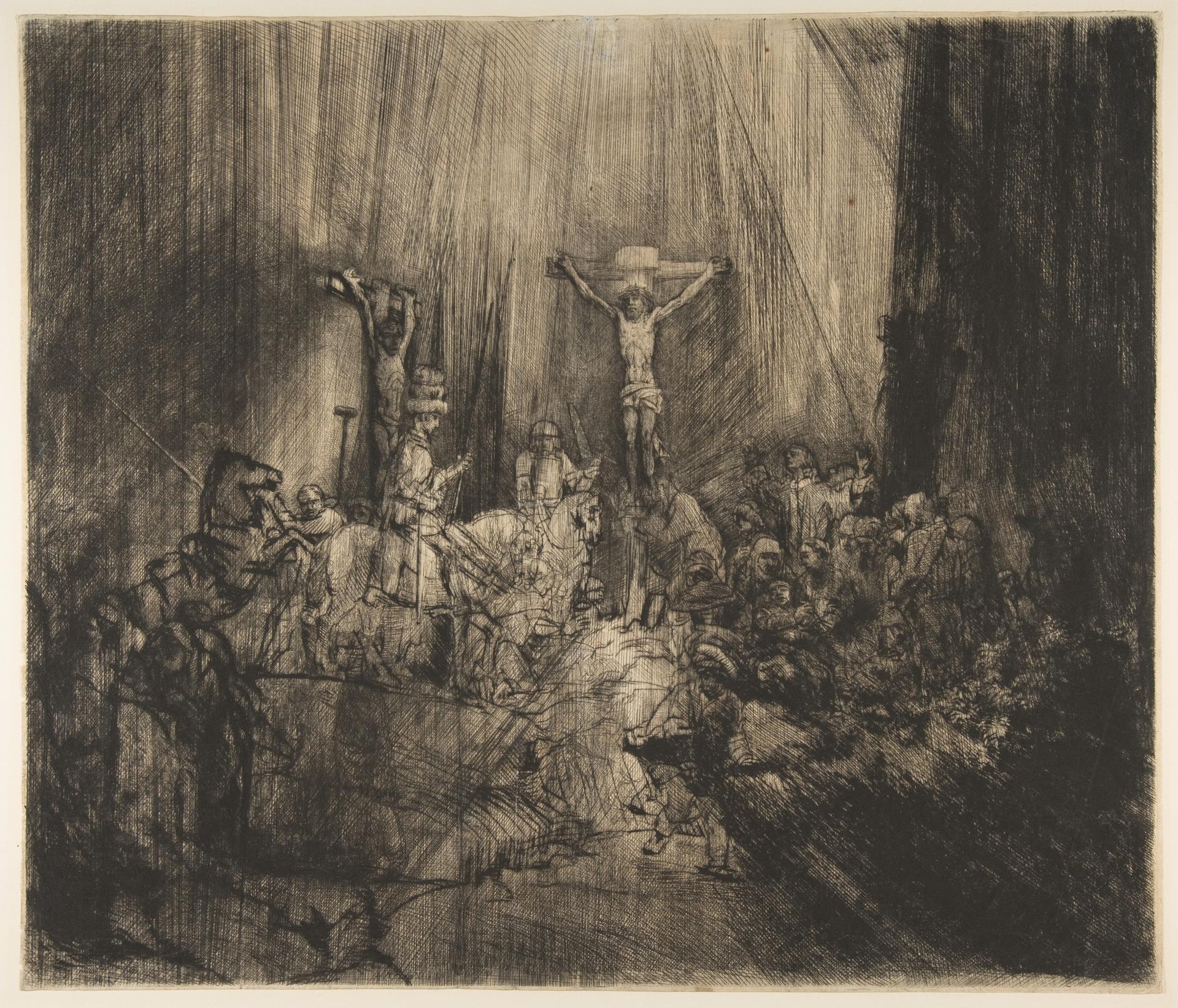
Christ Crucified between the Two Thieves: The Three Crosses (1653, Met-Objekt 5111)
Original title: Christ Crucified between the Two Thieves: The Three Crosses
kurzbeschreibung
Where many crucifixions of the period isolate the three condemned figures against an empty sky, Rembrandt's "The Three Crosses" of 1653 sets them inside a dense, pressing crowd. He made the sheet as a drypoint on vellum, and it numbers among his best-known prints.
Description
Christ hangs at the center of the image, the two thieves to his right and left. Around the event a crowd of people gathers, among them armored horsemen carrying weapons. Light falling from above picks out the outlines of the figures and the wooden beams of the crosses. Everything stays in shades of gray, the contours sharp, the lines detailed.
Context
Rembrandt was working in Amsterdam in 1653, in a phase of intense experimentation with printmaking. Using vellum for a drypoint was unusual at the time and shows his search for new means of expression. In these years he turned increasingly to religious subjects and to rendering their emotional weight. The sheet is considered a high point of his printed work and went through several revisions.
Impact
The crowded arrangement of the figures and the dramatic light produce an urgent, almost threatening mood. The delicate lines and the soft tone of the vellum give the print depth and a certain intimacy. The scene feels immediate and raw, which brings out the tragedy of the crucifixion.
Technique
In drypoint the lines are scratched directly into the copper plate, which yields a soft, velvety impression. For this print Rembrandt used vellum instead of paper, making the tonal values stronger and the details finer. At 38.1 by 43.8 cm, the plate is unusually large for an etching of that era.
AI-generated description text
Source: Metropolitan Museum of Art · Public Domain (CC0 1.0)