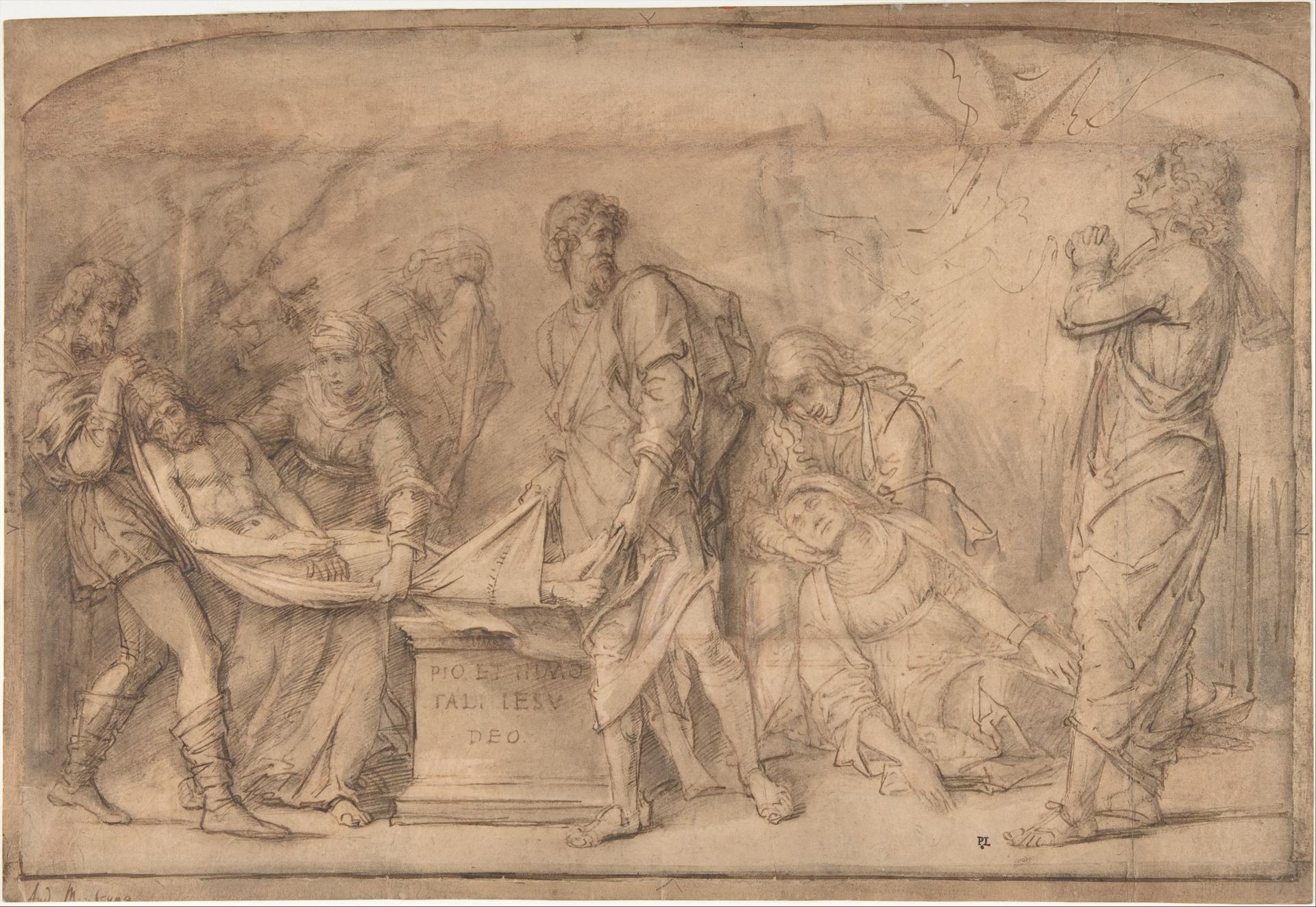
The Entombment, after Mantegna
Original title: The Entombment, after Mantegna
kurzbeschreibung
Rembrandt van Rijn made this drawing, The Entombment, after Mantegna, in the 17th century. It presents the burial of Christ in a crowded scene that derives from a model by Andrea Mantegna. The sheet is executed in pen and brown ink, with brush and brown wash, over red chalk, and heightened with white.
Description
A group of figures has gathered around the body of Christ, which lies on a sarcophagus. They wear classicizing garments, a sign of engagement with Mantegna's art. The layout is symmetrical, with the sarcophagus as the focal point. Brown tones and gray predominate, created by the interplay of brown wash and red chalk. Diffuse light emphasizes the contours of the figures and the sarcophagus.
Context
The drawing dates from the 17th century and was probably made as a free copy after an engraving or other reproduction of Andrea Mantegna's painting of the Entombment of Christ. Mantegna's work circulated in Northern Europe mainly through prints, which likely served Rembrandt as a model. Rembrandt engaged intensively with Italian art throughout his life, adopting motifs and developing them independently. The sheet is dated to the 1640s to 1650s, a period when Rembrandt increasingly experimented with washed pen drawings.
Impact
Quietly and symmetrically arranged, with muted color, the sheet feels solemn and serious. The soft washes and delicate white heightening create a silent drama. The realistic style with classicizing drapery gives the scene a timeless, classical air.
Technique
The sheet was executed with pen in brown ink and brush in brown wash over an underdrawing in red chalk. White heightening sets individual accents of light. This combination of washing and drawing technique is characteristic of Rembrandt's working method in this phase of his career.
AI-generated description text
Source: Metropolitan Museum of Art · Public Domain (CC0 1.0)