Study for a Pietà
Original title: Study for a Pietà
kurzbeschreibung
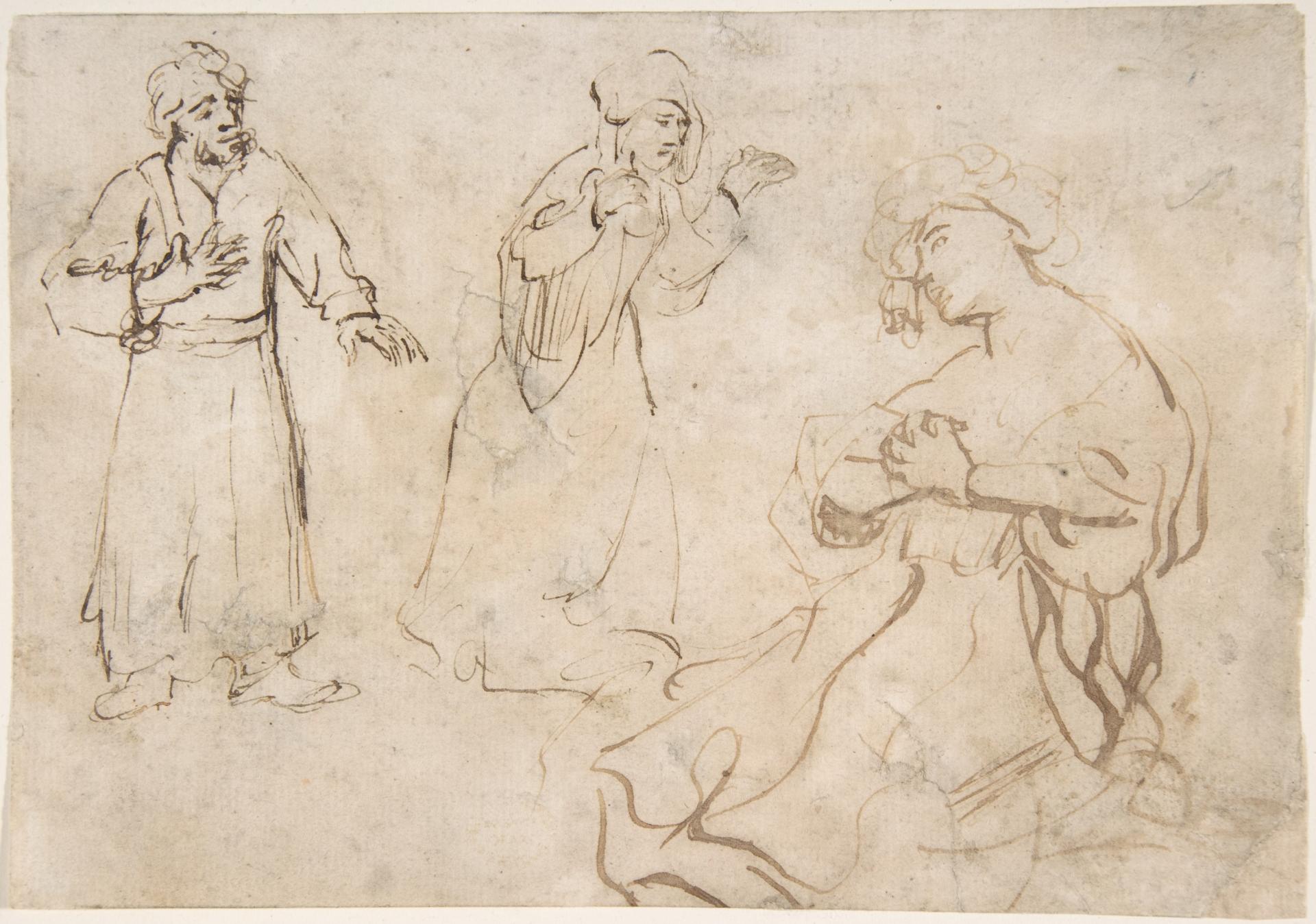
This pen drawing by Rembrandt van Rijn, made between 1606 and 1669, brings together three figures in different poses. It takes the motif of a Pietà—the grieving Mary with the dead Christ—as its starting point, but remains a sketchy grouping of figures.
Description
Three figures appear in brown ink on paper. On the left, a man places his hand on his chest and looks thoughtful. A woman with a head covering raises her arms in the middle, as if to highlight something. On the right, a man leans forward and points with one hand to his own chest. The garments look traditional and historical, and there is no background or setting at all.
Context
Many of Rembrandt's drawings served as preparations for larger paintings or etchings, often with biblical subjects. The Pietà is one of the core motifs of Christian art and deals with Mary's grief over the dead Christ. Whether this sheet actually preceded a larger arrangement cannot be proven with certainty. Rembrandt was known for making emotions tangible through gesture and posture, and that is exactly what comes to the fore here.
Impact
A few lines and deliberately placed gestures give the sheet a direct, expressive presence. The different poses create a tension that draws the viewer into the action, even though everything remains only suggested.
Technique
The sheet is executed in pen and brown ink on paper, as is typical of Rembrandt's drawing style. The strokes run fluently and sketchily; fine contours and hatching suggest volume. At approximately 12.1 x 17 cm, the format corresponds to that of a study and leaves room for quickly capturing ideas.
AI-generated description text
Source: Metropolitan Museum of Art · Public Domain (CC0 1.0)