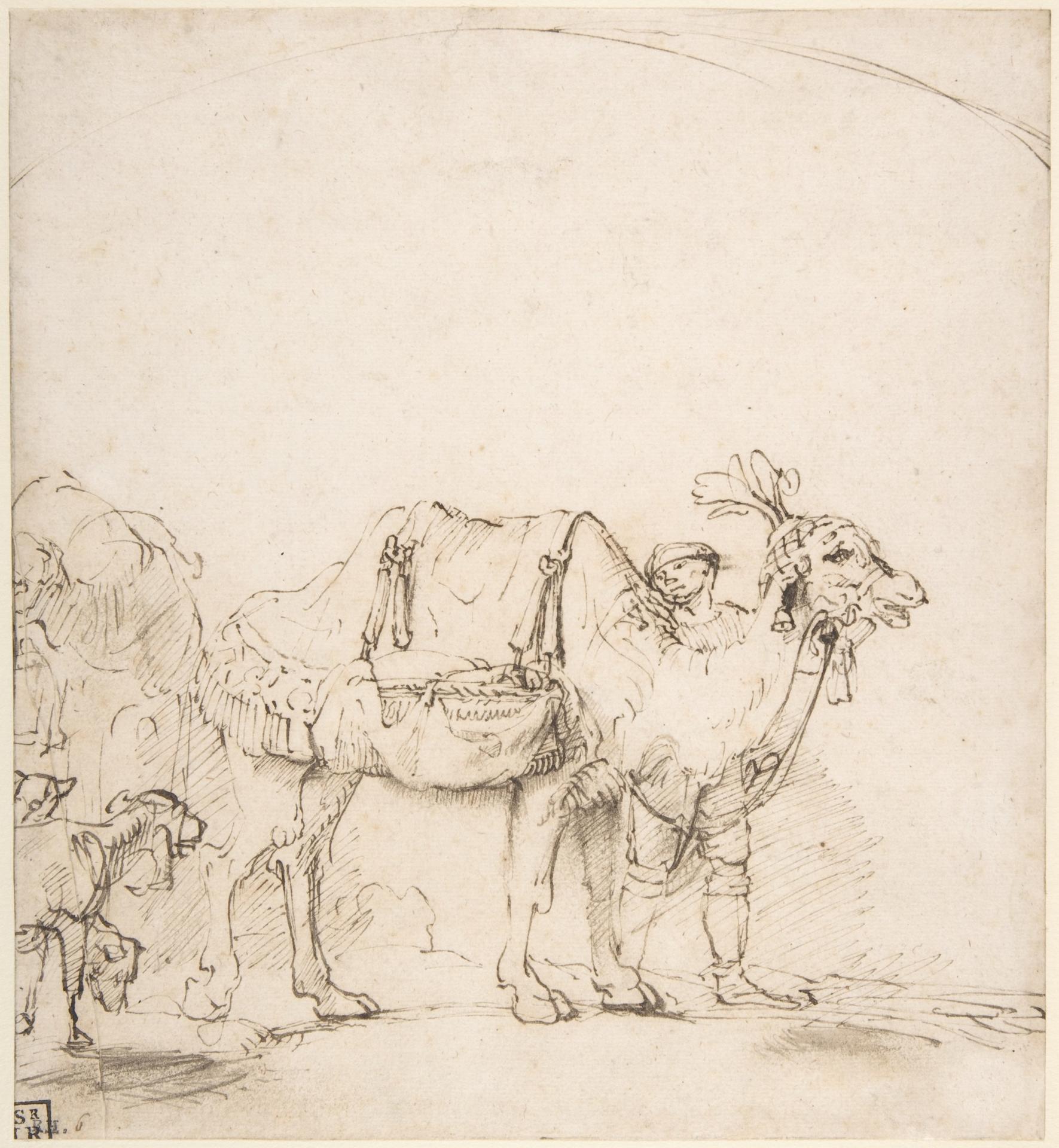
Man Leading a Camel
Original title: Man Leading a Camel
kurzbeschreibung
A man wearing a headscarf leads a loaded camel — Rembrandt (Rembrandt van Rijn) captured this scene in pen and brown ink between 1650 and 1669. Behind the pair, other camels and people carrying loads appear. The sheet measures 20.5 x 18.9 cm.
Description
In the foreground, a simply dressed man leads a camel by a rope; the animal carries a tightly secured load. Further back, additional camels and figures with baggage can be made out. The arrangement stays plain and brings man and beast into view in natural poses. Even light emphasizes the outlines.
Context
The drawing dates from Rembrandt's later career, roughly 1650 to 1669. As a study sheet, it likely relates to the orientalizing motifs that were in demand in the seventeenth-century Netherlands. In Amsterdam, Rembrandt could study exotic objects and animals — camels were shown there as attractions.
Impact
A few lines and a calm layout give the sheet something immediate and lively. The relaxed posture of both man and animal makes an everyday encounter palpable, while the exotic subject adds fascination.
Technique
The drawing is executed with pen in brown ink; traces of brush and brown wash are also present. It is on paper. The linework reflects Rembrandt's spontaneous, expressive hand.
AI-generated description text
Source: Metropolitan Museum of Art · Public Domain (CC0 1.0)