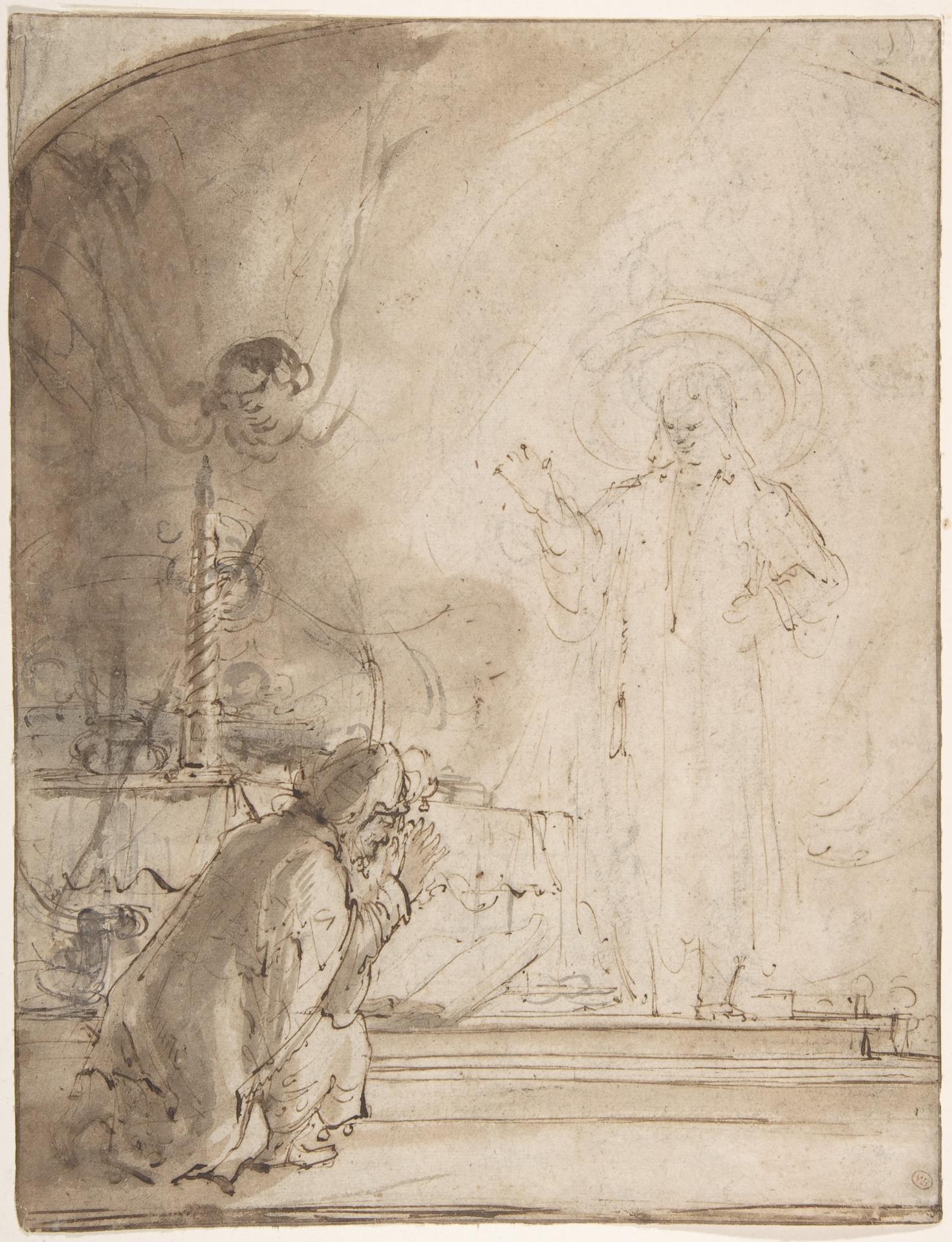
Zacharias and the Angel
Original title: Zacharias and the Angel
kurzbeschreibung
Rembrandt's drawing "Zacharias and the Angel" (1606–1669), made in the mid-17th century, differs from related depictions in the veiled figure of Zacharias. The sheet shows the biblical encounter with the angel Gabriel, executed in pen and brown ink, supplemented by brush wash and traces of black chalk. It measures 26 x 20 cm.
Description
Unlike many comparable works, Rembrandt places Zacharias in the lower left corner: he kneels in simple, rustic garments, his face covered by a veil. Gabriel stands in the middle, wrapped in a long, flowing robe, with a luminous halo and raised hand. A column and a window through which light falls structure the background. Diffuse light creates a sacred, mystical atmosphere; the palette remains predominantly in brown tones, produced by ink and brushstrokes.
Context
The sheet is considered an autograph work by Rembrandt from his mature period, when he devoted himself intensively to biblical themes. It belongs to a group of pen and ink drawings made for his own use or as studies. The exact dating is uncertain; workshop practice suggests a date around 1650–1660. The Annunciation to Zacharias is common in Christian iconography, but Rembrandt's depiction with a veiled face deviates from it.
Impact
An intimate, contemplative mood pervades the sheet, evoked by the diffuse light and the calm arrangement. Finest pen drawing and soft brush wash combine to create particular depth and liveliness. The viewer is drawn into the scene and experiences the encounter between human and divine directly.
Technique
Rembrandt worked with pen and brown ink, which he supplemented with brown brush wash for light and shadow effects. Indications of black chalk suggest a preparatory sketch that was reworked with ink. This mixed technique is typical of his drawing style: quick, expressive strokes and fluid transitions define the sheet.
AI-generated description text
Source: Metropolitan Museum of Art · Public Domain (CC0 1.0)