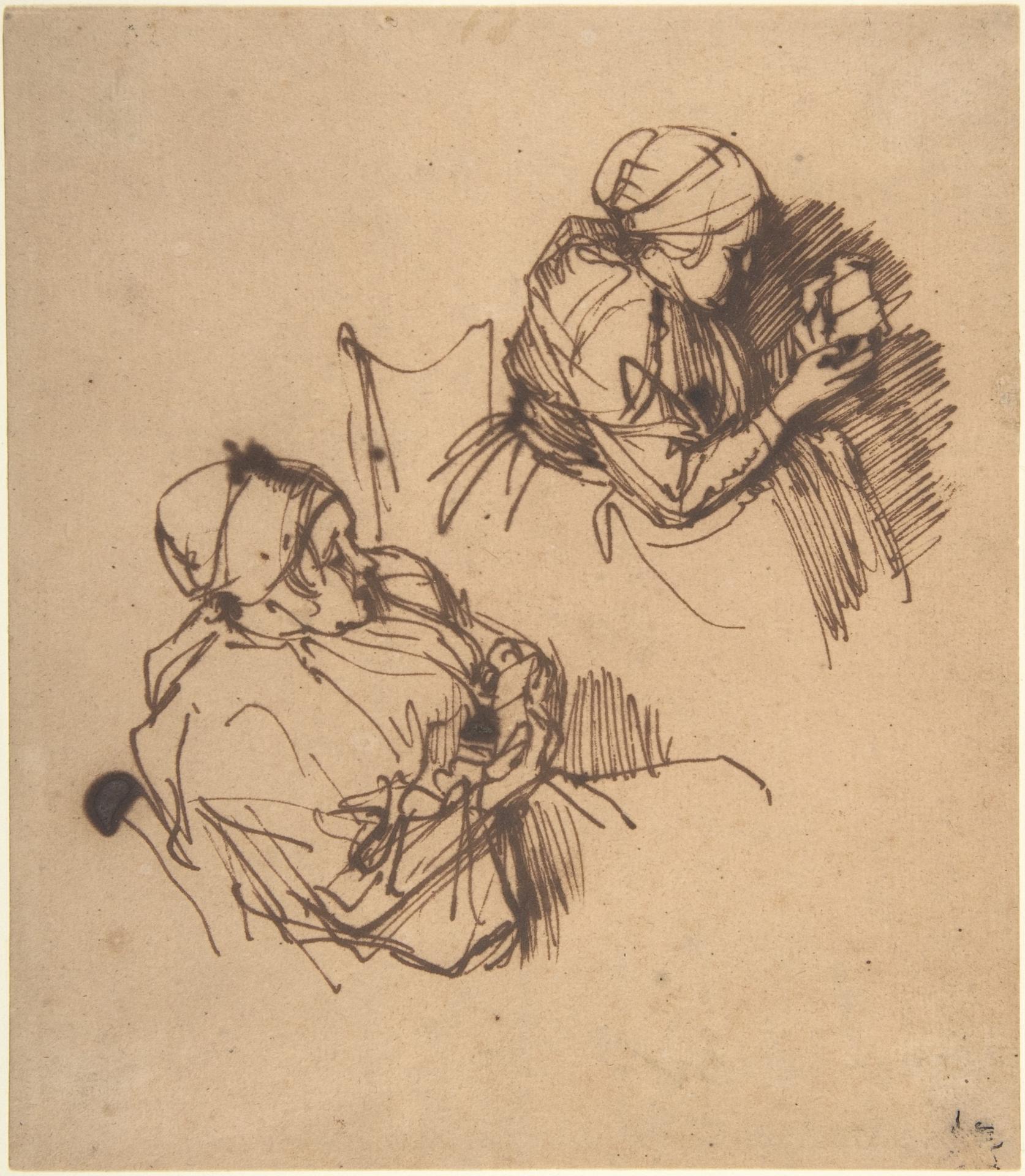
Two Studies of a Woman Reading
Original title: Two Studies of a Woman Reading
kurzbeschreibung
Rembrandt van Rijn drew 'Two Studies of a Woman Reading' between 1635 and 1640 with a pen in brown iron-gall ink. The sheet captures a woman in two moments of reading—once from behind, once in profile—and thus illustrates Rembrandt's fondness for intimate scenes of everyday life.
Description
In the upper sketch the woman appears from behind; she holds a book and reads, her hair tied in a knot and covered by a cloth. The lower view shows her from the side, leaning against a cushion, also reading, her face in gentle profile. Both studies are executed in a loose, sketchy manner with mostly horizontal strokes. The paper remains monochrome, without special color or light effects. The style corresponds to Baroque drawings that emphasize movement and expression.
Context
The sheet was made during Rembrandt's Amsterdam years, when he often drew scenes of daily life and figure studies. The reading woman was a common motif in seventeenth-century Dutch art and was frequently associated with virtue and domestic idyll. The drawing presumably served as a preliminary study for larger paintings or etchings, with Rembrandt testing various poses and angles. Such working sheets were typical of his practice for investigating movements and postures.
Impact
A quiet, private atmosphere surrounds the sheet and draws the viewer into the reading scene. The sketchy, almost fleeting linework feels immediate and spontaneous, while the two views create a sense of movement. Because everything inessential is omitted, the woman's posture and concentration come to the fore.
Technique
Pen and brown iron-gall ink—a drawing material common at the time—allowed fine lines and shading. The horizontal strokes and the loose handwriting reveal a quick, assured working method characteristic of sketches. The small paper format suggests an intimate, personal study.
AI-generated description text
Source: Metropolitan Museum of Art · Public Domain (CC0 1.0)