Susanna
Original title: Susanna
kurzbeschreibung
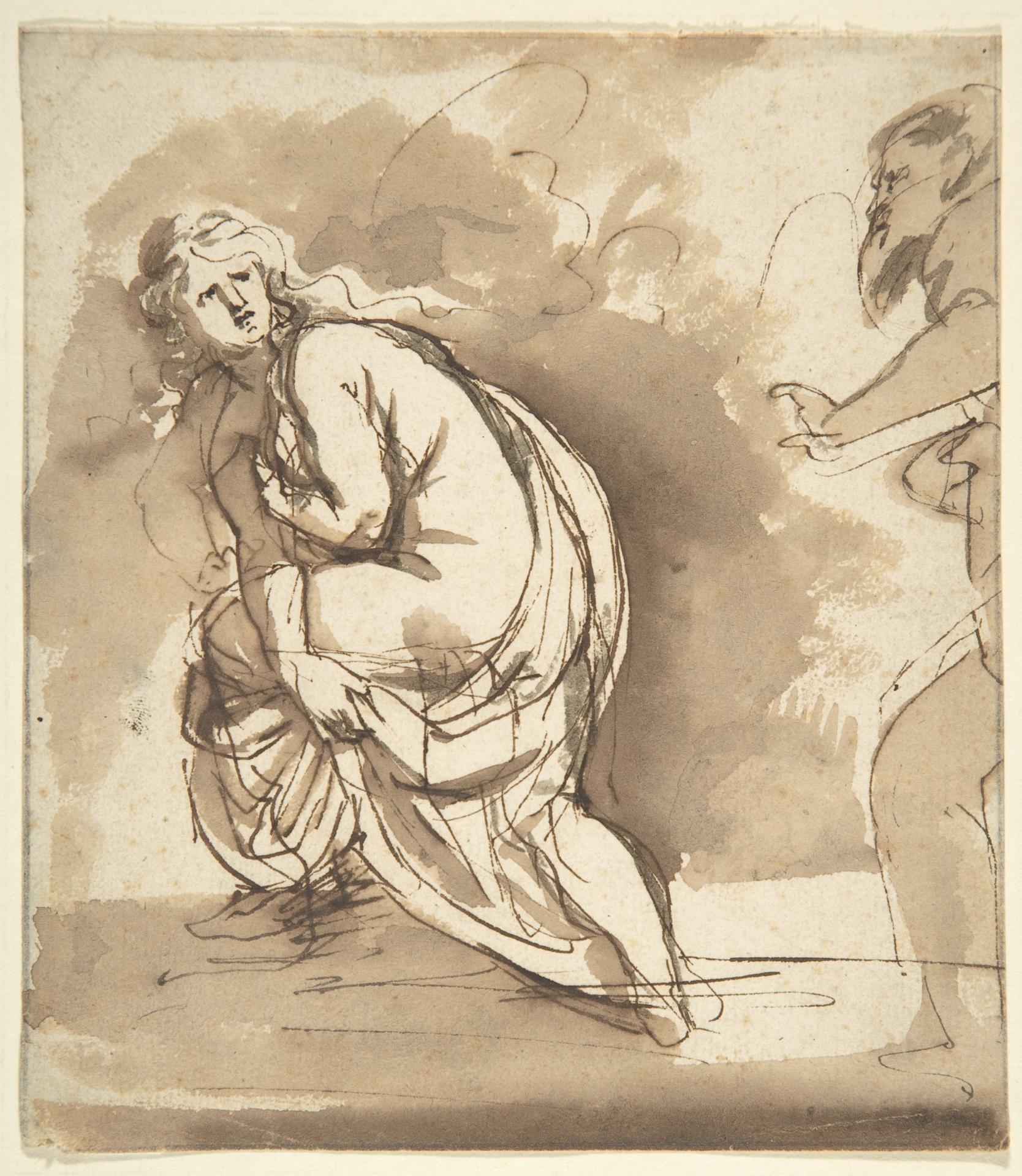
A seated woman, lost in thought, with only a faint suggestion of a second figure beside her — this is how Peter Paul Rubens's drawing "Susanna" presents itself. The sheet is executed in pen and brown ink, with additions in brush and brown wash. It was probably made between 1610 and 1620, when Rubens's work was at its peak.
Description
Turned to the left, the woman sits with her garment falling loosely around her. Her upper body leans slightly forward, and her expression reveals thoughtfulness or worry. To the right, a second figure is hinted at only in flowing lines — there is a sense of movement in them. The background remains abstract, with loose strokes and shading. Brown tones dominate the sheet, giving it a historical aura.
Context
For his paintings, Rubens produced countless sketches and preparatory studies, often after biblical or mythological subjects. Susanna, who is accosted by two elders in the Old Testament, was a common motif in the Baroque. This drawing may have served as a study for a larger painting, although no direct counterpart survives. Rubens often used pen and wash to test the interplay of light and shadow.
Impact
The unconstrained, expressive linework makes the sheet appear immediate and spontaneous. From the seated figure and the suggested movement arises a palpable inner tension that holds the viewer's attention.
Technique
Pen and brown ink form the basis, then a brush with brown wash modeled the forms. In this way Rubens achieved both precise contours and soft tonal gradations. The paper measures only 17.5 x 15.2 cm — a format that suggests an intimate study.
AI-generated description text
Source: Metropolitan Museum of Art · Public Domain (CC0 1.0)