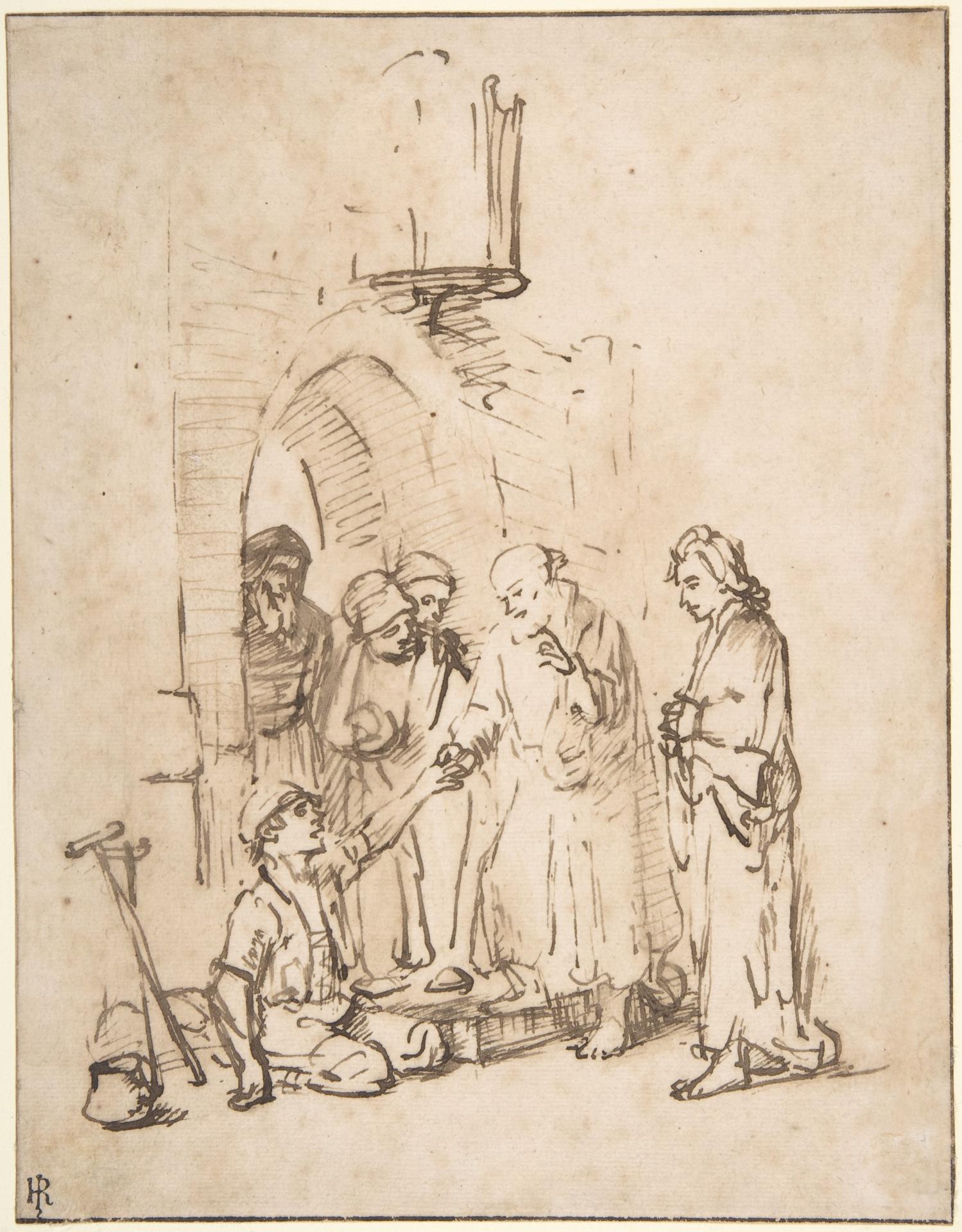
St. Peter and St John Healing the Paralytic
Original title: St. Peter and St John Healing the Paralytic
kurzbeschreibung
Drawn in the seventeenth century, this sheet by Rembrandt (1606–1669) captures the biblical moment when Peter and John heal a lame man. The artist worked in pen and brown ink together with brush and brown wash. This upright drawing measures 21.3 x 16.5 cm and belongs among his biblical studies.
Description
At the front a man kneels on the ground, looking up at a figure on a raised platform who reaches out a hand toward him. Behind them several figures appear in varied poses and with differing expressions. An interior with an open door and a window provides the setting. The drawing stays simple and sketchy, with mostly black lines on beige and grey paper. Light falling from above picks out the contours of the figures and the structure of the room.
Context
The sheet was made in the seventeenth century, when Rembrandt examined biblical subjects closely in drawings and etchings. The healing by Peter and John (Acts 3:1–10) was a familiar theme in Protestant art of the Netherlands. Rembrandt often used pen and ink with washes to test the effects of light and shadow. No precise date survives, since he frequently carried out such studies without adding a year.
Impact
The sketchy handling gives the sheet liveliness and immediacy. Because the drawing is reduced to lines and a few washes, the central encounter between the figures comes into focus. The handling of light creates a calm, concentrated mood that brings the miracle story forcefully to mind.
Technique
Rembrandt used pen and brown ink for the contours and details, adding shadowed passages with brush and brown wash. Framing lines in brown ink enclose the sheet. The paper has beige and grey tones, as is characteristic of his drawings.
AI-generated description text
Source: Metropolitan Museum of Art · Public Domain (CC0 1.0)