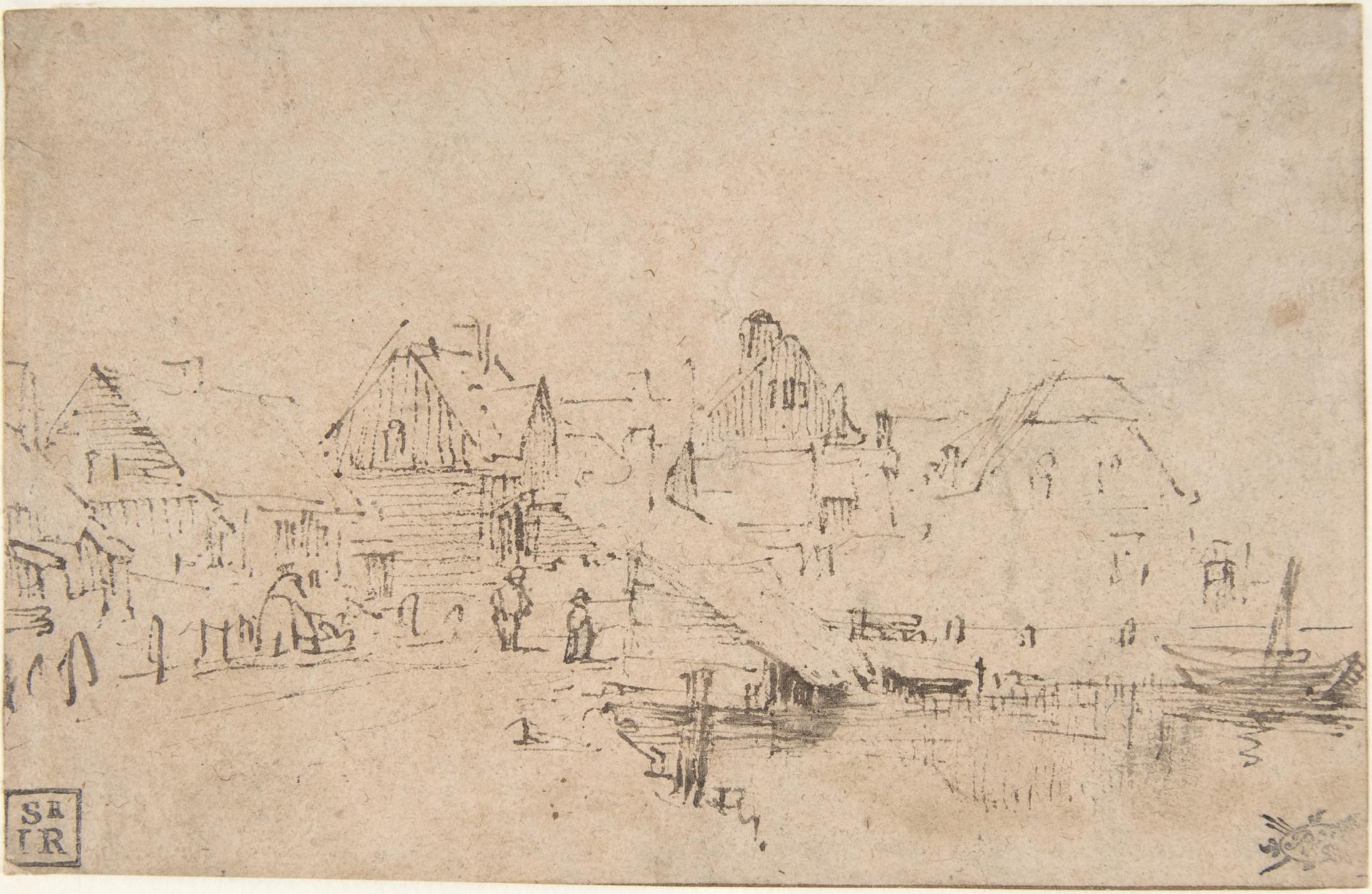
Houses by the Water
Original title: Houses by the Water
kurzbeschreibung
Around 1652, Rembrandt made the pen drawing 'Houses by the Water', which presents a tightly grouped cluster of houses beside a body of water. Executed in brown ink, the sheet measures 10 x 15.6 cm. It shows a view typical of Dutch landscape art, with buildings, a few staffage figures and a reflective water surface.
Description
The layout is horizontal: in the foreground, several closely neighbouring houses with different roof shapes press together, some tiled, others flatter. Before these buildings, individual figures stand or move about. The water surface in the foreground mirrors the buildings and people. Behind, further structures and a suggested sky appear. At lower left sits a signet with the letters 'SR' and 'IR'. Everything is drawn in brown tones, with thin, richly detailed strokes and without strong shadows or highlights.
Context
Around 1652 Rembrandt devoted himself more intensively to the Dutch landscape and its motifs; this sheet falls into that phase. Pen drawings of this kind were often made as studies from nature and could serve as models for etchings or paintings. Houses by water were a common theme in seventeenth-century Dutch art. The sheet belongs to a series of landscape drawings from the 1650s in which Rembrandt turned increasingly to nature.
Impact
The delicate strokes and evenly distributed light give the sheet a quiet, almost idyllic mood. The reflection and dense building create a sense of intimacy and everyday life. Because the colour is limited to brown tones, the drawing appears timeless and sketchily elegant.
Technique
The sheet was executed with pen in brown ink on paper; the lines are precise and detailed. Framing lines in the same technique are added. Material and approach correspond to Rembrandt's drawn work and allow a rapid, immediate grasp of the motif.
AI-generated description text
Source: Metropolitan Museum of Art · Public Domain (CC0 1.0)