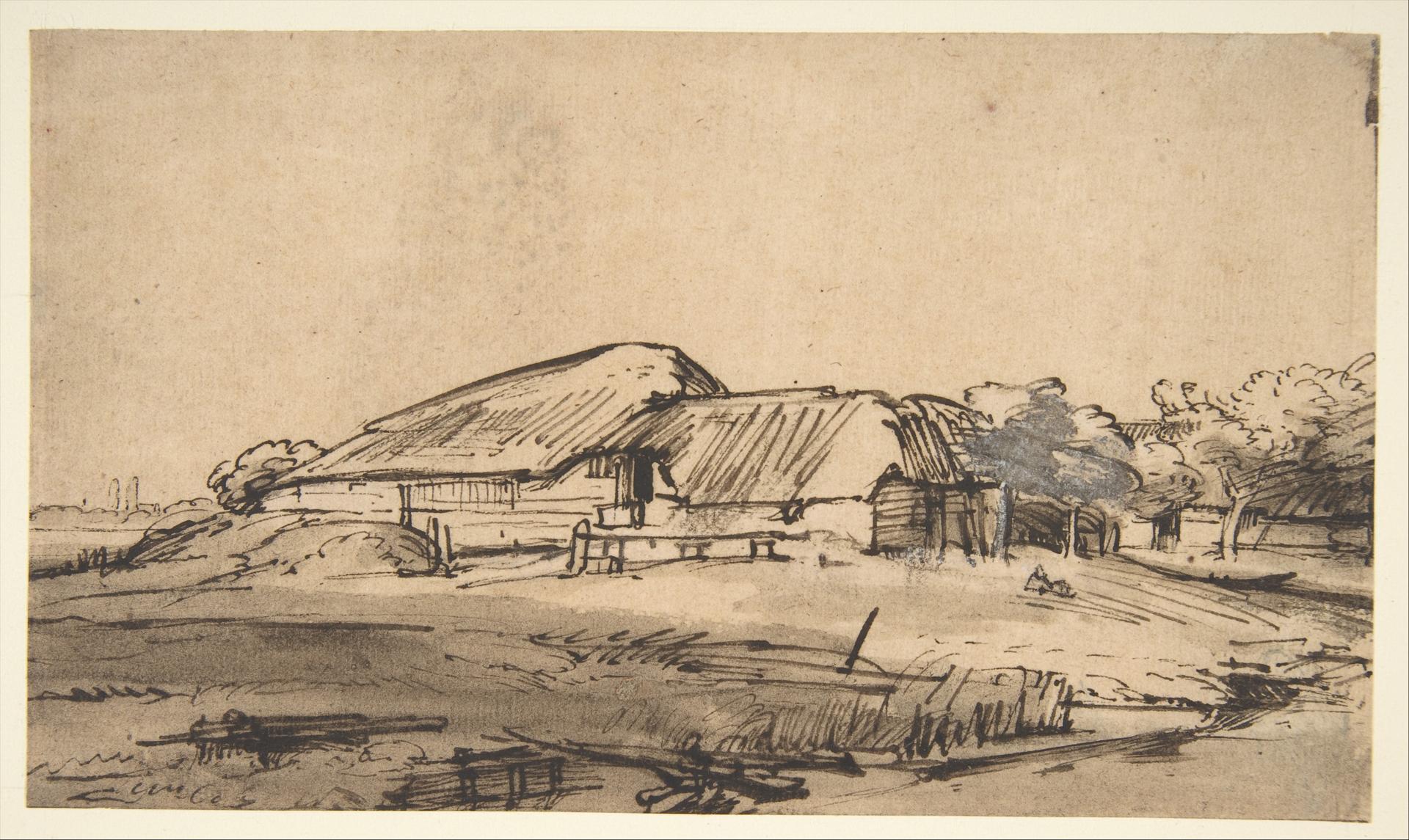
Group of Farm Buildings
Original title: Group of Farm Buildings
kurzbeschreibung
Pen and brown ink, brush and brown wash, with white gouache used for corrections — these are the means by which Rembrandt van Rijn captured a rural view of several farmhouses on brown-toned paper around 1648–52. The sheet, titled "Group of Farmhouses," belongs to his series of landscape studies.
Description
Steep, undulating roofs stagger into a loose row of farmsteads nestled among trees and shrubs. In the foreground a narrow watercourse, likely a brook or small river, winds through the image; behind it, sparse passages suggest further trees and an additional farm. Gentle lines and the muted brown tonality give the view a calm, almost peaceful character, while the prevailing browns emphasize its historical feel.
Context
The drawing dates from Rembrandt's later Amsterdam years, when he engaged deeply with landscapes. He often made such sketches on walks in the city's surroundings; they served as studies. Pen, ink, and gouache in this combination were common practice in the seventeenth-century Netherlands. The sheet joins a group of landscape drawings that attest to his interest in the natural environment.
Impact
A quiet, idyllic mood emanates from the sheet, transporting the viewer to the rural stillness of the seventeenth century. Fine pen lines and soft washes interlock, creating a harmonious, almost painterly impression. Because everything is reduced to brown tones, the image feels both nostalgic and timeless.
Technique
For contours and details Rembrandt used pen and brown ink; brush and brown wash set the shadows. White gouache was applied for corrections and to add highlights. The paper's brown base tone gives the entire arrangement a warm, unified color foundation.
AI-generated description text
Source: Metropolitan Museum of Art · Public Domain (CC0 1.0)