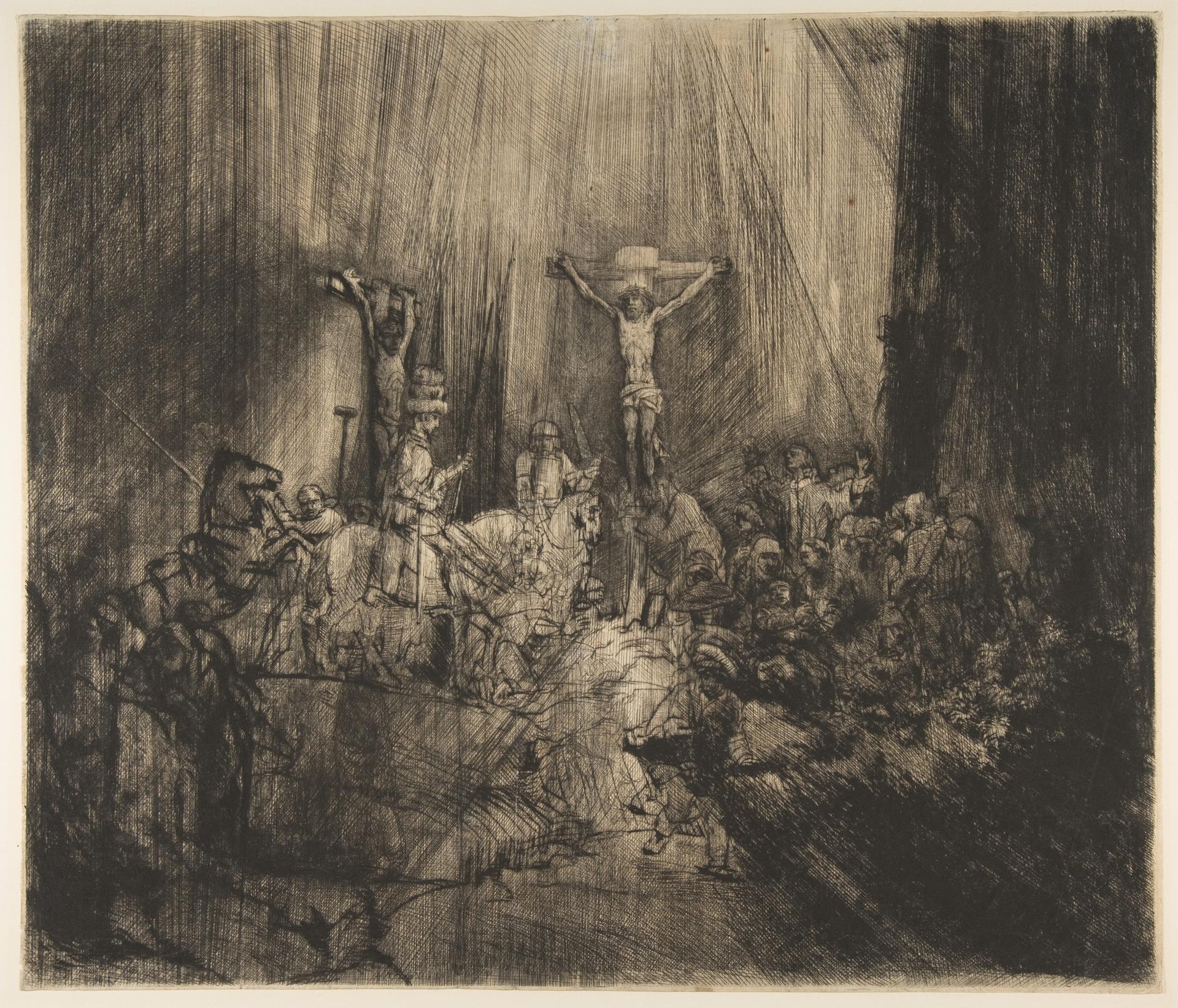
Christ Crucified between the Two Thieves: The Three Crosses (1653, Met-Objekt 5090)
Original title: Christ Crucified between the Two Thieves: The Three Crosses
kurzbeschreibung
Rembrandt van Rijn made this drypoint in 1653. Christ on the cross is set before our eyes, flanked by the two thieves to left and right. The image stays entirely within greys and blacks, with no colour at all.
Description
Christ's cross is the fixed point, yet a dense crowd of soldiers and onlookers presses in around it. The thieves hang on their crosses to either side. Vertical strokes thicken the sky into a dull, rain-heavy grey. The figures wear the dress of Rembrandt's own time, and the armed men appear with helmets and pieces of armour. Light falls from above onto the middle group and the central cross.
Context
The sheet was made in Amsterdam in 1653, during years when Rembrandt was working through biblical subjects in depth. It belongs to a series of Passion scenes from the 1650s. Influences from the Italian Renaissance and from Caravaggism can be read in its design.
Impact
Sharp contrasts of light and dark drive the eye toward the cross and create a tense, stage-like atmosphere. The sombre tonality and the restless sequence of figures carry the tragedy of the event. Out of the drypoint work comes a direct, unpolished force.
Technique
In drypoint the artist scratches the lines straight into the copper plate, producing soft, velvety strokes. Rembrandt varied the strength and density of his lines, gaining graduated greys in this way. Several surviving states of the print point to thorough reworking of the plate.
AI-generated description text
Source: Metropolitan Museum of Art · Public Domain (CC0 1.0)