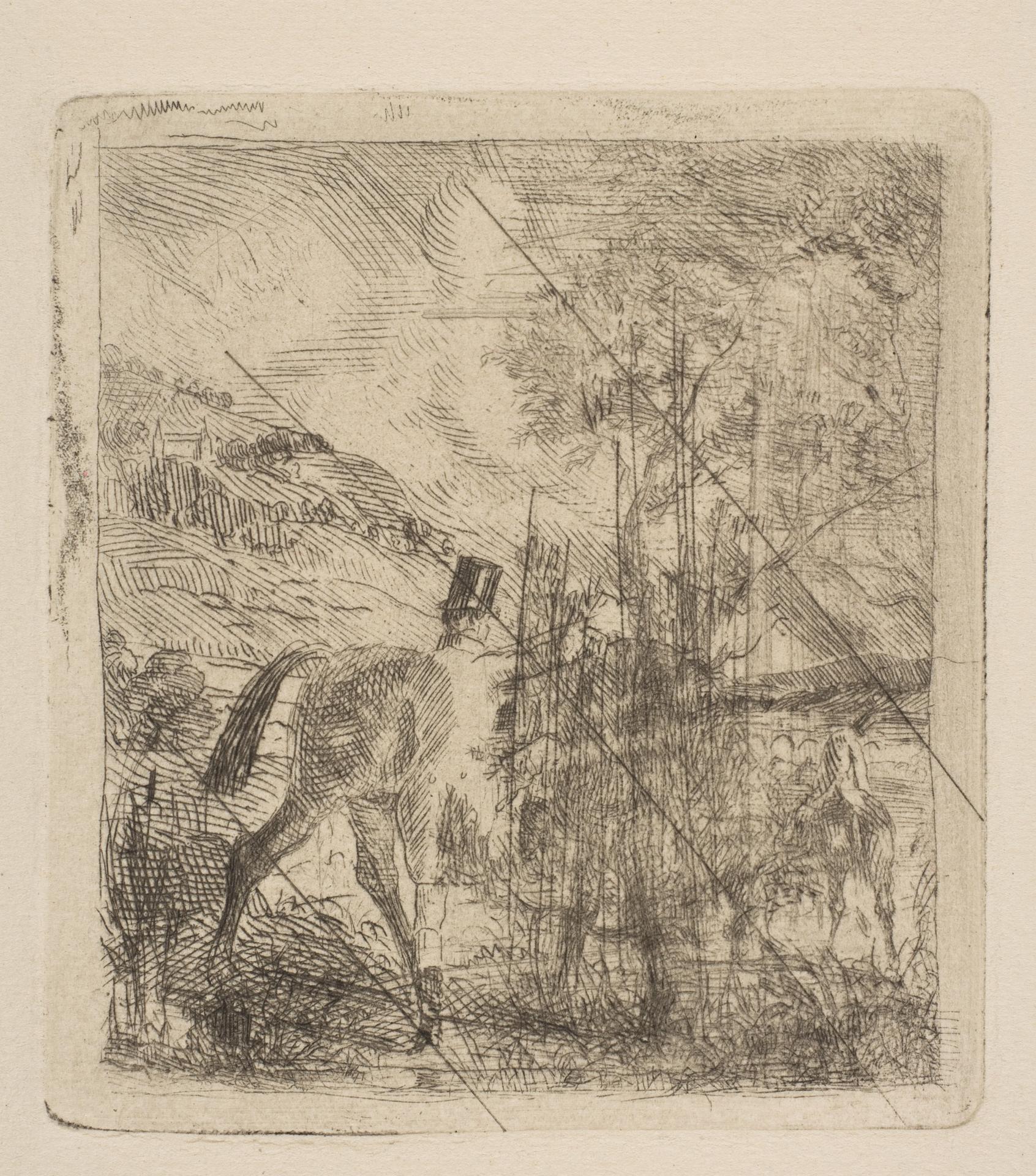
The Sportsman Mounting His Horse
Original title: The Sportsman Mounting His Horse
kurzbeschreibung
Edgar Degas's etching "The Rider Mounting His Horse" dates from 1856 and captures a rider in a tall cap at the moment of mounting. This black-and-white print is the fifth and final state, pulled from the canceled plate.
Description
In the foreground, a man in a tall cap swings onto a horse, its movement emphasized by quick strokes around it. Trees and a building hint at a rural setting, but remain sketchy. The layout is asymmetrical: figure and horse hold the eye, while the background recedes. Line weight and direction shift to create depth and dynamism.
Context
The etching belongs to Degas's early period of 1856, when he was deeply engaged with printmaking. Riders and horses were a common motif in the 19th century, often linked to sport and hunting.
Impact
The lively linework and restriction to black and white give the sheet an immediate, energetic presence. The horse's movement becomes tangible through the strokes. The contrast between the detailed foreground and the sparse background directs attention squarely to the action.
Technique
Etching is an intaglio process in which the drawing is bitten into a metal plate. This is the fifth and final state, printed after the plate was canceled. The lines are fine and vary in thickness, producing shadows and textures—typical of this printmaking technique.
AI-generated description text
Source: Metropolitan Museum of Art · Public Domain (CC0 1.0)