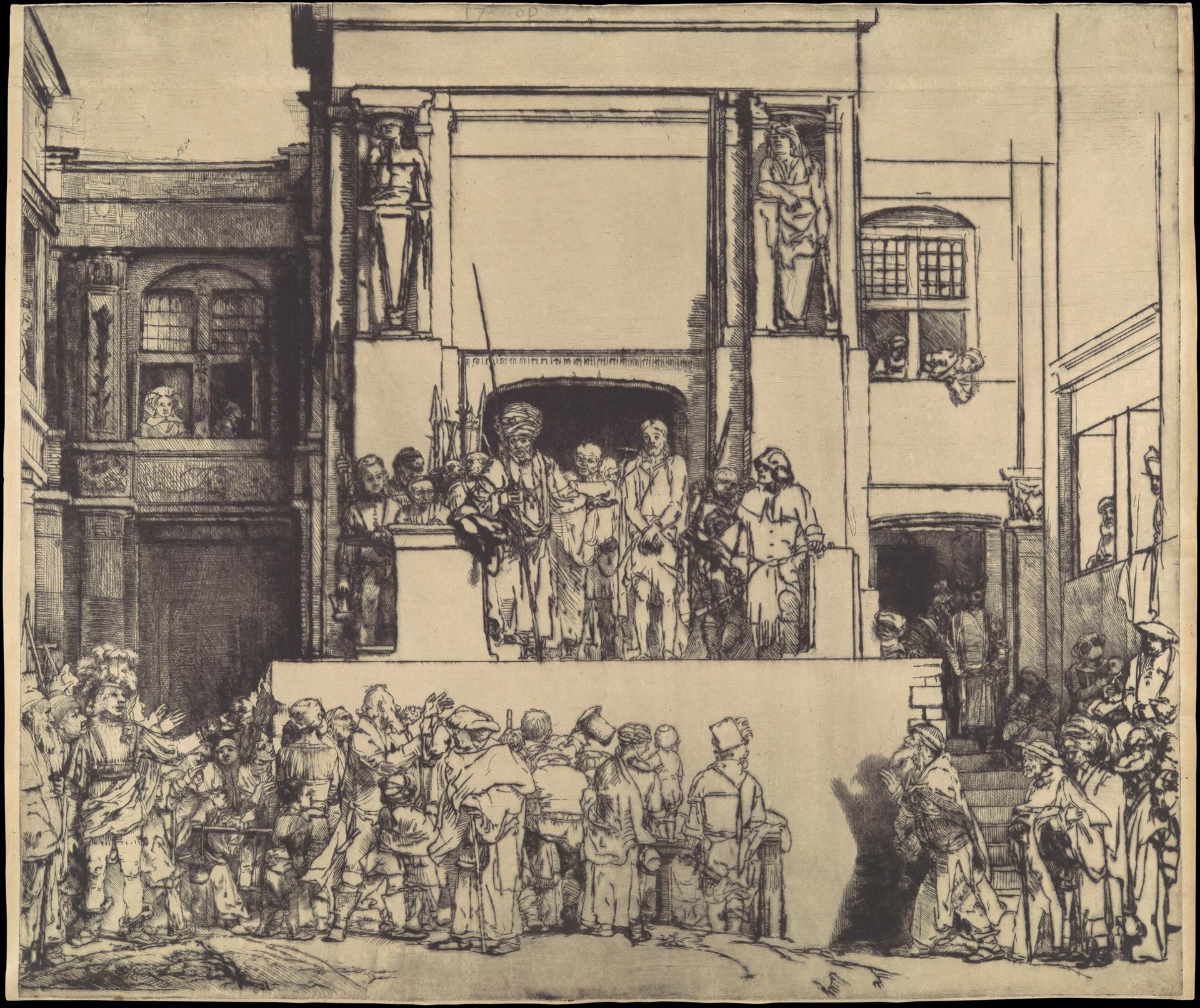
Christ Presented to the People (1655, Met-Objekt 5087)
Original title: Christ Presented to the People
kurzbeschreibung
Unlike many contemporary Ecce Homo depictions, Rembrandt van Rijn's 1655 drypoint turns the presentation of Christ to the crowd into a compressed, architecturally framed scene. This impression is the second of eight states and was pulled on Japanese paper.
Description
A courtyard or market square serves as the setting, with two columns topped by classical-looking statues rising at the back. Beneath them stands a group of people carrying weapons and other objects, suggesting a military or official occasion. To the left, more figures have gathered inside a building, while additional characters fill out the right side. Monochrome ink defines the execution, with fine shading modeling the light. The layout feels symmetrical, with the group under the columns providing the central focus.
Context
This etching was made in Amsterdam in 1655, during a period when Rembrandt was deeply engaged with experimenting in printmaking. The Ecce Homo scene was a common motif in the seventeenth-century Netherlands. That the artist reworked it across several states points to an extended working process. At the same time, the sheet belongs to a phase in which Rembrandt increasingly employed the drypoint technique.
Impact
The tight staggering of figures and the velvety drypoint strokes create a dramatic, almost oppressive mood. Monumental architecture and the densely packed crowd face each other, heightening the tension of the biblical event. Light and shadow draw the eye to the central group, giving the print a forceful presence.
Technique
In drypoint, lines are scratched directly into the copper plate, producing soft, velvety printed effects. The impression was taken on Japanese paper, valued for its fine surface and detailed reproduction. In the second state, reworkings are already visible that alter the composition compared with the first state.
AI-generated description text
Source: Metropolitan Museum of Art · Public Domain (CC0 1.0)