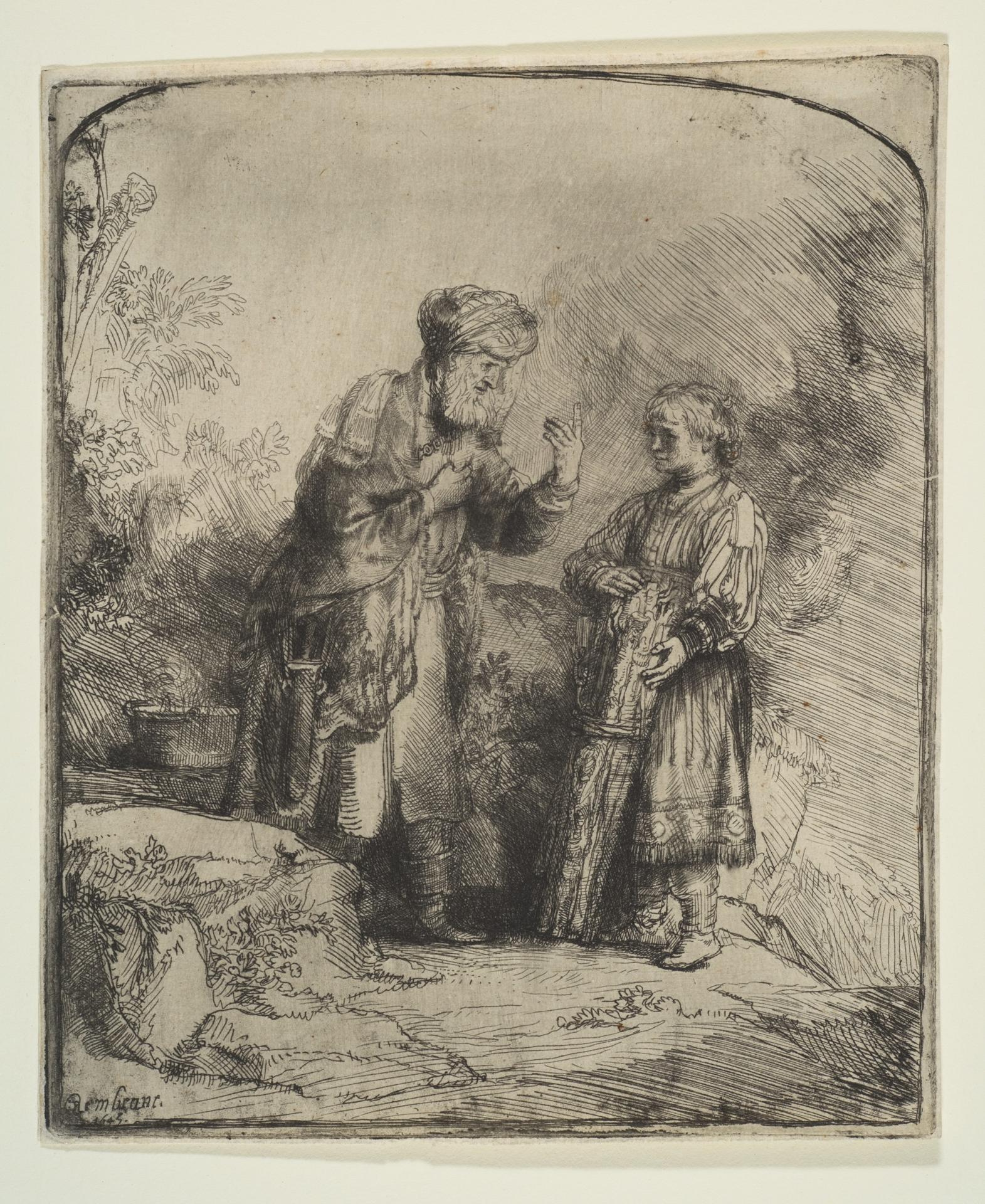
Abraham and Isaac
Original title: Abraham and Isaac
kurzbeschreibung
Rembrandt van Rijn etched the biblical story of Abraham holding his son Isaac by the hand in 1645. This impression, with plate tone, is the first of two states. Rendered in black and white without colour, it places the two figures in a rural setting.
Description
Abraham stands at the left, his gaze on Isaac, whose hand he has taken. Isaac, in simple clothing, looks back at him. Plants and a small smoking oven fill the background, which frames the figures standing in the foreground. Soft, diffuse light falls from the front and picks out the two of them.
Context
The etching was made in 1645, during a period of intense engagement with biblical subjects. Abraham and Isaac were a familiar motif in seventeenth-century Dutch art, often read as a sign of obedience and faith. Rembrandt was known for his innovations in etching technique; here he uses plate tone and fine hatching. The print belongs to a series of etchings from the 1640s.
Impact
The closeness of the two figures creates an intimate, thoughtful mood. The diffuse light and delicate shading give the scene something calm, almost melancholy. Rembrandt's realistic approach, with a quiet pull toward the dramatic, stresses the emotional depth of this biblical moment.
Technique
In etching, a metal plate is bitten with acid so that the lines form. Rembrandt used plate tone by not wiping the plate entirely clean, which yields soft transitions and a tonal effect. The fine lines and shading are characteristic of his way of etching and testify to great technical precision.
AI-generated description text
Source: Metropolitan Museum of Art · Public Domain (CC0 1.0)