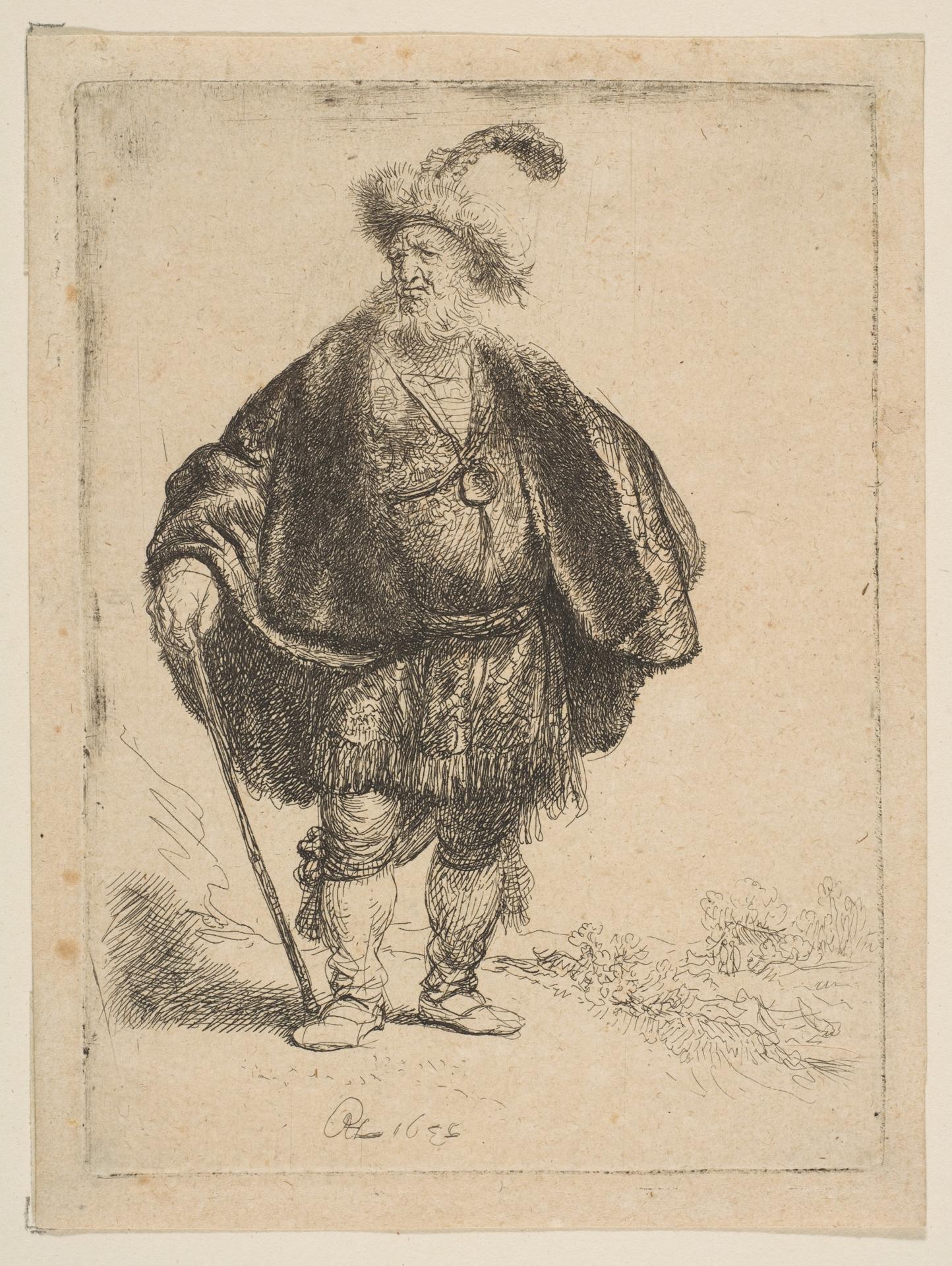
The Persian (1632, Met-Objekt 5082)
Original title: The Persian
kurzbeschreibung
Rembrandt's etching "The Persian" from 1632 shows a man standing upright, likely in Persian dress, wearing a fur-trimmed coat and a feathered headdress, holding a staff in his right hand.
Description
A male figure appears in garments that can be interpreted as Persian: a fur-lined coat with fringe, and a head covering adorned with feathers. He stands straight, staff in his right hand. Scattered flowers and leaves cover the ground; the background remains plain. The layout places the figure at the center, giving him most of the space.
Context
The etching was made in Leiden in 1632, when Rembrandt was increasingly exploring foreign figures. Travel accounts or prints circulating in the Netherlands at the time likely provided the inspiration for the Persian motif. The sheet belongs to a series of studies in which the artist experimented with various garments and poses.
Impact
A calm, dignified mood emanates from the print, immediately drawing the viewer's eye to the upright figure. The central arrangement and the pose give the figure weight. Fine hatching creates even light and an almost monumental presence.
Technique
Executed as an etching, as is evident from the fine lines and hatching that define the contours and surfaces of the figure and surroundings. The sheet is New Holl.'s second state of three, indicating that the plate was reworked. The monochrome gray palette results from the density and direction of the strokes.
AI-generated description text
Source: Metropolitan Museum of Art · Public Domain (CC0 1.0)