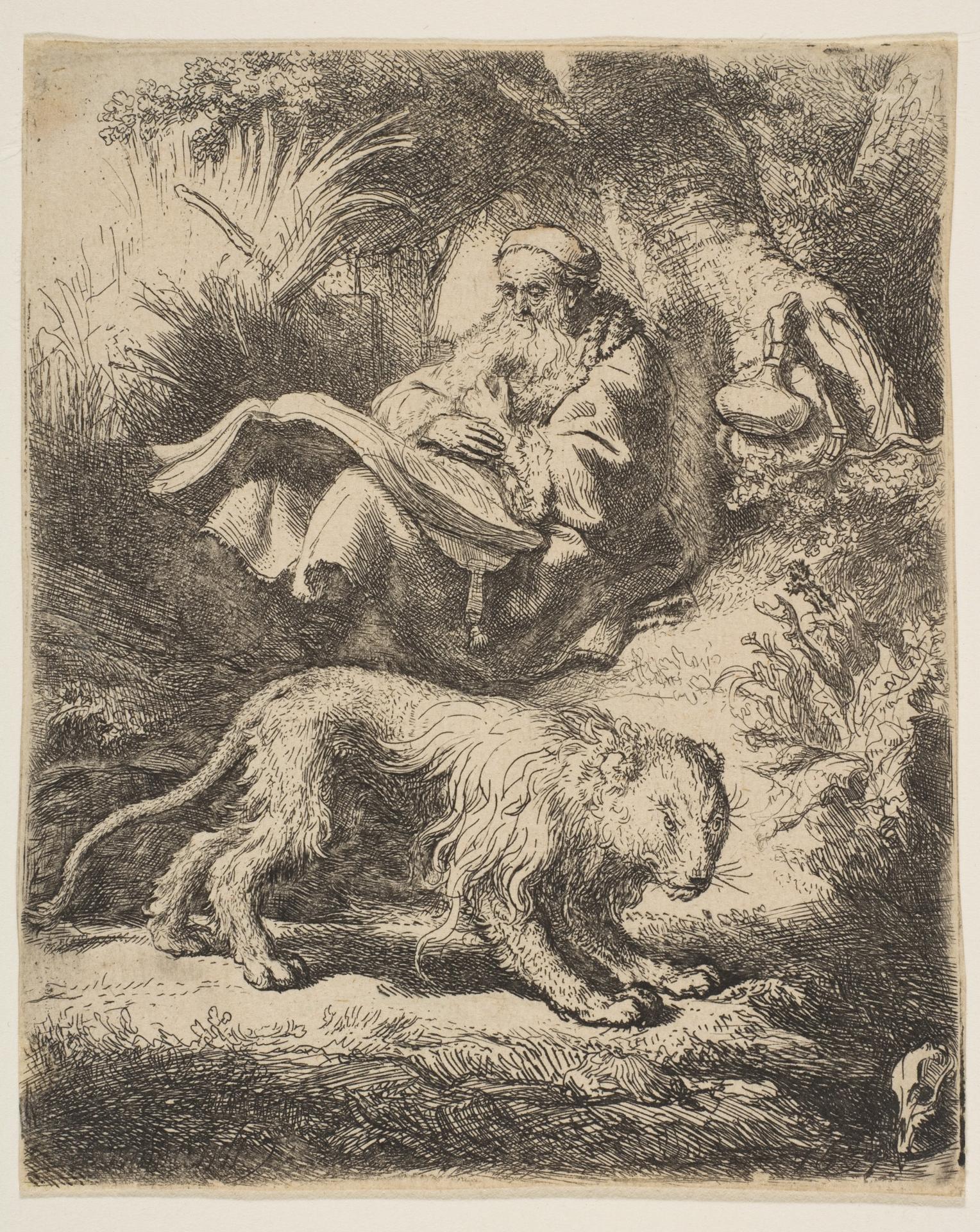
St. Jerome Reading
Original title: St. Jerome Reading
kurzbeschreibung
Rembrandt van Rijn etched 'Der heilige Hieronymus liest' in 1634. The church father appears absorbed in a book within a natural landscape, a lion resting directly beside him. The print remains entirely in shades of gray.
Description
Hieronymus sits reading in a rural setting. Over his long robe he wears a white hood, and his face looks quiet and collected. A lion lies motionless at his feet on the ground. Trees and plants step back into the distance, tying the figure to nature. Soft light falling from the front models the bodies and picks out details, while the etched lines define both figures and surroundings.
Context
The etching dates from around 1634, when Rembrandt was testing the acid technique thoroughly and often turned to biblical and hagiographic subjects. Jerome, a church father and patron of scholars, appealed to humanist circles. Several versions of the saint exist from Rembrandt's hand; this one stands out for its quiet, intimate tone.
Impact
Calm and closeness define the impression of this print, reinforced by carefully placed strokes. The subdued light and the reader's absorbed posture give the view a contemplative quality. Man and lion meet without tension, lending the image an almost idyllic note.
Technique
The motif was etched into a plate treated with acid, after the lines had been incised. From the sparse, precisely guided strokes come fine transitions between light and dark. The palette stays monochrome; graded gray values create space and surface texture.
AI-generated description text
Source: Metropolitan Museum of Art · Public Domain (CC0 1.0)