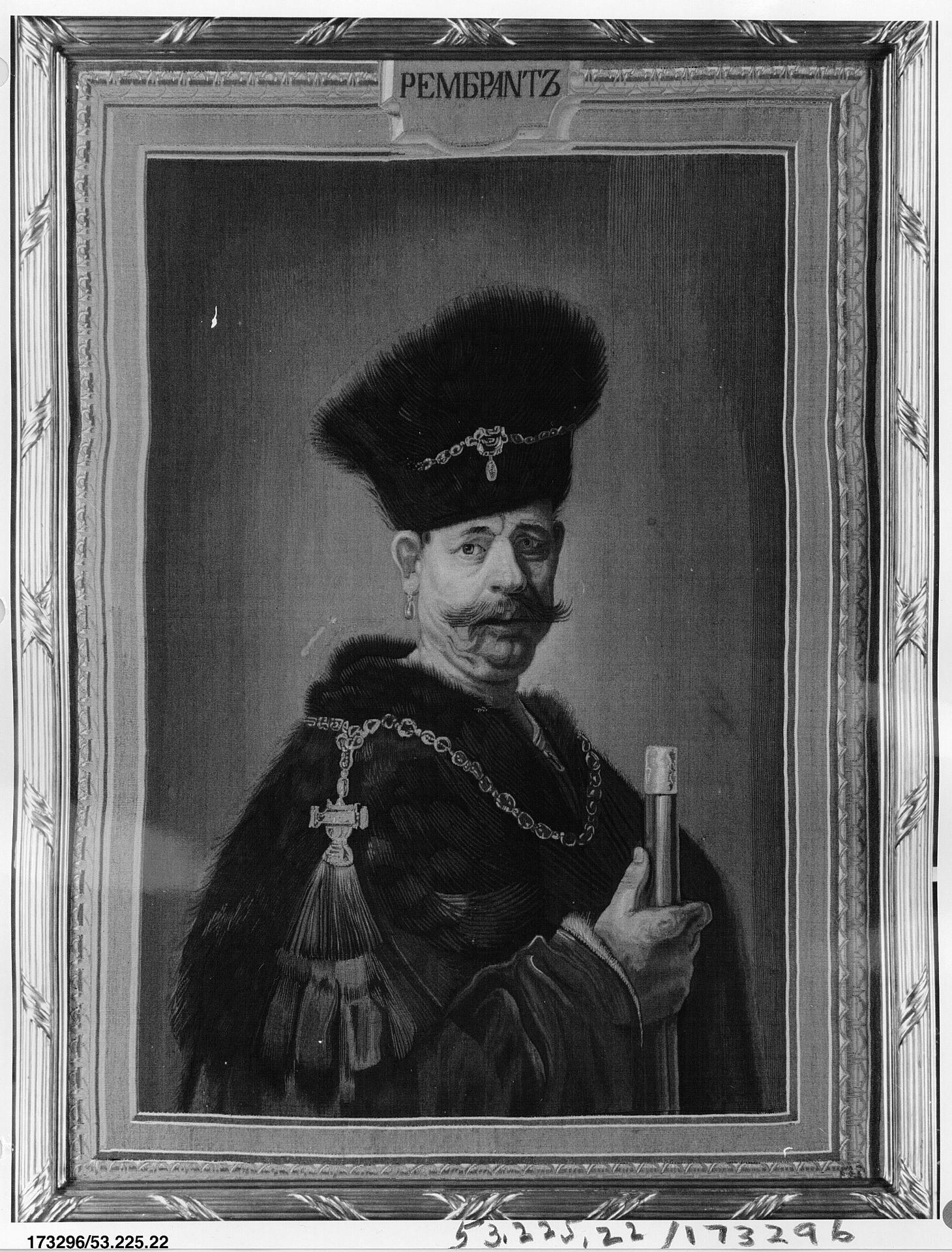
A Polish Nobleman
Original title: A Polish Nobleman
kurzbeschreibung
This late 18th-century tapestry, titled "A Polish Nobleman," was produced at the Imperial Russian Tapestry Manufactory in Saint Petersburg. It portrays a man dressed in the attire of the Polish nobility and is woven from wool and metal thread.
Description
A man wearing a fur hat, a chain with a pendant, and a fur coat with long, hanging trim. In one hand he holds a rod-like or cylindrical object. The plain dark background pushes the figure forward. The head is placed centrally, and the layout is symmetrical. The image is rendered in black and white; the border shows an ornate pattern and bears the inscription "REMBRANTZ" at the top.
Context
The Imperial Russian Tapestry Manufactory in Saint Petersburg was founded in 1717 by Peter the Great; tapestries for the court were made there until the 19th century. This piece dates to the late 18th century, when Polish noble culture was of interest in Russia. The inscription "REMBRANTZ" suggests that it is an adaptation of a Rembrandt painting depicting a Polish nobleman. Portrait tapestries of this kind served representative purposes in Russian aristocratic residences.
Impact
The dark background and symmetrical arrangement give the portrait a dignified, almost ceremonial presence. The contrast between the coarse wool structure and the fine metal threads creates a texture that is both refined and earthy. The restrained color palette emphasizes the forms and the historical feel.
Technique
The tapestry was woven in tapestry-weaving technique using wool and metal thread. With 20–25 warps per inch (8–10 per centimeter), the density is high enough to reproduce fine details. The metal threads add shining accents and reflect light.
AI-generated description text
Source: Metropolitan Museum of Art · Public Domain (CC0 1.0)