Tunisian View
Original title: Tunisian View
kurzbeschreibung
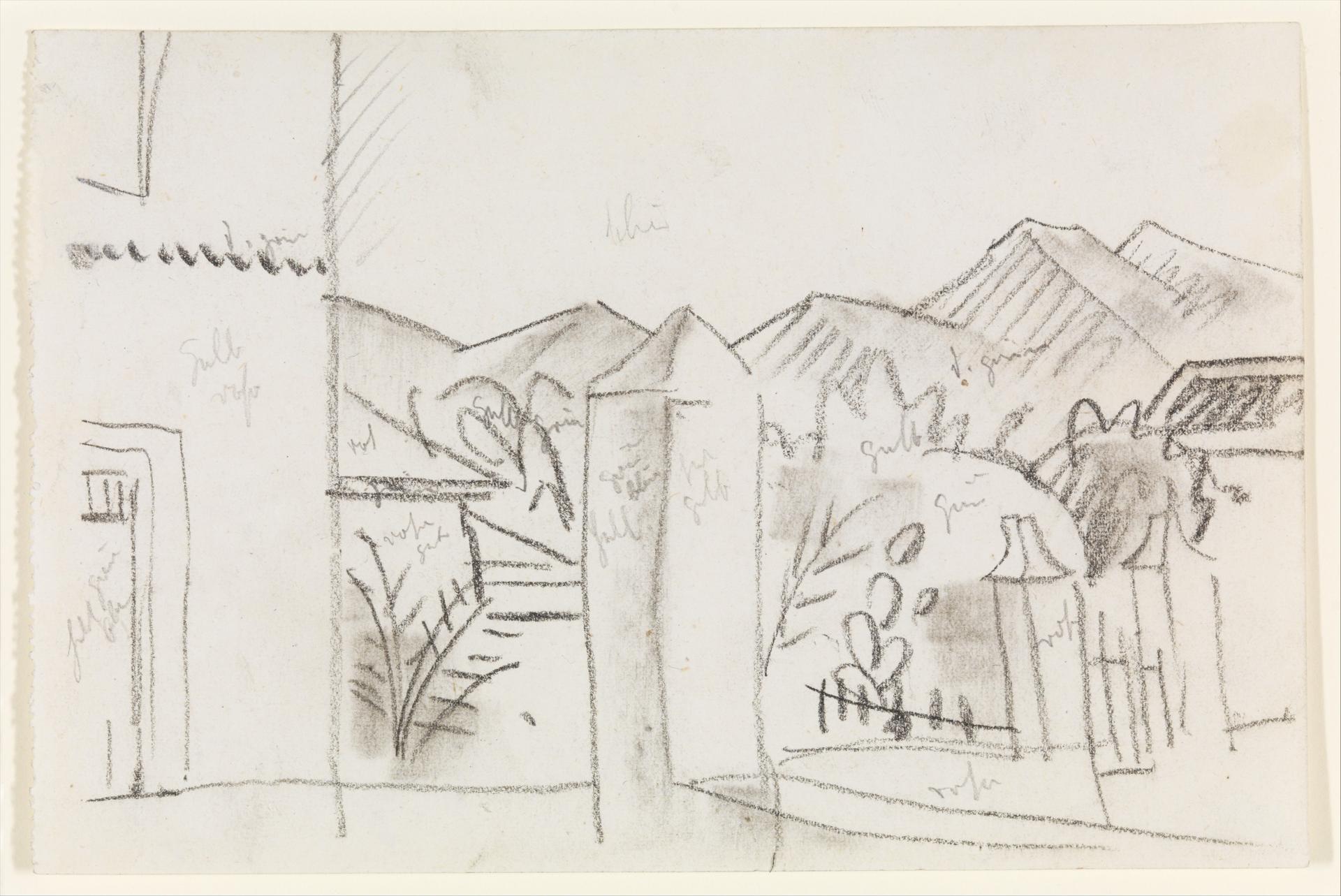
August Macke drew Tunesische Ansicht in 1914 using black chalk and graphite on paper. The sheet presents a view of Tunis: houses sit in the foreground, with mountains rising behind them. The execution stays sketchy and stylized, with forms simplified rather than fully worked out.
Description
In front, houses step back in layers, their roofs and windows barely outlined and hardly detailed—more abstracted than painted. Above them, several mountain peaks are indicated just as tersely and reduced. There is no color; the sheet remains in shades of gray. Because there are no targeted light accents, brightness spreads evenly across the surface.
Context
In 1914 Macke set off for Tunisia with Paul Klee and Louis Moilliet; numerous watercolors and drawings were made there. Artistically, the trip was a turning point, as he engaged intensely with light and color. This drawing belongs to the works from that stay and captures how he approached the North African landscape.
Impact
The eye is first drawn to the loosely placed houses in the foreground, then wanders to the mountain shapes behind. Because everything is reduced to essentials, the sheet radiates calm and clarity. The sketchiness and the monochrome approach together give the work something timeless, almost graphic.
Technique
Black chalk and graphite on paper allow confident linework and finely graded gray values. These very means emphasize the sketchy character of the drawing and direct attention to the structure and form of the things depicted.
AI-generated description text
Source: Metropolitan Museum of Art · Public Domain (CC0 1.0)