Mäda Primavesi (1903–2000)
Original title: Mäda Primavesi (1903–2000)
kurzbeschreibung
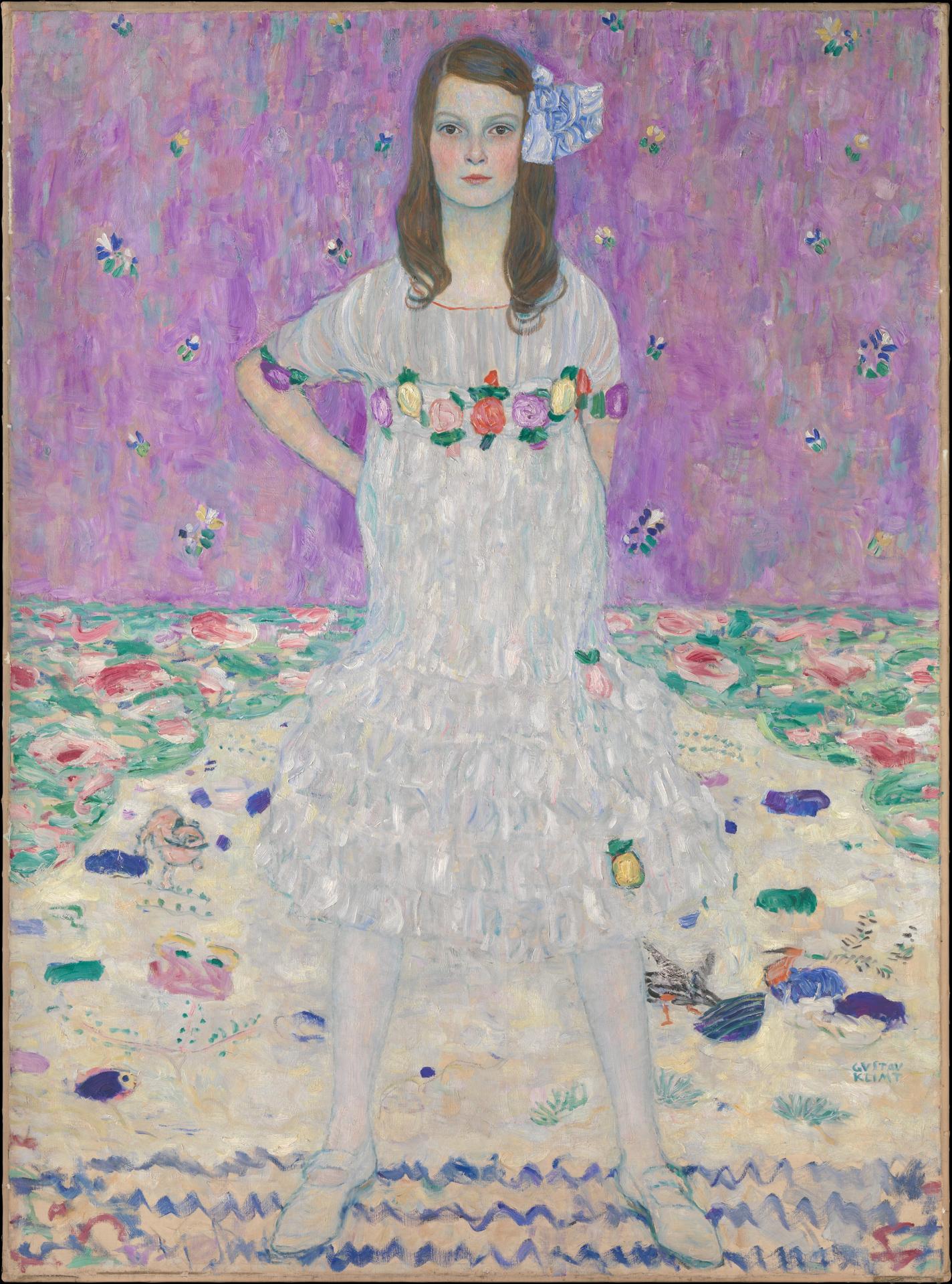
Gustav Klimt painted nine-year-old Mäda Primavesi in oil on canvas in 1912–13. The girl wears a white dress covered with colorful flowers against a purple background with plant forms. The picture ranks among the important works of Klimt's late portraiture.
Description
Mäda Primavesi occupies the center of the picture, her white garment densely covered with colorful floral patterns. The floor beneath is divided into different colors and ornaments, including flowers and decorative elements. A strong purple with small blossom motifs fills the background, and the girl wears a wreath of flowers in her hair. The palette remains intense and lively, and the style relies on effects of color and structure.
Context
Klimt made the portrait in a late phase when decorative surfaces and strong colors became increasingly important to him. Mäda was the daughter of the Moravian industrialist Otto Primavesi and his wife Eugenia, both patrons of the painter. In 1913 the picture was shown at the International Art Exhibition in Vienna; among Klimt's child portraits it is considered one of the most significant.
Impact
The almost ornamental flatness and the luminous colors give the portrait a timeless, nearly dreamlike aura. Childlike innocence meets artistic abstraction, producing a peculiar tension that holds the viewer's gaze for a long time.
Technique
Executed in oil on canvas, Klimt worked with thin layers of paint and fine brushstrokes. The surface combines smooth areas with relief-like structures, marked by impasto application and by the use of metal leaf that appears in other works of these years.
AI-generated description text
Source: Metropolitan Museum of Art · Public Domain (CC0 1.0)