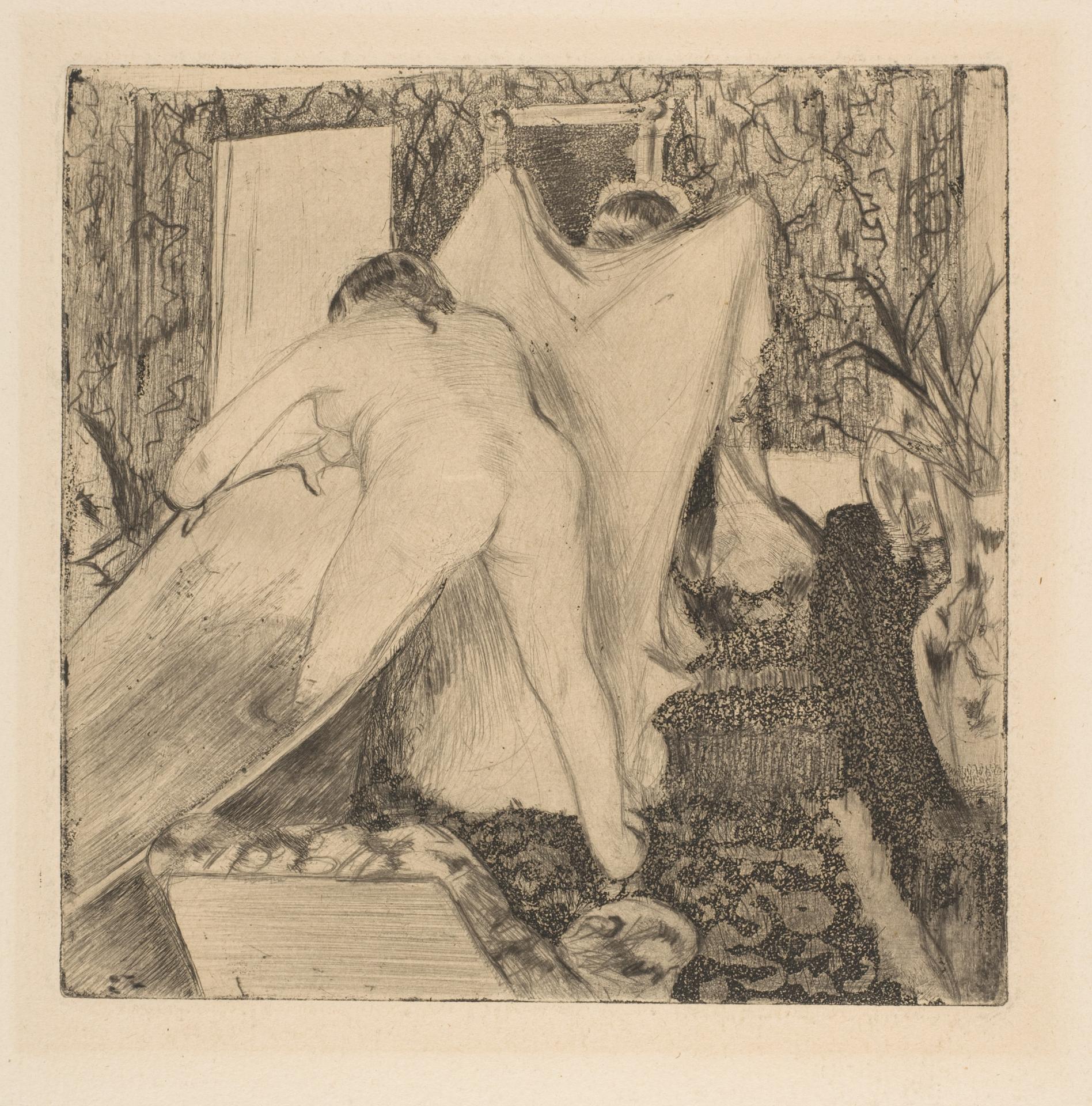
Leaving the Bath (1879–80, Met-Objekt 504)
Original title: Leaving the Bath
kurzbeschreibung
Edgar Degas's 1879–80 etching 'Das Verlassen des Bades' presents two figures in a sparsely furnished bathroom. The print is executed in drypoint and aquatint on laid paper and is the twelfth state of twenty-two or more.
Description
Two figures bend out of a tub, one in front and one behind. Through a window behind them, a winter landscape with bare trees and snow is visible. Gray tones dominate the monochrome image; fine lines and hatching shape bodies and space. Light from outside casts shadows that emphasize volume. The layout is asymmetrical and places the two figures at the center.
Context
In the late 1870s Degas increasingly turned to the bathroom as a subject for his prints, and this sheet belongs to that group. At least twenty-two states attest to an experimental approach. Degas was among the Impressionists but went his own way in printmaking, using aquatint for painterly effects. The private space and unidealized poses were unusual for art of the time and point to his interest in everyday, intimate scenes.
Impact
The etching radiates a quiet, intimate mood through its delicate linework and nuanced grays. The wintry view in the window contrasts with the warm, enclosed atmosphere of the bathroom and underscores its privacy. The figures' casual posture gives the sheet a documentary immediacy that draws the viewer into the moment.
Technique
The print was made as a drypoint and aquatint on laid paper; the plate measures 12.7 x 12.7 cm. The drypoint lines leave strong, slightly raised contours, while aquatint provides tonal areas and soft transitions. Together, the two techniques allow a broad range of grays and a painterly effect typical of Degas's printmaking.
AI-generated description text
Source: Metropolitan Museum of Art · Public Domain (CC0 1.0)