Portrait of a Man (1914)
Original title: Portrait of a Man
kurzbeschreibung
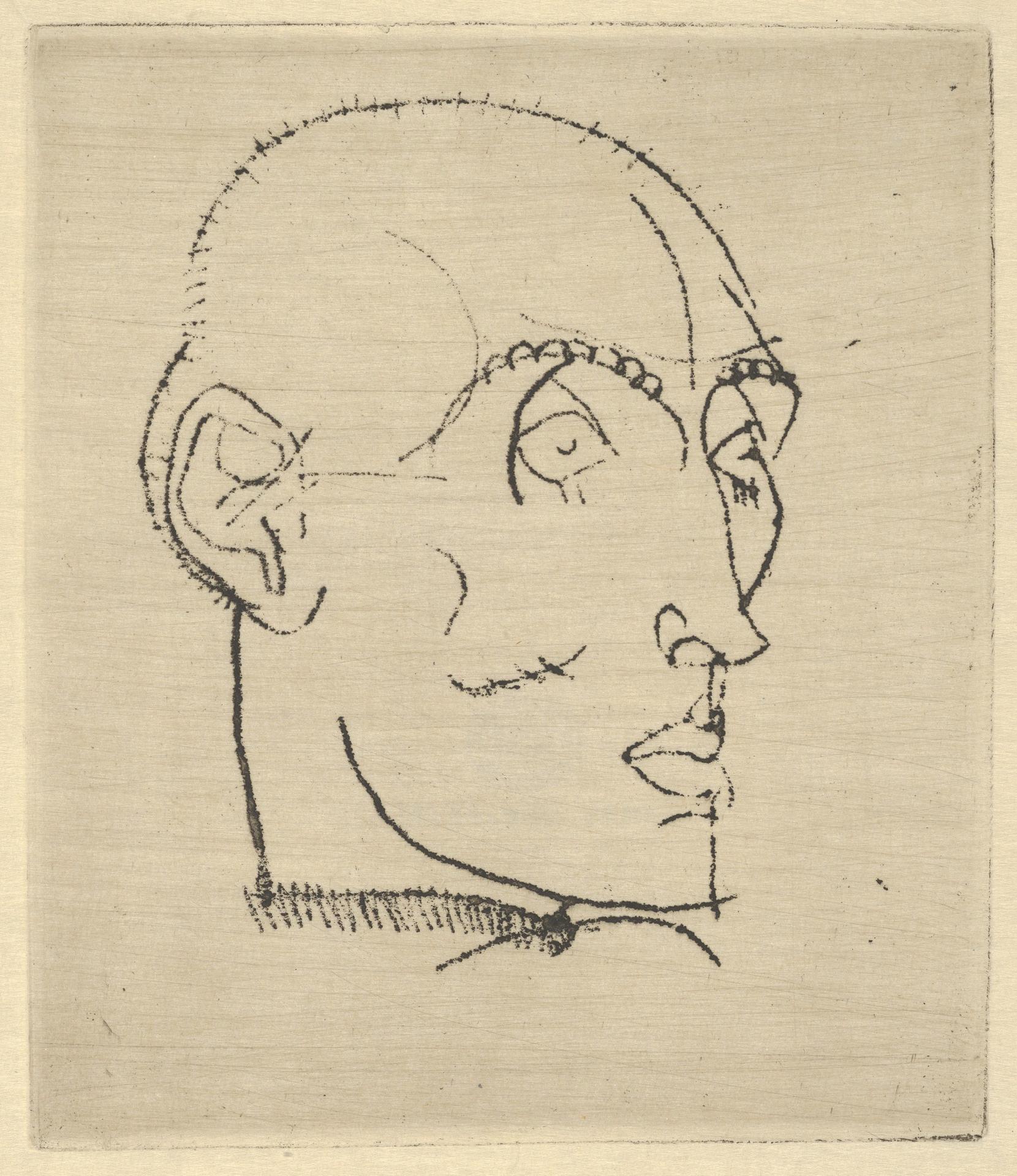
Egon Schiele made this drypoint portrait of a man in 1914, printing it on paper. Seen in half profile, the sitter wears glasses and has very short, almost bald hair. Fine lines and deliberate dots build up the features of his face.
Description
The man's head is turned slightly to the right, creating a half profile. Close-cropped, bald hair and spectacles define the head. Eyes, ears and mouth are clearly worked out, while the background stays empty and throws attention back onto the face. Contours run continuously around the forms; shading comes from thin strokes and rows of dots. Light falls evenly across the face, with no hard shadows.
Context
The etching dates from 1914, a period when Schiele turned increasingly to portraiture. It was made in Vienna, where the artist was living and working at the time. Within his oeuvre, printmaking holds a place of its own alongside painting and drawing.
Impact
Because the face is reduced to a few features, the portrait feels collected and close to the viewer. The calm linework and absence of colour give the sheet a quiet, thoughtful tone.
Technique
In drypoint, the drawing is scratched directly into the printing plate. The needle leaves fine grooves and dots that produce a soft, velvety edge when printed. The paper measures 32 x 25 cm, larger than the plate at 12.2 x 10.5 cm, so a white margin surrounds the image.
AI-generated description text
Source: Metropolitan Museum of Art · Public Domain (CC0 1.0)