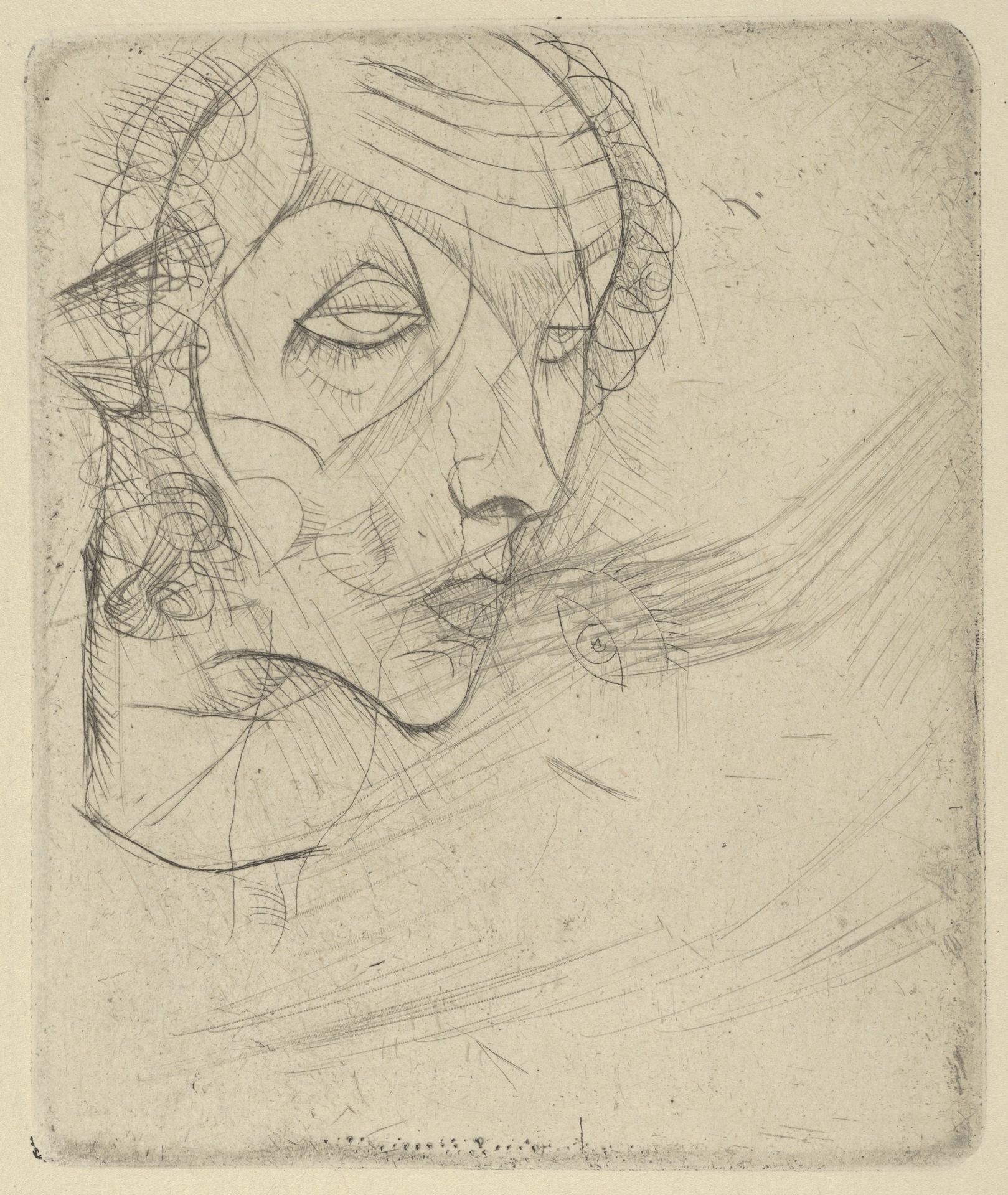
Self-Portrait (1914)
Original title: Self-Portrait
kurzbeschreibung
Egon Schiele made this self-portrait as a drypoint in 1914. It shows a woman with her eyes closed, captured in a spare, expressive line.
Description
Tightly spaced, wave-like lines run across the woman's face, whose eyes are shut; they can be read as hair or wrinkles. The edges and gradations come from the drypoint technique. The background stays plain and empty, so the gaze focuses on the face. Grays dominate, the light seems even, with no visible shadows. The layout is centered, the face stands out while the background narrows slightly to the right.
Context
The self-portrait dates from 1914, a phase when Schiele was experimenting intensively with printmaking. Around 1900 drypoint was widespread in Vienna, and Schiele used it for expressive portraits. Who the woman is cannot be said with certainty—a hint at the trial-like character of this sheet.
Impact
The closed eyes and dense lines evoke an inward, almost unsettling mood. Because the portrait is limited to grays and centered, it feels immediate and concentrated.
Technique
In drypoint, lines are scratched directly into the printing plate, which produces the typical, slightly blurred edges. The sheet measures 21.8 x 17.5 cm, the plate 12.7 x 10.7 cm—an intimate, hand-sized format.
AI-generated description text
Source: Metropolitan Museum of Art · Public Domain (CC0 1.0)